


Printuri giclée sau pe canvas de calitate muzeală, cu proces de producție rapid și opțiuni flexibile de finisare. ( Comandă pictură realizată manual Comută pe Imagine Digitală)





























Alegeți dintre dimensiunile noastre prestabilite, care respectă proporțiile originale ale operei de artă.

Introduceți lățimea și înălțimea necesare pentru a se potrivi ramei sau peretelui dumneavoastră. O printare poate fi doar tăiată, niciodată extinsă dincolo de dimensiunea imaginii originale, astfel încât o dimensiune cu o formă diferită va pierde o parte din imagine. Vă trimitem o simulare digitală pentru aprobare înainte de a imprima orice. Imaginea afișată pe această pagină nu prezintă tăierea reală — doar simularea arată acest lucru.
Livrare în întreaga lume () în 2 săptămâni, în loc de cele 4/5 săptămâni standard. (17 Noiembrie)
William Holman Hunt
Dimensiune reproducere
Sir William Blake Richmond painted this portrait of William Holman Hunt in 1900. The work captures the subject during the final decade of his life, presenting a dignified study of the man who co-founded the Pre-Raphaelite Brotherhood. Richmond, a contemporary of the movement, utilizes a realistic approach to document the sitter's presence.
The portrait is currently held at the National Portrait Gallery, London. It was gifted to the institution in 1936 by Gladys Millais Mulock Holman Hunt, the daughter of the sitter. This provenance links the work directly to the family of the subject, ensuring its historical connection to the legacy of the Pre-Raphaelite circle.
The composition is a medium close-up, centering on the face and upper torso of an elderly man. He possesses a long, white beard that dominates the lower portion of the frame. A dark, indistinct background provides a stark contrast to the subject, pushing the figure forward and emphasizing his physical presence. The lighting is directional, originating from the upper left to cast significant shadows across the right side of the face, creating a sense of depth and three-dimensionality.
The subject's expression is contemplative and serious, conveying a sense of wisdom or weariness. This psychological weight is supported by a muted and earthy color palette. Deep browns, blacks, and creams define the primary tones, while subtle hints of olive green appear within the clothing. The interplay of light and shadow highlights the textures of the skin and the voluminous hair.
Executed in oil on canvas, this portrait utilizes a medium known for its capacity to build depth through layered applications. The work measures 65.8 x 54.3cm (25 7/8 in. x 21 3/8 in.), a scale that emphasizes the intimacy of the sitter's presence. The physical dimensions are recorded as 658 mm x 543 mm.
The piece is held within the National Portrait Gallery, London, and is identified by NPG Number 2803. The painting was created about 1900. Its material composition and specific dimensions reflect the academic precision characteristic of late nineteenth-century portraiture.
Perioada istorică a operei "William Holman Hunt" de William Blake Richmond este 19th Century. Această clasificare plasează lucrarea în contextul istoriei artei.
Driftwood (#b98957) este culoarea dominantă a operei "William Holman Hunt" de William Blake Richmond.
Originalul "William Holman Hunt" de William Blake Richmond este o lucrare de tip Oil On Canvas, cu dimensiunile de 65.8 x 54.3cm. Tehnica și dimensiunea descriu obiectul original.

Sir William Blake Richmond was a British painter, sculptor, and designer of stained glass and mosaic. Born in London, United Kingdom, he was the son of the portrait painter George Richmond and Julia Tatham. His artistic journey began with private tutoring at home, followed by three years of studying drawing and painting at the Royal Academy of Art starting in 1858. A significant period of his development occurred during a six-week tour of Italy, where he viewed the works of Old Masters such as Michelangelo, Tintoretto, and Giotto.
Richmond achieved early success as a portrait painter, exhibiting his first major work at the Royal Academy in 1861. His talent led to his election as an Associate of the Royal Academy in 1888 and a Royal Academician in 1895. Beyond portraiture, he was a prolific designer of monumental decorations, most notably the mosaics in the quire and apse of St Paul's Cathedral in London.
His work in mosaic design was characterized by a vibrant treatment using jagged, irregular glass set at angles to catch the light. This technique, influenced by Byzantine and early Christian styles, involved a collaboration with glassmakers James Powell and Sons to develop new colors and materials. These innovations expanded the palette available to artists within the Arts and Crafts movement. His stained-glass designs, such as those in St Mary's, Stretton, utilized thick, streaked glass to mimic the sparkling effects of his mosaic work.
In addition to his visual arts, Richmond was a sculptor and an environmental advocate. His notable sculptural works include:
Furthermore, he was an early advocate for clean air in London, founding the Coal Smoke Abatement Society in 1898 to address the darkness caused by coal smoke.

1842 - 1921 , United Kingdom
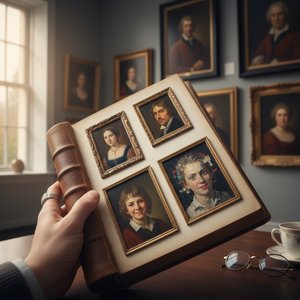
Master the nuances of portrait composition with our expert guide for collectors. Discover how light, gaze, and texture create emotional depth in fine art, from classical masterpieces to bespoke oil commissions.

Discover how master portraitists use light and texture to convey authority. Explore the visual language of wisdom in fine art.
 Previzualizare

 Trimite prin felicitare
 Distribuie
 Detalii despre lucrare
 Ghid


 Descarcă imaginea
 Produse similare
 Radiografie
 Galerie foto
 Întrebări și răspunsuri

 Statistici


 Vezi mai mult









 Opțiunea cu sticlă este disponibilă doar pentru dimensiuni de sub 110 cm


