A Journey Into Darkness And Redemption: Exploring William Blake’s “The Descent Of Christ”
William Blake's "The Descent of Christ," etched in 1804, is not merely a depiction of a biblical scene; it’s a profound meditation on suffering, salvation, and the eternal struggle between light and darkness. This powerful image transcends its religious subject matter to become a universal allegory of human experience, inviting viewers into a world of intense emotion and symbolic weight. Blake, largely unrecognized during his lifetime, possessed an extraordinary ability to fuse poetry and visual art, creating works that continue to resonate with audiences today. “The Descent of Christ” exemplifies this unique genius, showcasing his mastery of etching technique and his deeply personal interpretation of Christian theology.
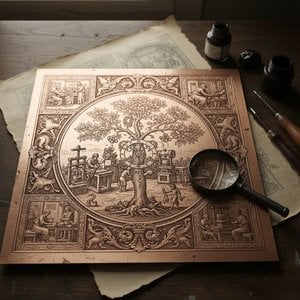
The scene itself is arresting: Jesus, rendered in stark detail, descends into a cavernous abyss – Hell – not as a triumphant warrior, but as a figure of immense sorrow and compassion. He’s surrounded by tormented souls, their faces etched with despair, yet also hinting at a glimmer of hope. Angels, both protective and mournful, flank the scene, acting as witnesses to this pivotal moment. The composition is deliberately claustrophobic, emphasizing the oppressive nature of Hell while simultaneously drawing attention to Christ’s unwavering commitment to rescue those trapped within its depths. Blake’s use of light and shadow is particularly striking; a single shaft of illumination cuts through the darkness, highlighting Jesus and offering a fragile promise of redemption.
Neo-Romanticism: Emotion, Imagination, And Spiritual Vision
“The Descent of Christ” firmly resides within the realm of Neo-Romanticism, an artistic movement that emerged in the late 18th and early 19th centuries. Rejecting the Enlightenment’s emphasis on reason and order, Neo-Romantics prioritized emotion, imagination, and individualism. Blake was a key figure in this movement, and his work is characterized by its intricate details, symbolic elements, and intensely personal vision. The etching's complex layering of figures, textures, and expressions perfectly embodies the Neo-Romantic spirit – a desire to tap into the depths of human feeling and explore the mysteries of the soul.
Blake’s technique is crucial to understanding the work’s impact. He employed a meticulous approach to etching, utilizing fine lines and subtle tonal variations to create an astonishing level of detail. The textures of the clothing, the tormented faces of the damned, and even the folds in the earth are rendered with remarkable precision. This technical mastery serves not merely as a display of skill but as a means of conveying emotional intensity – the despair of the souls trapped in Hell, the sorrowful determination on Christ’s face, and the protective vigilance of the angels.
Symbolism: A Tapestry Of Meaning
“The Descent of Christ” is rich with symbolism, inviting multiple layers of interpretation. The descent itself represents Christ’s willingness to endure suffering for the sake of humanity. The tormented souls are not simply representations of evil; they symbolize all those who have lost their way and need redemption. The angels, often depicted as weeping, embody divine compassion and sorrow. The darkness surrounding Jesus is a potent symbol of temptation, despair, and the forces that oppose God’s will. Blake frequently used symbolism in his work to explore complex theological themes, and “The Descent of Christ” is no exception.
Furthermore, the image can be viewed as an allegory for the human condition – our own struggles with darkness and doubt, our yearning for salvation, and our capacity for both compassion and cruelty. The scene’s power lies in its ability to evoke a profound emotional response, prompting viewers to contemplate their own relationship with faith, morality, and the eternal quest for meaning.
Historical Context And Legacy
“The Descent of Christ” was created during a period of significant social and political upheaval in Europe. The French Revolution had challenged traditional notions of authority and inspired calls for liberty, equality, and fraternity. Blake’s work reflects this spirit of rebellion against established norms, as he sought to express his own radical vision of the world through art. The etching is housed at the Yale Center for British Art, a testament to its enduring significance within the canon of British art.
Blake's influence extends far beyond his immediate contemporaries. His work paved the way for later artists and writers who sought to explore the power of imagination and challenge conventional artistic boundaries. His exploration of spiritual themes continues to inspire artists today, demonstrating the timeless relevance of his vision. For those seeking a profound and emotionally resonant artwork, “The Descent of Christ” offers a powerful glimpse into the heart of human experience – a journey through darkness towards the promise of redemption.
- Artist: William Blake
- Born Year: 1757
- Death Year: 1827
- Birth City: London
- Birth Country: United Kingdom
- Size: 219 x 159 cm
- Date: 1804
The Yale Center for British Art holds this masterpiece, ensuring its legacy continues to captivate audiences worldwide. Blake's meticulous etching technique—characterized by fine lines and tonal variations—perfectly conveys the emotional depth of the scene.



 Previzualizare
 Comandă printul
 Trimite
 Distribuie
 Detalii despre lucrare

 Descarcă
 Produse similare
 Radiografie
 Diapozitive automate


 Vezi mai mult






































 Opțiunea cu sticlă este disponibilă doar pentru dimensiuni de sub 110 cm