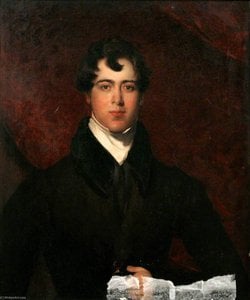
Biografie artist
Early Life and Artistic Foundations
Thomas Phillips, born in Dudley, Worcestershire, in 1770, emerged from relatively modest beginnings to become a prominent figure in the British art scene of the late 18th and early 19th centuries. His initial artistic training wasn’t within the traditional confines of painting, but rather in the craft of glass-painting under Francis Eginton in Birmingham. This foundational experience instilled in him a meticulous attention to detail and an understanding of color and light – skills that would prove invaluable when he later transitioned to portraiture. The intricate designs and vibrant hues of stained glass demanded precision and a keen eye for composition, qualities Phillips readily absorbed. A pivotal moment arrived in 1790 when he journeyed to London, armed with an introduction to Benjamin West, a leading artist of the time and a key figure in the Royal Academy. West’s guidance proved transformative, opening doors to opportunities that would shape his artistic trajectory. He was immediately placed on the painted-glass windows of St George's Chapel at Windsor Castle – a project that allowed him to hone his skills within a grand architectural context, working alongside master craftsmen and absorbing the techniques of large-scale decorative art. This early exposure to intricate patterns, rich colors, and collaborative design fostered a deep appreciation for narrative storytelling through visual means. It also instilled in him an understanding of how light interacts with surface, a crucial element in his later portraiture.
A Rising Portraitist: Style and Subject Matter
Phillips quickly found his niche in portraiture, though not without navigating a competitive landscape already populated by renowned artists like Thomas Lawrence and John Hoppner. Initially, his sitters were largely unknown individuals – tradesmen, local dignitaries, and members of the gentry who sought to capture their likenesses for posterity. However, through dedication, technical skill, and an innate ability to discern character, he steadily ascended the social ladder, attracting increasingly prominent figures to his studio. His style was characterized by a meticulous realism, reflecting both the influence of his early training in glass-painting – particularly its emphasis on detail and color – and the prevailing artistic tastes of the era. He possessed an uncanny ability to capture not just physical likeness, but also something of the sitter’s personality, their social standing, and even their inner thoughts. This wasn't merely a replication of appearance; it was an attempt to distill the essence of a person onto canvas. His portraits were often imbued with a subtle sense of drama or emotion, achieved through careful manipulation of pose, expression, and lighting. He favored a restrained palette, typically employing muted tones that allowed his subjects’ features to emerge from the shadows. His compositions were generally balanced and harmonious, reflecting a classical sensibility tempered by a distinctly British aesthetic.
Royal Patronage and Academic Recognition
The year 1804 marked a significant turning point in Phillips's career with his election as an associate of the Royal Academy, alongside William Owen. This recognition, a testament to his growing reputation, solidified his position within the established art world. Shortly thereafter, he moved to 8 George Street, Hanover Square – a prestigious address that would become his home and studio for the next four decades. The move signaled a shift from working primarily on commissions to establishing himself as an independent artist with a dedicated workspace. His clientele continued to expand dramatically, encompassing members of the royal family, including Prince Frederick (later King William IV), as well as prominent figures from across British society – politicians, writers, scientists, and explorers. He painted portraits of the Prince of Wales (later George IV), the Marchioness of Stafford, Lord Thurlow, and numerous other notable individuals. These commissions demanded not only technical skill but also a keen understanding of social etiquette and the nuances of aristocratic life. His ability to capture both outward appearance and inner character made him highly sought after by those who wished to immortalize themselves in paint.
Major Achievements and Artistic Legacy
Phillips’s most celebrated works include his portrait of William Blake, painted in 1807 and now housed in the National Portrait Gallery – a remarkably sensitive depiction of the poet's intense gaze and visionary spirit. The painting is considered by many to be one of Phillips’s finest achievements, capturing not just Blake’s physical appearance but also something of his intellectual depth and spiritual intensity. He also produced several striking portraits of Lord Byron, including a particularly evocative rendition in Albanian costume that remains a favorite among art historians. In 1808, he achieved full academician status, presenting *Venus and Adonis* as his diploma work – a bold departure from the traditional portraiture that had characterized much of his earlier career. This mythological subject demonstrated a willingness to experiment with scale and narrative, showcasing a broader artistic range. Phillips’s legacy extends beyond individual works; he played a crucial role in shaping the development of British portraiture during the early 19th century, establishing a standard of realism and psychological insight that influenced generations of artists. His meticulous attention to detail, combined with his ability to capture the essence of his subjects, continues to resonate with viewers today.
Later Years: Professorship and Reflection
In 1825, Phillips was appointed Professor of Painting at the Royal Academy, succeeding Henry Fuseli – a position he held until 1832. This role allowed him to share his knowledge and expertise with aspiring artists, shaping the next generation of British painters. He published *Lectures on the History and Principles of Painting* in 1833, offering insights into his artistic philosophy and pedagogical approach. Despite a slight decline in public acclaim during his later years, Phillips remained a respected figure within the art community until his death in 1845. His studio at 8 George Street became a gathering place for artists and intellectuals, fostering a vibrant exchange of ideas and perspectives. Thomas Phillips died peacefully at his home, leaving behind a substantial body of work that continues to be admired for its technical skill, psychological depth, and enduring beauty. His portraits offer not just likenesses but glimpses into the lives and minds of some of Britain’s most influential figures – a testament to the power of art to capture both appearance and essence.



 Vezi în context
 Comandă pictură realizată manual
 Trimite
 Distribuie
 Detalii
 Guide
Guide

 Descarcă
 Produse similare
 Radiografie
 Diaporama
 Statistici


 Citește mai mult






































 Opțiunea cu sticlă este disponibilă doar pentru dimensiuni de sub 110 cm