Obțineți un fișier gata de imprimare care depășește cu mult calitatea previzualizării web. Fiecare imagine digitală pe care o vindem provine dintr-un master de înaltă rezoluție din baza noastră de date — având, de regulă, o lățime între 5.000 și 15.000 de pixeli — astfel încât să puteți printa în format mare, să decupați strâns sau să reproduceți detalii fine cu încredere.
Niciun fișier nu părăsește studioul nostru fără să fie tratat. Un expert digital verifică nuanțele de culoare în raport cu pictura originală și le corectează acolo unde este necesar, apoi îmbunătățește claritatea și detaliile folosind instrumente profesionale de retușare — rămânând întotdeauna fidel gestului pictural și stilului artistului. Rezultatul este o imagine care seamănă cu tabloul propriu-zis, nu cu o scanare filtrată.
Aprobați înainte de finalizare: expertul nostru vă va trimite imaginea prin e-mail în termen de 72 de ore pentru revizuire. Nu sunteți mulțumit? Solicitați îmbunătățiri sau corecturi, ori cereți o restituire a plății dacă calitatea nu este pe măsura așteptărilor.
Aceasta este calitatea pe care se bazează editorii, studiourile de design, galeriile și tipăriturile.
Descărcați un fișier la rezoluție înaltă pentru afișare personală, imprimare și proiecte creative. ( Comută pe versiunea Print Comandă pictură realizată manual)
Când alegeți WahooArt.com, nu primiți doar o simplă imagine – primiți o operă de artă digitală îmbunătățită profesional, creată cu precizie și susținută de o garanție de satisfacție. Iată tot ceea ce primești odată cu comanda ta, în mod automat:
Fișierul imaginii digitale la rezoluție înaltă vă va fi trimis prin e-mail în termen de 72 de ore de la finalizarea comenzii – gata pentru utilizare imediată.
Opera ta de artă este optimizată profesional prin intermediul unor instrumente AI avansate și al editării manuale, asigurând un nivel maxim de detalii, claritate și acuratețe a culorilor.
Ai șters sau ai pierdut din greșeală fișierul? Nu îți face griji – ți-l vom retrimite oricând, gratuit.
Bucură-te instant de noua ta operă de artă, fără taxe vamale, taxe de import sau costuri de livrare – descărcările digitale sunt întotdeauna fără taxe.
Asigurăm o reflectare cât mai fidelă a culorilor originale în imaginea ta digitală, prin utilizarea unor instrumente profesionale și a proceselor de gestionare a culorii.
Dacă nu sunteți mulțumit de imaginea digitală achiziționată, o vom revizui sau vă vom returna 100% în termen de 100 de zile – fără nicio întrebare.
Nu ești mulțumit? Primești rambursarea integrală în termen de 100 de zile de la primirea fișierului digital – fără nicio întrebare.
Cumpără 3 imagini, economisește 10% - Cumpără 5, economisește 15% - Cumpără 10+, economisește 20%. Ideal pentru proiecte creative, galerii și agenții.
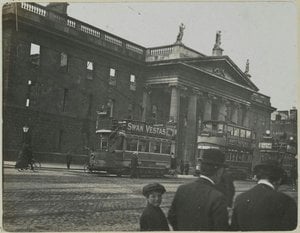
Thomas Johnson Westropp’s “Eden Quay” isn't merely a photograph; it’s a frozen moment in time—a visceral testament to the devastation wrought by the Easter Rising of 1916. Captured on May 17th, just weeks after Dublin endured the brutal bombardment of British forces during the rebellion, this monochrome image transcends documentation and becomes an emblem of loss interwoven with an undeniable spirit of defiance.
The composition is strikingly simple yet profoundly effective. A long, straight street dominates the frame, receding into a hazy distance—a deliberate choice that amplifies the sense of scale and underscores the immensity of the destruction surrounding it. Buildings loom large in the background, their facades scarred by explosions and fires, forming a jagged skyline that speaks volumes about the conflict’s destructive force. At the forefront stands a horse-drawn carriage, providing a grounding element against which the grandeur of ruin is contrasted.
Westropp's masterful use of light contributes significantly to the photograph’s mood. Diffused illumination softens shadows and minimizes harsh contrasts, fostering an atmosphere of solemn contemplation rather than dramatic spectacle. This understated lighting emphasizes textures—the rough cobblestones beneathfoot, the crumbling brickwork of the buildings—drawing the viewer into a detailed sensory experience.
Beyond its technical merits, “Eden Quay” resonates with powerful symbolic significance. The ruined buildings serve as poignant reminders of human vulnerability in the face of overwhelming power – a visual representation of fragility against the backdrop of historical upheaval. Yet, amidst the devastation, figures populate the sidewalk, symbolizing enduring life and resilience—a subtle but crucial element that elevates the photograph beyond mere depiction to profound contemplation.
Ultimately, “Eden Quay” compels us to confront not only the horrors of war but also the capacity for beauty to emerge from ruin. It’s a hauntingly evocative piece that invites viewers to consider themes of loss, memory, and the enduring spirit of humanity—a timeless image destined to inspire admiration and contemplation for generations to come.
Originalul „Eden Quay” se află la Biblioteca Trinity College Dublin, iar opera este în domeniul public – drepturile de autor au expirat.
În ceea ce privește luminozitatea percepută, "Eden Quay" de Thomas Johnson Westropp este brilliant.
Tehnica utilizată pentru "Eden Quay" de Thomas Johnson Westropp este Giclée Print, iar lucrarea datează din 1916.

Thomas Johnson Westropp was born on August 16, 1860, at Attyflin Park, Patrickswell, County Limerick, Ireland. His ancestors were landowners of English origin who had resided in the area since the mid-16th century. From a young age, Westropp displayed a keen interest in antiquities, meticulously documenting topography, ancient buildings, and folk life during family trips throughout neighboring counties.
He pursued higher education at Trinity College Dublin, earning an MA in 1882. He furthered his studies with a degree in civil engineering in 1885, subsequently apprenticing under Bindon Blood Stoney, who was overseeing the expansion and dredging of the Dublin port entrance.
Despite his initial training as an engineer, Westropp soon abandoned professional practice to dedicate himself fully to archaeological research. He became assistant surveyor for County Meath briefly but quickly prioritized his passion for uncovering Ireland’s past. For the remainder of his life, he focused on researching antiquities along the western seaboard of Ireland.
Westropp is renowned for his incredibly detailed sketches of buildings, grave slabs, and other archaeological remains found throughout Ireland. These drawings are not merely artistic representations; they serve as invaluable historical records. Many of these sketches are now preserved by the Royal Irish Academy.
His work extended beyond visual documentation to include the collection of folklore and local traditions, providing a rich tapestry of cultural insights into 19th and early 20th-century Ireland.
Westropp’s initial engineering training likely influenced his meticulous approach to documentation and precise rendering of architectural details. His mentor, Bindon Blood Stoney, a prominent engineer involved in significant infrastructural projects, instilled a sense of technical precision. However, it was his innate curiosity and passion for Irish history that truly shaped his artistic development.
His work can be seen as part of a broader movement of antiquarianism prevalent during the Victorian era, where there was growing interest in preserving and understanding historical artifacts and traditions.
Thomas Johnson Westropp died in 1922, leaving behind a substantial body of work that continues to be studied by historians, archaeologists, and folklorists today. His detailed sketches and meticulous notes remain essential resources for understanding Ireland’s rich past. He is remembered as a dedicated scholar who played a crucial role in preserving Irish cultural heritage.
His publications are widely accessible in libraries throughout the west of Ireland, ensuring his contributions continue to inspire future generations.

1860 - 1922 , Ireland
 Trimite prin felicitare
 Distribuie
 Detalii despre lucrare
 Ghid
Ghid

 Descarcă imaginea
 Produse similare
 Galerie foto
 Întrebări și răspunsuri
 Statistici


 Vezi mai mult