Biografie artist
A Life Painted in Myth and Landscape
Sir Sidney Robert Nolan, born in Melbourne in 1917, stands as a monumental figure in 20th-century Australian art. His journey was not one of conventional artistic training but rather an explosive emergence from the working-class streets of St Kilda into a world of vibrant imagination and relentless experimentation. Nolan wasn’t simply a painter; he was a visual storyteller, a mythmaker who wrestled with Australia's history, its landscapes, and its very identity. From his early days as a runner for an illegal betting ring to his eventual acclaim on the international stage, Nolan’s life was marked by a restless energy and a refusal to be confined by artistic norms. He absorbed influences from diverse sources – the poetry of Rimbaud, the spatial innovations of Cézanne, the raw emotion of Danila Vassilieff – yet forged a style uniquely his own, one that resonated with a distinctly Australian sensibility. His early exposure to the harsh realities of Melbourne life and the allure of its underbelly would profoundly shape his artistic vision, imbuing his work with a sense of both defiance and vulnerability.
Early Life and Influences
Nolan’s formative years were steeped in intellectual ferment. The Heide Circle, centered around patrons John and Sunday Reed, proved pivotal. This haven for artists and writers fostered a spirit of radical experimentation and provided Nolan with crucial support during his developing phase. It was at Heide that he encountered kindred spirits – Albert Tucker, Joy Hester, Arthur Boyd – all grappling with the challenge of creating a distinctly Australian modernism. The influence of modernist literature, particularly the Symbolist poets, cannot be overstated. Rimbaud’s call for a “systematic derangement of the senses” became a guiding principle for Nolan, liberating him from representational constraints and encouraging him to explore the emotional power of color, form, and symbolism. He wasn't interested in merely depicting reality; he sought to capture its essence, its underlying emotions, and its hidden narratives. His early works demonstrate this influence, often featuring fragmented figures and dreamlike landscapes that hint at deeper psychological truths. He studied at the National Gallery of Victoria’s School of Art in 1934 and 1936 but educated himself primarily through books on Pablo Picasso, Paul Klee, Henri Matisse and the surrealists. From 1938 he was encouraged and supported by art patrons Sunday and John Reed. Their house, ‘Heide’, in the outer Melbourne suburb of Heidelberg (now Heide Museum of Modern Art), was a meeting place for the avant-garde group known as the Angry Penguins, named after the radical cultural journal. The group included the artists Albert Tucker, Joy Hester, John Perceval and Arthur Boyd. The Angry Penguins sought to modernise Australian art and poetry by adopting spontaneous and visionary processes influenced by surrealism.
The Heide Circle and Artistic Exploration
Nolan’s engagement with the Heide Circle solidified his commitment to artistic experimentation and fueled his exploration of diverse mediums. He embraced Cézanne's spatial innovations, seeking to convey depth and perspective in his paintings—a deliberate departure from traditional representational techniques. Tucker, Hester and Boyd shared Nolan’s fascination for capturing the emotional resonance of landscapes and figures, mirroring Rimbaud’s belief that art should transcend mere observation. This collaborative spirit fostered a dynamic exchange of ideas and encouraged Nolan to push boundaries, constantly striving for new forms of expression. He was particularly drawn to Danila Vassilieff's raw emotion and unflinching honesty—values he carried throughout his artistic career. His early works reflect this multifaceted influence, demonstrating both intellectual rigor and profound sensitivity.
The Iconic Ned Kelly Series
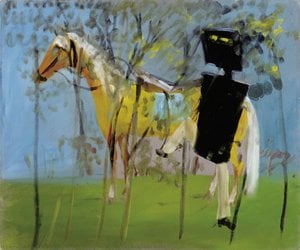
Nolan’s magnum opus is undoubtedly the Ned Kelly series, a monumental undertaking that cemented his place as Australia's foremost modernist artist. Beginning in 1946, he embarked on a systematic exploration of Australian history and mythology—specifically, the legend of Ned Kelly, the charismatic outlaw who defied Victorian law and embodied defiance against authority. He approached Kelly not as a historical figure to be accurately portrayed but as a symbol for Australia itself—a land grappling with its past, confronting its contradictions, and yearning for identity. Nolan’s stylistic innovation was transformative: he employed a technique of layering color over black silhouettes, creating images that were simultaneously starkly graphic and imbued with emotional depth. This method—the use of bold black forms against vibrant hues—became his signature visual device, reflecting Rimbaud's concept of “systematic derangement of the senses.” The Kelly paintings captured the spirit of a generation grappling with disillusionment and searching for meaning in a rapidly changing world. They remain among Australia’s most recognizable artworks, embodying the nation’s fascination with its rebellious heroes and its complex relationship to its history.
A Legacy of Visionary Art
Throughout his prolific career, Nolan continued to explore themes drawn from Australian folklore and mythology—the Burke and Wills Expedition, Antarctica—each series characterized by his distinctive blend of poetic intensity and historical awareness. He experimented with ceramics, stage design, and opera sets, demonstrating a remarkable versatility that defied categorization. His landscapes—often desolate yet imbued with an underlying sense of beauty—captured the vastness and grandeur of the Australian Outback. Nolan’s influence extended far beyond his own lifetime, inspiring countless contemporary artists who embraced experimentation and sought to convey emotion through unconventional techniques. He received numerous accolades throughout his career, including appointments as an Officer of the Order of Merit (OM), a Companion of the Order of Australia (AC), and a Commander of the Order of the British Empire (CBE). His paintings are held in major museums and collections around the world, ensuring that his legacy will endure for generations to come. To explore more of his artwork, platforms like WahooArt offer a wide range of reproductions, allowing art lovers to experience the power and beauty of his vision firsthand. He left behind not just a collection of paintings but a new way of seeing Australia—a land of myth, mystery, and enduring artistic potential.



 Previzualizare
 Comută pe Print
 Trimite
 Distribuie
 Detalii despre lucrare

 Descarcă
 Produse similare
 Radiografie
 Diapozitive automate
 Statistici


 Vezi mai mult






































 Opțiunea cu sticlă este disponibilă doar pentru dimensiuni de sub 110 cm