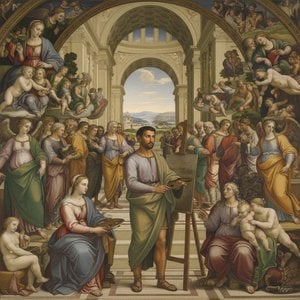
A Renaissance Masterpiece: Raphael’s St Sebastian
Raphael (Raffaello Sanzio da Urbino), a luminary of the High Renaissance, gifted the world with an extraordinary body of work characterized by grace, harmony, and profound humanism. His *St Sebastian*, painted around 1501-1502, stands as a compelling example of his artistic prowess, currently residing in the Accademia Carrara of Bergamo, Italy. This oil on canvas (43 x 34 cm) is not merely a depiction of a martyred saint; it’s a meditation on faith, suffering, and divine beauty.
The Artist & His Historical Context
Born in Urbino in 1483, Raphael quickly ascended to become one of the most celebrated painters alongside Leonardo da Vinci and Michelangelo. He absorbed influences from his father, Giovanni Santi, and artists like Perugino, but rapidly developed a distinctive style marked by clarity of form, balanced composition, and an idealized representation of the human figure. The High Renaissance—a period of artistic flourishing centered in Italy during the late 15th and early 16th centuries—emphasized classical ideals, anatomical accuracy, and harmonious proportions. Raphael embodied these principles perfectly, creating works that resonated with both spiritual devotion and intellectual refinement. He was influenced by humanist thinkers like Pico della Mirandola who championed the idea of human dignity and potential. The Duke Federico da Montefeltro’s court in Urbino fostered an environment where artistic innovation thrived, shaping Raphael's formative years and instilling a lifelong appreciation for beauty and intellect.
Decoding the Image: Subject & Symbolism
The painting portrays St Sebastian, an early Christian martyr renowned for his endurance of suffering. Legend recounts how he was bound to a post and pierced with arrows, yet miraculously survived multiple times before ultimately being clubbed to death. Raphael doesn’t depict the brutality of the martyrdom itself; instead, he presents a moment of quiet contemplation *before* the final blow. St Sebastian stands serene, almost melancholic, his gaze directed slightly downward. The figure embodies the Renaissance ideal of human dignity and resilience—a testament to the enduring spirit of faith amidst adversity.
The symbolism is rich and layered. The arrows represent not only physical torment but also spiritual trials and temptations. They symbolize the wounds inflicted by evil, yet they are also seen as emblems of purification and divine grace. St Sebastian was often invoked as a protector against plagues and epidemics, making him a particularly relevant figure during times of crisis—a reflection of the anxieties prevalent in Renaissance Italy. His youthful beauty and athletic physique embody these classical ideals, highlighting Raphael’s mastery of anatomical representation.
Technique & Artistic Style
Raphael’s mastery is evident in every brushstroke. He employs subtle *sfumato* – a technique pioneered by Leonardo da Vinci involving soft, blurred outlines – to create a sense of atmospheric depth and ethereal beauty. The composition is carefully balanced, with St Sebastian centrally positioned and the landscape providing a tranquil backdrop. Raphael utilizes linear perspective to convincingly portray space, creating an illusion of depth that draws the viewer into the scene. The use of light and shadow delicately models the figure’s anatomy, highlighting his musculature and conveying a sense of vulnerability. He achieves this remarkable effect through meticulous glazing techniques—applying thin layers of translucent paint over previous layers—resulting in luminous colors and subtle tonal variations.
- Composition: A pyramidal structure lends stability and focus to the image.
- Color Palette: A harmonious blend of warm tones—reds, browns, and golds—creates a visually pleasing effect.
- Perspective: Raphael’s understanding of linear perspective creates a convincing illusion of depth.
Emotional Impact & Lasting Legacy
*St Sebastian* evokes a complex range of emotions. It is simultaneously beautiful and sorrowful, serene and poignant. The painting invites viewers to contemplate themes of faith, sacrifice, and the human condition—questions that continue to resonate across centuries. Raphael’s ability to imbue his figures with such psychological depth is what sets him apart as one of history's greatest artists. This artwork continues to inspire awe and admiration. A reproduction of *St Sebastian* offers a unique opportunity to bring the elegance and emotional power of the High Renaissance into your home or office—a testament to Raphael’s genius and a celebration of artistic excellence. Its enduring appeal lies in its timeless beauty, technical brilliance, and profound spiritual resonance.
Photo Description: --Overall Impression-- The artwork is a portrait of a young man, likely depicting Saint Sebastian, rendered in the style of Renaissance painting. It exhibits classical composition with the subject centrally positioned and framed by a golden halo. The image utilizes sfumato technique to create soft transitions between colors and forms, characteristic of Leonardo da Vinci’s work. The background depicts a hazy landscape with rolling hills and distant buildings, providing depth and context. The figure is draped in rich red robes adorned with intricate gold embroidery, contrasting sharply with his pale skin. He holds a guitar, an unexpected modern element juxtaposed against the historical setting, adding a surreal quality to the piece. The lighting is diffused and warm, emanating from an unseen source, highlighting the subject’s face and clothing while casting subtle shadows. Lines are used subtly to define the form of the figure and landscape, with careful attention paid to anatomical accuracy. Shapes are predominantly organic – flowing hair, rounded features, and naturalistic forms in the background. The texture is rich and layered, achieved through meticulous brushwork and glazing techniques. The style is undeniably Renaissance, drawing heavily on classical ideals of beauty and proportion. The technique involves layering thin glazes of oil paint to build up color and luminosity. Materials used are primarily oil paints on canvas.
Size: Unknown
Date: Unknown
ARTIST INFORMATION:
==================
Artist: Raphael
Birth Year: 1483
Death Year: 1520
Birth City: Urbino
Birth Country: Italy
Biography:
The Urbino Renaissance: Raphael’s Early Life and Formation
Raffaello Sanzio da Urbino, known to the world as Raphael (Raffaello Sanzio da Urbino), was born in 1483 within the walls of Urbino—a small but intellectually vibrant city-state in central Italy—where his father Giovanni Santi was court painter to the Duke. The reputation of the court had been established by Federico da Montefeltro, a highly successful condottiere who had been created Duke of Urbino by Pope Sixtus IV – Urbino formed part of the Papal States – and who died the year before Raphael was born. The emphasis of Federico’s court was more literary than artistic, but Giovanni Santi was a poet of sorts as well as a painter, and had written a rhymed chronicle of the life of Federico, and both wrote the texts and produced the decor for masque-like court entertainments. His poem to Federico shows him as keen to demonstrate awareness of the most advanced North Italian painters, and Early Netherlandish artists as well. This immersion in a courtly environment, one that valued refinement and intellectual discourse, profoundly shaped the young Raphael's sensibilities. The loss of his father at age eleven thrust responsibility upon him, but also provided an opportunity to hone his skills within the family workshop, absorbin
Întrebări și răspunsuri
Ce atmosferă ar aduce într-o încăpere o reproducere a operei "St Sebastian" de Rafael?
Cu atmosfera sa Serenitate, „St Sebastian” este recomandată pentru o Living Room.
Cât de multă lumină par să reflecte culorile din "St Sebastian"?
Luminanța înregistrată pentru "St Sebastian" de Rafael este Umbră difuză.
Pot examina "St Sebastian" mai detaliat?
Vizualizarea X-Ray a operei "St Sebastian" de Rafael se regăsește pe pagina Raze X a lucrării: o examinare interactivă a imaginii prin eleven straturi optice.



 Vezi în context
 Comandă pictură realizată manual
 Trimite
 Distribuie
 Detalii
 Ghidul

 Descarcă
 Produse similare
 Radiografie
 Diaporama
 Statistici

 Citește mai mult






































 Opțiunea cu sticlă este disponibilă doar pentru dimensiuni de sub 110 cm