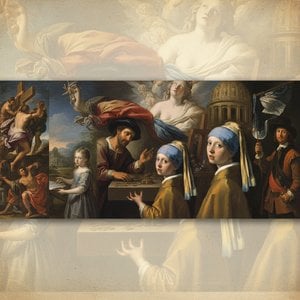
Philippe de Champaigne’s “The Annunciation”: A Symphony of Light and Faith
Philippe de Champaigne’s “The Annunciation,” completed around 1644, stands as a cornerstone of French Baroque art—a testament to the artistic fervor that gripped Europe during Louis XIII's reign. More than just a depiction of biblical narrative, it embodies the intellectual currents of Jansenism, a theological movement advocating for strict moral discipline and emphasizing God’s grace as paramount to salvation.
The painting resides within the Wallace Collection in London, measuring an impressive 334 x 214 cm on oak. Executed in oil paint with meticulous detail, Champaigne's technique showcases a masterful command of chiaroscuro—the dramatic interplay between light and shadow—a hallmark of Baroque artistry. Observe how the artist skillfully illuminates the central figures, drawing the viewer’s eye upwards towards Mary’s serene gaze and Gabriel’s outstretched hand, symbolizing divine communication.
A Composition Steeped in Symbolism
Champaigne's compositional choices are laden with symbolic significance. The positioning of Mary kneeling before Gabriel underscores humility and receptiveness to God’s will. The angel’s gesture directs attention towards the heavens, representing spiritual aspiration and enlightenment. Furthermore, the cherubs adorning the upper register—holding books, musical instruments, and flowers—are traditional emblems conveying knowledge, harmony, and divine benevolence. These elements collectively reinforce the painting's overarching theme of faith and redemption.
The Wallace Collection’s Context
Commissioned for the chapel of Queen Anne of Austria, “The Annunciation” reflects the anxieties surrounding religious dogma prevalent during Louis XIV’s era. The Jansenists faced suppression by the monarchy due to fears that they harbored sympathies for Protestant doctrine. Champaigne's stylistic preference—characterized by austere forms and restrained color palettes—mirrors this intellectual climate.
Technical Brilliance and Emotional Resonance
Champaigne’s meticulous attention to detail extends beyond mere representation; he strives to evoke emotion through nuanced shading and textural variations. The dark room setting enhances the luminosity of the figures, creating a palpable sense of drama and emphasizing their spiritual importance. “The Annunciation” transcends its biblical subject matter, becoming an enduring symbol of grace, devotion, and artistic excellence—a masterpiece that continues to captivate audiences centuries later.
Further Exploration
For more information on Champaigne’s oeuvre and the broader context of Baroque art, consult The Annunciation by CHAMPAIGNE, Philippe de at The Web Gallery of Art. You can also delve deeper into the Wallace Collection’s holdings and artistic heritage at Wallace Collection.
Întrebări și răspunsuri
Există lucrări similare cu "The Annunciation"?
Descoperă lucrări similare cu „The Annunciation” în pagina Lucrări similare a operei de artă.
Unde pot cumpăra o reproducere pictată manual a operei "The Annunciation" de Philippe De Champaigne?
Reproducțiile pictate manual ale operei "The Annunciation" de Philippe De Champaigne pot fi achiziționate pe acest site web: o reproducere pictată manual în ulei pe pânză de in, prin comandă direct de pe pagina Reproducere pictată în ulei.
Există o fișă informativă despre "The Annunciation" de Philippe De Champaigne pentru studenți?
Ghidul pentru "The Annunciation" reprezintă pagina de Fișă informativă a operei de artă – o fișă informativă imprimabilă care prezintă lucrarea împreună cu legenda sa, mențiunea de credit și tabelul de identificare (artist, date, tehnică, dimensiunea originală, colecție).



 Previzualizare
 Comută pe versiunea Print
 Trimite prin felicitare
 Distribuie
 Detalii despre lucrare
 Ghid
Ghid

 Descarcă imaginea
 Produse similare
 Radiografie
 Galerie foto
 Q&A
Q&A Statistici


 Vezi mai mult






































 Opțiunea cu sticlă este disponibilă doar pentru dimensiuni de sub 110 cm