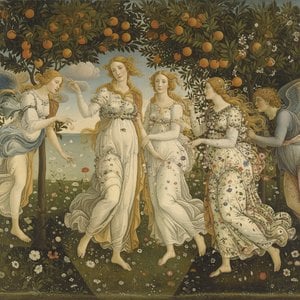
The Adoration of the Magi
Paolo Uccello’s “The Adoration of the Magi” is not merely a depiction of a biblical event; it's a captivating window into the burgeoning artistic sensibilities of the Early Renaissance. Painted around 1435, this work embodies the period’s fascination with perspective, detail, and narrative storytelling. The scene unfolds with a gentle reverence as Mary cradles the infant Jesus, surrounded by the three wise men—the Magi—who have journeyed far to bestow gifts upon the newborn king. Uccello masterfully orchestrates a composition brimming with figures, each rendered with individual character and contributing to the overall sense of awe and devotion.
What truly sets Uccello apart is his pioneering approach to perspective. He wasn't content with merely representing space; he sought to understand and mathematically define it. In “The Adoration,” this manifests as a deliberate, almost architectural arrangement of figures and landscape elements. Lines converge towards a vanishing point, creating a sense of depth that was revolutionary for its time. Notice how the stable, yet slightly dreamlike, architecture frames the holy family, drawing the eye inexorably toward the central focus: the Christ child. This isn’t accidental; Uccello's deep engagement with geometry and mathematics informed every brushstroke. He reportedly spent countless nights studying perspective, driven by an intellectual curiosity that transformed his artistic practice. The inclusion of animals – two horses flanking the procession and a small dog nestled amongst the figures – adds a touch of earthly realism to this divine encounter, grounding the scene in a tangible world.
Beyond its technical brilliance, “The Adoration of the Magi” is rich with symbolic meaning. The gifts brought by the Magi—gold, frankincense, and myrrh—are not merely tokens of wealth but carry profound theological significance. Gold represents Jesus’s kingship, frankincense his divinity, and myrrh a foreshadowing of his mortality and sacrifice. The vibrant colors employed by Uccello also contribute to the painting's symbolic weight. The rich blues and reds evoke royalty and spiritual power, while the delicate use of light highlights the sacredness of the moment. Even the positioning of figures isn’t arbitrary; it reflects a carefully considered hierarchy that emphasizes Mary and Jesus as the focal point of worship.
The painting's influence extends far beyond Uccello’s own lifetime. Though he didn’t establish a large workshop or school of followers, his innovative use of perspective and his unique artistic vision paved the way for future generations of Renaissance artists. “The Adoration of the Magi” stands as a testament to his enduring legacy—a masterpiece that continues to inspire awe and wonder centuries after its creation. Owning a reproduction of this work isn’t just acquiring a beautiful image; it’s inviting a piece of art history into your space, a reminder of the power of faith, intellect, and artistic innovation.
A Florentine Visionary: The Life and Art of Paolo Uccello
Paolo Uccello, born Paolo di Dono in 1397 amidst the rolling hills near Florence, remains one of the most captivatingly enigmatic figures of the Early Renaissance. His very nickname, “Uccello” – little bird – hints at a whimsical nature and an artistic inclination towards depicting the avian world, yet it belies a mind deeply engaged with the burgeoning intellectual currents of his time. He wasn’t merely a painter; he was a pioneer, a mathematician of the canvas, striving to unlock the secrets of visual space and translate them into breathtaking works of art. His father, Dono di Paolo, practiced the dual profession of barber-surgeon, while his mother, Antonia, hailed from a Florentine noble family – a lineage that perhaps instilled in young Paolo both a practical sensibility and an appreciation for refined aesthetics. From 1412 to 1416, Uccello’s formative years were spent unde
The Geometry of Belief
Uccello's fascination with perspective began early on, fueled by his studies in mathematics and influenced by the humanist thinkers of his era. He meticulously researched techniques for creating illusionistic depth, drawing inspiration from ancient treatises on optics and architecture. This intellectual rigor translated into a radical departure from traditional Byzantine iconography, where space was often flattened and symbolic representations prioritized over realistic depiction.
Symbolism Woven into Every Detail
The painting’s symbolism is multilayered and profound. The gifts of gold, frankincense, and myrrh represent Jesus's divine majesty, earthly royalty, and sacrificial atonement—concepts central to Christian theology. The careful arrangement of figures underscores the sacred hierarchy, emphasizing Mary as the Virgin Mother and Jesus as the incarnate Son of God. Furthermore, the inclusion of animals – two horses flanking the procession and a small dog nestled amongst the figures – serves as a reminder of earthly realities alongside divine grace.
A Legacy of Innovation
Paolo Uccello’s legacy extends beyond his own artistic output. He championed linear perspective—a technique that would revolutionize painting and profoundly impact subsequent generations of artists. His groundbreaking work on “The Adoration of the Magi” solidified his place as a pivotal figure in the Renaissance, demonstrating the transformative potential of combining intellectual curiosity with artistic skill.
Saint George and the Dragon (Uccello)
Saint George and the Dragon is a painting by Paolo Uccello dating from around 1470. It is on display in the National Gallery, London, United Kingdom. It was formerly housed in the Palais Lanckoroński in Vienna, belonging to Count Karol Lanckoroński and sold by his son and heir Anton in 1959 through Mr. Farago. The first mention of its being there is 1898.



 Vezi în context
 Comandă pictură realizată manual
 Trimite
 Distribuie
 Detalii
 Ghidul

 Descarcă
 Produse similare
 Radiografie
 Diaporama
 Statistici

 Citește mai mult






































 Opțiunea cu sticlă este disponibilă doar pentru dimensiuni de sub 110 cm