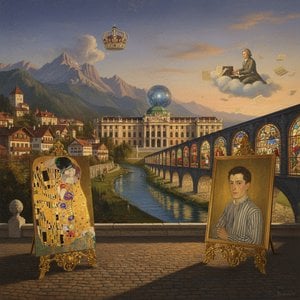
Biografie artist
A Pioneer of Modernity: The Life and Vision of Otto Koloman Wagner
Otto Koloman Wagner, born in Vienna in 1841, stands as a pivotal figure bridging the gap between 19th-century historicism and the dawn of modern architecture. His journey wasn’t one of immediate revolution, but rather a gradual evolution—a thoughtful dismantling of established norms coupled with an unwavering commitment to functionality and honest expression. Initially steeped in classical training at the Vienna Polytechnic Institute and later refined at the Royal Academy of Architecture in Berlin, Wagner's early work reflected the prevailing academic styles. However, even within these traditional frameworks, seeds of innovation were sown. His studies under August Sicardsburg and Eduard von der Nüll instilled a crucial principle: architecture must possess a “rational expression” suited to its modern purpose—a concept that would become central to his life’s work. These formative years weren't merely about mastering technique; they were about questioning the very foundations of architectural thought, setting the stage for Wagner’s eventual break from convention. He began building a reputation through speculative ventures, designing apartment houses that subtly blended classical elements with emerging modernist ideas, financing these projects himself and demonstrating an entrepreneurial spirit alongside his artistic vision.
Wagner's early career was marked by a fascination with classical forms—particularly those of Palladio and Michelangelo—which profoundly influenced his aesthetic sensibilities. He honed his skills at the Royal Academy in Berlin, absorbing the lessons of August Sicardsburg and Eduard von der Nüll, who championed the idea that architecture should serve as a vehicle for conveying “rational expression.” This conviction would become the bedrock of Wagner’s artistic philosophy and guide his subsequent endeavors. His initial architectural projects—primarily apartment buildings—were executed in a distinctive “free Renaissance” style, demonstrating his ability to reinterpret classical motifs within a contemporary context. Notably, he financed these ambitious undertakings himself, showcasing an uncommon blend of artistic ambition and financial acumen. Early on, Wagner’s reputation grew as a builder of tenement houses in Vienna, establishing him as a leader in the field—a testament to his talent and dedication. Among his notable achievements were the Orthodox Synagogue in Budapest (1871–76), where he skillfully blended Moorish influences with Byzantine ornamentation, and the Österreichische Länderbank in Vienna (1882–84), which embodied Wagner’s refined Renaissance style.
The Vienna Secession and a Blossoming Style
A transformative moment arrived in 1893 when Wagner entered the Vienna city-planning competition—a contest that would propel him to prominence within Viennese artistic circles. Though his proposals weren't ultimately victorious in securing the overall plan, they garnered considerable acclaim for their innovative vision of urban space and transportation, particularly his advocacy for an extensive urban rail network. This recognition led to his appointment as chief architect of the municipal railway system in 1894—a position that afforded him unparalleled access to resources and allowed him to realize his architectural ambitions on a grand scale. Simultaneously, Wagner became deeply involved with the burgeoning Vienna Secession movement—a collective of artists, architects, and designers who sought liberation from the constraints of academic tradition. Founded in 1897, the Secession championed new artistic approaches and challenged the conservative dominance of Viennese cultural life. Wagner’s stylistic evolution during this period mirrored the broader trends shaping European art at the time: a rejection of historical imitation in favor of expressive abstraction and a preoccupation with geometric forms—a decisive break from his earlier classical leanings.
The Secession's influence on Wagner was palpable, fostering an environment of experimentation and innovation that culminated in the creation of masterpieces like Majolikahaus (1898–99)—a stunning residential building adorned with vibrant majolica tiles—and Karlsplatz Pavillion (1897–1904), which stands as a symbol of Viennese modernist ambition. Wagner’s collaborators included Josef Maria Olbrich and Josef Hoffmann, two Secessionist luminaries who shared his conviction that architecture should embrace new materials and techniques—a radical departure from the stylistic conventions of previous eras. His architectural style during this period became characterized by floral motifs and Art Nouveau ornamentation—a deliberate homage to the aesthetic sensibilities of Belle Époque Vienna. Wagner’s unwavering dedication to functionality underpinned every project he undertook, reflecting his belief that architecture should serve as a tool for enhancing human experience—a principle that would define his artistic legacy.
Landmark Creations and Architectural Innovations
Wagner's architectural output spanned from 1894 to 1918, producing buildings that exemplify the zenith of Viennese modernist design. The Casa Poștală din Viena (Vienna Postal Savings Bank), completed in 1902, showcased his mastery of structural engineering and employed innovative materials—steel and glass—to create a monumental edifice that defied conventional architectural norms. His Kirche am Steinhof (St. Leopold’s Church), erected between 1897 and 1905, represents Wagner's most ambitious undertaking—a sprawling complex designed to serve as both a place of worship and a symbol of Viennese civic pride. The church’s soaring interior space and intricate sculptural ornamentation exemplify Wagner’s ability to synthesize artistic vision with structural ingenuity. Furthermore, Wagner’s commitment to exploring new architectural concepts extended beyond monumental buildings; he tackled smaller projects with equal fervor—demonstrating his versatility as an architect and his unwavering pursuit of innovation. His exploration of steel and glass construction was particularly noteworthy, foreshadowing the developments that would characterize twentieth-century architecture.
Wagner's final years were marked by critical acclaim but limited commissions—a poignant reminder of the challenges faced by artists striving to realize their creative ambitions amidst shifting social and economic conditions. Nevertheless, his enduring legacy rests upon his pioneering role in shaping Viennese architectural history—a visionary who irrevocably altered the course of artistic expression. Otto Koloman Wagner’s influence continues to resonate within the annals of art history—a testament to his unwavering conviction that architecture should serve as a conduit for conveying “rational expression” and embracing new aesthetic horizons. He remains an icon of Viennese Modernism, whose buildings stand as enduring symbols of innovation and beauty.



 Previzualizare
 Comandă pictură lucrată manual
 Trimite
 Distribuie
 Detalii despre lucrare

 Descarcă
 Produse similare
 Radiografie
 Diapozitive automate
 Statistici

 Vezi mai mult






































 Opțiunea cu sticlă este disponibilă doar pentru dimensiuni de sub 110 cm