PrevizualizarePrevizualizare Previzualizare ARPrevizualizare AR Comandă pictură lucrată manual Comandă pictură lucrată manualComută pe Imagine Digitală Comută pe Imagine Digitală TrimiteTrimite
Detalii despre lucrareDetalii despre lucrare Adaugă la favorite Adaugă la favorite DescarcăDescarcă Produse similareProduse similare RadiografieRadiografie Diapozitive automateDiapozitive automate StatisticiStatistici

Triumph of Pan

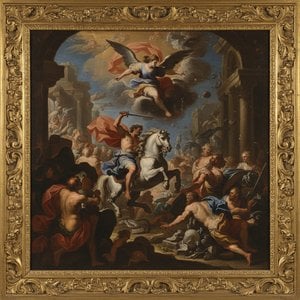
Explore Nicolas Poussin’s iconic Triumph of Pan (1635-36)! This Baroque masterpiece showcases classical mythology with dynamic composition & rich symbolism—a cornerstone of French art history.

Descoperă operele impresionante ale lui Nicolas Poussin – pictor francez celebru pentru armonie și solemnitate în scene istorice și mitologice inspirate din antichitate! Vizualizare acum!

Giclée / Imprimare artistică

Printuri giclée sau pe canvas de calitate muzeală, cu proces de producție rapid și opțiuni flexibile de finisare. (Comandă pictură lucrată manual Comandă pictură lucrată manualComută pe Imagine Digitală Comută pe Imagine Digitală)

P118B $10
P118H $10
P118W $10
P438Z $10
P508JH $12
P508YH $12
P805H $10
P805Z $10
P919BZ $10
P919G $10
P919XJ $10
P959ZH $10
P968JZ $12
W106C $8
W218G $10
W218JH $8
W218Y $10
W307PJ $10
W316G $10
W316PJ $8
W316Y $10
W398PJ $8
W4111J $10
W500HY $15
W500JH $15
W692G $12
W849H $8
W940BG $15
W953PJ $8

Standard
personalizat
CM
INCH

Alegeți dintre dimensiunile noastre prestabilite, care respectă proporțiile originale ale operei de artă.

lățime
înălțime

Puteți introduce propriile dimensiuni pentru a se potrivi unui anumit cadru sau spațiu. Dacă dimensiunea selectată nu corespunde proporțiilor imaginii originale, vom decupa lucrarea de artă sau vom extinde imaginea cu margini oglindite sau cu o culoare uniformă. Un mockup digital va fi trimis pentru aprobarea dumneavoastră înainte de începerea producției.
Vă rugăm să rețineți că previzualizarea de pe ecran nu reflectă decuparea sau extinderea reală. Doar mockup-ul va arăta cu exactitate compoziția finală.
Deși dimensiunile personalizate sunt disponibile, vă recomandăm să selectați o dimensiune din lista predefinită pentru a păstra proporțiile originale.

Livrare în întreaga lume () în 2 săptămâni, în loc de cele 4/5 săptămâni standard. (12 Septembrie)

why_choose_icon
Livrare expres gratuită la nivel mondial
why_choose_icon
Pânză de in de înaltă calitate
why_choose_icon
Asigurare completă pentru transport
why_choose_icon
Garanție de rambursare a taxelor vamale
why_choose_icon
Garanția fidelității culorilor
why_choose_icon
Politica de retur de 100 de zile (doar pentru defecte)
why_choose_icon
Garanție de rambursare 100%
why_choose_icon
Ofertă pentru comenzi multiple

Preț total

$ 68

reproduction

Triumph of Pan

Giclée / Imprimare artistică

Dimensiune reproducere

-

Preț total calculat

$ 68

Informații rapide

  • Artist: Nicolas Poussin
  • Location: National Gallery, London
  • Notable elements or techniques: Classical allegory; Dynamic composition
  • Artistic style: Classicism
  • Influences: Raphael
  • Title: Triumph of Pan
  • Year: 1635

A Symphony of Classical Grace: Decoding Nicolas Poussin’s Triumph of Pan

Nicolas Poussin, arguably the foremost champion of classical painting in 17th-century France, possessed an artistic vision profoundly rooted in the ideals of antiquity. Born in Le Havre in June 1594, his formative years fostered a lifelong fascination with Greco-Roman aesthetics—a passion that would propel him to Rome around 1624 and solidify his reputation as one of the era’s most influential artists. Unlike many contemporaries preoccupied with dramatic Baroque flourishes, Poussin pursued a path characterized by serene landscapes interwoven with mythological narratives, meticulously crafted to convey intellectual depth alongside visual beauty. This dedication to classical principles distinguishes him from his peers and ensures his enduring legacy within art history.

The Drawing's Genesis: A Blueprint for Perfection

The drawing under scrutiny—a sheet measuring 228 x 338 mm—represents more than just a preparatory sketch; it embodies Poussin’s groundbreaking approach to artistic creation. Departing from the conventions of his time, he eschewed detailed figure drawings in favor of a technique that prioritized compositional harmony and intellectual rigor. Instead of painstakingly sketching individual poses, Poussin employed wax figures arranged on a stage-like surface—a method remarkably innovative for its period—allowing him to experiment with spatial relationships and visual pathways before committing to the final canvas. This process reflects his conviction that beauty stemmed from clarity of expression and meticulous attention to detail, prioritizing design over mere representation. As Pierre Rosenberg eloquently noted, “never an irrelevant mark or a superfluous line.”

A Dialogue Between Landscape and Myth: Compositional Innovation

The Triumph of Pan exemplifies Poussin’s masterful manipulation of visual elements—particularly landscape and figure placement—to achieve profound symbolic resonance. The drawing meticulously captures the grandeur of Arcadia, employing a panoramic vista dominated by towering trees that serve as both backdrop and structural element. These trees aren't merely decorative; they establish a framework for the unfolding drama, guiding the viewer’s gaze across the scene and reinforcing the overarching narrative. Furthermore, Poussin cleverly compresses the perspective of the figures at the rear, diminishing their scale relative to those in the foreground—a technique that contributes to the painting’s flattened spatial illusion. This deliberate simplification underscores Poussin's commitment to classical ideals of proportion and clarity, mirroring the principles championed by artists like Raphael and Michelangelo.

Symbolism Embodied: Echoes of Antiquity

The Triumph of Pan is replete with symbolic references drawn directly from Greek mythology—specifically, the myth of Pan, god of shepherds and wild animals, and his triumph over Dionysus, god of wine and revelry. The figures depicted engage in various activities—dancing, reclining, gesturing—each gesture imbued with significance and contributing to the overarching theme of ecstasy and liberation. Notably, the inclusion of a screen of slender tree trunks echoes the decorative motifs found on ancient Greek vases, demonstrating Poussin’s conscious emulation of classical artistic traditions. These visual cues invite contemplation and elevate the painting beyond mere depiction, transforming it into an embodiment of humanist ideals—a celebration of beauty, intellect, and spiritual transcendence.

Legacy and Influence: Shaping Artistic Discourse

Nicolas Poussin's influence extended far beyond his own lifetime, shaping the aesthetic sensibilities of subsequent generations of artists. Figures such as Jacques-Louis David, Jean-Auguste-Dominique Ingres, and Paul Cézanne recognized in Poussin’s work a paragon of artistic excellence—a synthesis of Renaissance refinement with classical grandeur. His meticulous attention to detail, his masterful use of landscape, and his profound understanding of mythological narratives served as models for artists striving to achieve similar levels of sophistication and intellectual depth. Indeed, Poussin's legacy continues to inspire admiration and scholarly debate today, cementing his position as one of the most enduring icons of French Baroque painting and a pivotal figure in the history of Western art.

Biografie artist

Nicolas Poussin

Nicolas Poussin, a name synonymous with the grandeur of French Baroque painting, was nonetheless a soul deeply rooted in Italian soil for much of his artistic life. Born in Les Andelys, Normandy, in June 1594, his early years remain somewhat veiled in mystery, yet they undoubtedly laid the foundation for a career that would become pivotal in shaping the classical tradition within French art. Though he briefly studied in Paris during the early 1610s, absorbing influences from lesser-known artists of the time—primarily those experimenting with Venetian Mannerism—it was his journey to Rome in 1624 that truly ignited his artistic destiny. This wasn’t merely a geographical relocation; it was an immersion into the heart of antiquity, a pilgrimage to the very source of inspiration that would define his aesthetic vision. Poussin's initial explorations of painting were marked by a sensuous quality reminiscent of Titian and Giorgione—a characteristic of Venetian art at the time—yet even in these early works, a nascent sense of order and intellectual rigor began to emerge—a foreshadowing of the style he would so masterfully refine. He demonstrated considerable talent from a young age, capturing landscapes with remarkable accuracy and conveying emotion through subtle tonal variations.

The Roman Years: Forging a Classical Ideal

Rome proved to be more than just a studio for Poussin; it became his intellectual crucible. He found himself amidst a vibrant circle of scholars, archaeologists, and fellow artists—including Cassiano dal Pozzo, whose profound understanding of classical antiquity profoundly influenced the artist’s approach. Dal Pozzo's unwavering dedication to meticulously documenting ancient remains instilled in Poussin a deep respect for historical accuracy and a fervent desire to imbue his paintings with a sense of timelessness. This period witnessed a decisive shift away from the flamboyant excesses prevalent amongst some of his contemporaries—a conscious rejection of theatricality in favor of clarity, balance, and a deliberate emphasis on linear composition. He devoted himself tirelessly to studying Raphael’s monumental frescoes in Stanza della Segnatura at Vatican City, absorbing their harmonious arrangements and graceful forms with meticulous attention. Simultaneously, he drew inspiration from sculptures unearthed during excavations—particularly those embodying the ideals of beauty and virtue—further cementing his commitment to classical principles. The influence of Michelangelo's sculptural achievements was palpable, shaping Poussin’s understanding of human anatomy and expressive gesture.

Influences and Artistic Style

Poussin’s artistic style developed organically from these formative experiences. Initially experimenting with Venetian techniques—characterized by rich color palettes and luminous effects—he swiftly transitioned to a more restrained aesthetic informed by the precepts of Renaissance Humanism. He embraced a compositional strategy rooted in disegno—the Italian concept of drawing—prioritizing careful planning and precise execution. Linear perspective was employed rigorously, creating illusionistic depth that conveyed both spatial realism and intellectual contemplation. Unlike many Baroque painters who sought to overwhelm the viewer with dramatic emotion, Poussin cultivated a serene and dignified visual language—one designed to elevate the spirit rather than incite immediate sensation. Raphael’s influence was particularly profound, shaping his mastery of harmonious proportions and graceful drapery—elements that would become hallmarks of his oeuvre. Furthermore, he absorbed lessons from humanist writers like Petrarch and Erasmus, whose philosophical meditations on beauty and virtue resonated deeply within him.

Major Achievements: Mythological Narratives and Religious Visions

Poussin’s artistic output spanned a remarkable range of subjects—ranging from biblical narratives to mythological tales and expansive landscapes—yet consistently united by his unwavering devotion to classical ideals. He achieved international renown for his monumental paintings depicting scenes from Greek mythology, notably *Et in Arcadia ego*, which captured the melancholic beauty of pastoral life while simultaneously meditating on mortality and the elusive nature of divine presence. This masterpiece exemplifies Poussin’s ability to synthesize observation with imagination—to transform historical references into evocative visual metaphors. He produced a prolific series of canvases illustrating biblical stories—including *The Seven Sacraments*—demonstrating his profound theological understanding alongside his unparalleled artistic skill. These works are distinguished by their meticulous detail and symbolic richness, conveying moral truths through carefully crafted compositions and luminous color palettes. His landscapes—particularly those depicting idealized vistas bathed in golden light—became celebrated for their tranquility and sublimity—reflecting a humanist vision of the natural world as harmonious and ordered.

Legacy: Shaping French Classicism

Nicolas Poussin’s impact on French art extended far beyond his own lifetime. He served as First Painter to the King under Cardinal Richelieu from 1640, establishing himself as a leading figure in the Académie Royale de Peinture et de Sculpture—a pivotal institution that championed classical principles and fostered artistic excellence. Artists like Jacques-Louis David and Paul Cézanne openly acknowledged their debt to Poussin’s rigorous approach and intellectual depth—recognizing him as a cornerstone of French Classicism. His legacy resides not merely in stylistic imitation but in the enduring conviction that art should aspire to moral elevation—a testament to an artist who sought not simply to depict the world but to illuminate its deepest truths through the transformative power of beauty. He remains revered as one of France’s greatest painters, a figure whose work continues to inspire admiration and contemplation centuries after his death in 1665.
  • Notable Works: *The Death of Germanicus*, *The Seven Sacraments Series*, *A Roman Road*, *Orion Blinded Searching for the Sun*, *The Seasons*.
  • Key Characteristics: Classical Composition, Linearity, Historical and Mythological Themes, Serene Landscapes.

Nicolas Poussin

Nicolas Poussin

1594 - 1665 , Franța

Detalii rapide

  • Artistic Movement Or Style: Baroc, Clasicism
  • Artists Who Influenced This Artist:
    • Rafael
    • Titian
  • Date Of Birth: 1594
  • Full Name: Nicolas Poussin
  • Nationality: Franțuzesc
  • Notable Artworks:
    • Moartea lui Germanicus
    • Șapte Sacrament
    • Drum roman
    • Orion căutând Soarele
    • Sezoanele
  • Place Of Birth: Le Havre, Franța
Explorați opere de artă organizate pe teme, stiluri și caracteristici.