Nicolas Poussin
Nicolas Poussin, a name synonymous with the grandeur of French Baroque painting, was nonetheless a soul deeply rooted in Italian soil for much of his artistic life. Born in Les Andelys, Normandy, in June 1594, his early years remain somewhat veiled in mystery, yet they undoubtedly laid the foundation for a career that would become pivotal in shaping the classical tradition within French art. Though he briefly studied in Paris during the early 1610s, absorbing influences from lesser-known artists of the time—primarily those experimenting with Venetian Mannerism—it was his journey to Rome in 1624 that truly ignited his artistic destiny. This wasn’t merely a geographical relocation; it was an immersion into the heart of antiquity, a pilgrimage to the very source of inspiration that would define his aesthetic vision. Poussin's initial explorations of painting were marked by a sensuous quality reminiscent of Titian and Giorgione—a characteristic of Venetian art at the time—yet even in these early works, a nascent sense of order and intellectual rigor began to emerge—a foreshadowing of the style he would so masterfully refine. He demonstrated considerable talent from a young age, capturing landscapes with remarkable accuracy and conveying emotion through subtle tonal variations.
The Roman Years: Forging a Classical Ideal
Rome proved to be more than just a studio for Poussin; it became his intellectual crucible. He found himself amidst a vibrant circle of scholars, archaeologists, and fellow artists—including Cassiano dal Pozzo, whose profound understanding of classical antiquity profoundly influenced the artist’s approach. Dal Pozzo's unwavering dedication to meticulously documenting ancient remains instilled in Poussin a deep respect for historical accuracy and a fervent desire to imbue his paintings with a sense of timelessness. This period witnessed a decisive shift away from the flamboyant excesses prevalent amongst some of his contemporaries—a conscious rejection of theatricality in favor of clarity, balance, and a deliberate emphasis on linear composition. He devoted himself tirelessly to studying Raphael’s monumental frescoes in Stanza della Segnatura at Vatican City, absorbing their harmonious arrangements and graceful forms with meticulous attention. Simultaneously, he drew inspiration from sculptures unearthed during excavations—particularly those embodying the ideals of beauty and virtue—further cementing his commitment to classical principles. The influence of Michelangelo's sculptural achievements was palpable, shaping Poussin’s understanding of human anatomy and expressive gesture.
Influences and Artistic Style
Poussin’s artistic style developed organically from these formative experiences. Initially experimenting with Venetian techniques—characterized by rich color palettes and luminous effects—he swiftly transitioned to a more restrained aesthetic informed by the precepts of Renaissance Humanism. He embraced a compositional strategy rooted in disegno—the Italian concept of drawing—prioritizing careful planning and precise execution. Linear perspective was employed rigorously, creating illusionistic depth that conveyed both spatial realism and intellectual contemplation. Unlike many Baroque painters who sought to overwhelm the viewer with dramatic emotion, Poussin cultivated a serene and dignified visual language—one designed to elevate the spirit rather than incite immediate sensation. Raphael’s influence was particularly profound, shaping his mastery of harmonious proportions and graceful drapery—elements that would become hallmarks of his oeuvre. Furthermore, he absorbed lessons from humanist writers like Petrarch and Erasmus, whose philosophical meditations on beauty and virtue resonated deeply within him.
Major Achievements: Mythological Narratives and Religious Visions
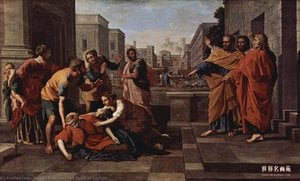
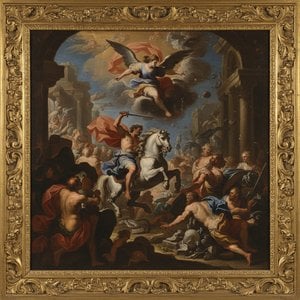
Poussin’s artistic output spanned a remarkable range of subjects—ranging from biblical narratives to mythological tales and expansive landscapes—yet consistently united by his unwavering devotion to classical ideals. He achieved international renown for his monumental paintings depicting scenes from Greek mythology, notably *Et in Arcadia ego*, which captured the melancholic beauty of pastoral life while simultaneously meditating on mortality and the elusive nature of divine presence. This masterpiece exemplifies Poussin’s ability to synthesize observation with imagination—to transform historical references into evocative visual metaphors. He produced a prolific series of canvases illustrating biblical stories—including *The Seven Sacraments*—demonstrating his profound theological understanding alongside his unparalleled artistic skill. These works are distinguished by their meticulous detail and symbolic richness, conveying moral truths through carefully crafted compositions and luminous color palettes. His landscapes—particularly those depicting idealized vistas bathed in golden light—became celebrated for their tranquility and sublimity—reflecting a humanist vision of the natural world as harmonious and ordered.
Legacy: Shaping French Classicism
Nicolas Poussin’s impact on French art extended far beyond his own lifetime. He served as First Painter to the King under Cardinal Richelieu from 1640, establishing himself as a leading figure in the Académie Royale de Peinture et de Sculpture—a pivotal institution that championed classical principles and fostered artistic excellence. Artists like Jacques-Louis David and Paul Cézanne openly acknowledged their debt to Poussin’s rigorous approach and intellectual depth—recognizing him as a cornerstone of French Classicism. His legacy resides not merely in stylistic imitation but in the enduring conviction that art should aspire to moral elevation—a testament to an artist who sought not simply to depict the world but to illuminate its deepest truths through the transformative power of beauty. He remains revered as one of France’s greatest painters, a figure whose work continues to inspire admiration and contemplation centuries after his death in 1665.
- Notable Works: *The Death of Germanicus*, *The Seven Sacraments Series*, *A Roman Road*, *Orion Blinded Searching for the Sun*, *The Seasons*.
- Key Characteristics: Classical Composition, Linearity, Historical and Mythological Themes, Serene Landscapes.



 Vezi în context
 Comandă pictură realizată manual
 Trimite
 Distribuie
 Detalii
 Ghidul

 Descarcă
 Produse similare
 Radiografie
 Diaporama
 Statistici


 Citește mai mult






































 Opțiunea cu sticlă este disponibilă doar pentru dimensiuni de sub 110 cm