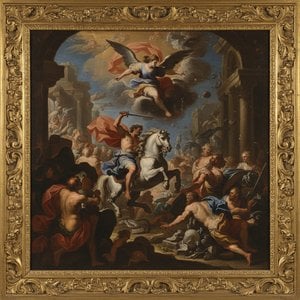
Midas Bathing in Pactolus: A Baroque Masterpiece
Nicolas Poussin's "Midas Bathing in Pactolus," created in the 17th century, is a captivating work of art that showcases the artist’s skill and mastery in depicting mythological scenes. This baroque piece features several nude figures, including a man and a woman, surrounded by nature, creating a scene rich in symbolism and dramatic beauty.
Composition and Symbolism
The painting includes elements of mythology, such as a goat and a tree, which add to the overall atmosphere of the piece. The central narrative revolves around Midas, the king of Phrygia, washing himself in the river Pactolus to undo the curse that turned everything he touched into gold. This story, taken from Ovid's Metamorphoses, serves as a classic example of the dangers of greed and the importance of humility. The composition is pyramidal, with the largest figure at the apex, suggesting stability and importance. The scene evokes feelings of tranquility mixed with sadness and perhaps loss.
Artistic Style and Influences
Nicolas Poussin's style is characterized by his use of classical themes, harmonious composition, and balanced proportions. His work was influenced by the Italian Renaissance and the art of Titian. The painting "Midas Bathing in Pactolus" is a testament to Poussin’s skill in creating beautiful and thought-provoking works of art. The style aligns with Baroque painting, characterized by dramatic lighting, dynamic compositions, and emotional intensity.
Technical Details & Materials
The artwork depicts a classical scene featuring three nude male figures resting near a stream or riverbank. It’s an oil painting with a dramatic and somewhat melancholic atmosphere. The use of lines is predominantly curvilinear, following the contours of the bodies and natural forms, creating a sense of fluidity. Shapes are largely organic – flowing drapery, rounded figures, and irregular rock formations. Textures appear rich and layered, achieved through impasto techniques, particularly evident in the rocks and foliage. Lighting is directional, casting strong shadows that emphasize volume and form, contributing to the dramatic effect. The technique involves meticulous brushwork and glazing to build up color and luminosity. Materials used are oil paints on canvas.
Historical Context & Legacy
Nicolas Poussin (1594-1665) was a renowned French painter who spent much of his career in Rome. His work significantly influenced later artists, including Jacques-Louis David and Paul Cézanne. The painting is currently housed at the Musée des Beaux-Arts in Rouen, France. For more information on Nicolas Poussin and his works, visit WahooArt.com. Handmade oil paintings reproductions of "Midas Bathing in Pactolus" are available at WahooArt.com, allowing art lovers to own a piece of history.
Întrebări și răspunsuri
Ce origine națională stă la baza Baroque-ului din "Midas Bathing in Pactolus"?
"Midas Bathing in Pactolus" a fost creat de Nicolas Poussin, născut în Franța, în cadrul mișcării Baroque. Originea artistului leagă această operă de Baroque, așa cum este practicat de artiștii din Franța.
Pot vedea "Midas Bathing in Pactolus" de Nicolas Poussin sub diferite lumini?
„Midas Bathing in Pactolus” poate fi explorat strat cu strat pe pagina Raze X a operei de artă, printr-un vizualizator inspirat de masa de lumină a unui conservator, care oferă unsprezece lecturi optice ale imaginii.
Care sunt culorile dominante în "Midas Bathing in Pactolus" de Nicolas Poussin?
„Midas Bathing in Pactolus” este definit de o paletă Dark, dominată de culoarea Espresso (#3f2514).



 Previzualizare
 Comută pe versiunea Print
 Trimite prin felicitare
 Distribuie
 Detalii despre lucrare
 Ghid
Ghid

 Descarcă imaginea
 Produse similare
 Radiografie
 Galerie foto
 Statistici

 Vezi mai mult






































 Opțiunea cu sticlă este disponibilă doar pentru dimensiuni de sub 110 cm