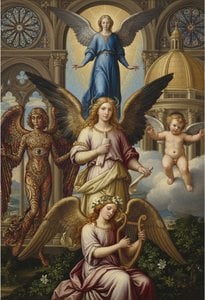
Hans Memling’s Angel Musicians: A Symphony of Devotion
Hans Memling's "Angel Musicians," painted in 1480, is more than just a depiction of celestial beings; it’s an immersive experience of harmony, faith, and the burgeoning artistic spirit of the Northern Renaissance. Housed within the Royal Museum of Fine Arts in Antwerp, this masterpiece invites viewers into a world where music transcends earthly concerns, offering a glimpse of divine grace. The painting's meticulous detail – from the delicate folds of the angels’ robes to the precise rendering of their instruments – speaks volumes about Memling’s unparalleled skill and his dedication to capturing both the physical and spiritual realities of his time.
The composition itself is a carefully orchestrated ballet. Six angelic figures, each engaged in playing a distinct instrument – a lute, flute, drum, and stringed harp-like device – create a vibrant sonic landscape. Their poses are dynamic yet serene, reflecting the joy and concentration inherent in their musical pursuits. The inclusion of two birds adds to the painting’s tranquil atmosphere, symbolizing peace and innocence. Memling's masterful use of oil on wood allows for an astonishing level of detail and color saturation, creating a luminous effect that elevates the scene beyond mere representation.
A Window into the Flemish Renaissance
Created during the height of the Flemish Renaissance, "Angel Musicians" reflects the profound religious influence that permeated art and society in Flanders during the late 15th century. Memling’s work aligns perfectly with the period's emphasis on realism, humanism, and a deep engagement with Christian themes. The triptych format – likely commissioned by a wealthy patron or the church – suggests a deliberate intention to create a devotional object intended for contemplation and prayer. The painting’s style is deeply rooted in the traditions of Northern European art, particularly the work of Rogier van der Weyden, Memling's mentor, showcasing a refined approach to detail and perspective.
Symbolism and Technique
Beyond its aesthetic beauty, "Angel Musicians" is rich with symbolic meaning. The angels’ white robes represent purity and innocence, while their musical instruments symbolize the divine harmony that permeates creation. Memling's technical prowess is evident in his meticulous rendering of textures – the smooth sheen of the wood, the intricate carvings on the instruments, and the delicate folds of the fabric. The use of light and shadow adds depth and dimension to the scene, further enhancing its three-dimensional quality. The golden sky, filled with clouds, evokes a sense of otherworldliness and elevates the angels to a realm beyond human comprehension.
Preserving a Masterpiece
The Koninklijk Museum voor Schone Kunsten has undertaken extensive conservation efforts over the past sixteen years to ensure the longevity of this exceptional artwork. This meticulous restoration process guarantees that future generations will continue to be captivated by Memling’s vision and technical brilliance. This reproduction captures not only the visual elements but also the essence of a work deeply rooted in history, faith, and artistic innovation.



 Previzualizare
 Comandă pictură lucrată manual
 Trimite
 Distribuie
 Detalii despre lucrare

 Descarcă
 Produse similare
 Radiografie
 Diapozitive automate
 Statistici


 Vezi mai mult






































 Opțiunea cu sticlă este disponibilă doar pentru dimensiuni de sub 110 cm