The Spirit of the Unrestrained Brush: The Life of Liang Kai
In the storied annals of the Southern Song Dynasty, few names evoke as much intrigue and spontaneous energy as Liáng Kǎi. Known to history by the evocative moniker “Madman Liang,” he was an artist who dared to defy the rigid, meticulous standards of the imperial court in favor of a more visceral, spiritual truth. Born around 1140 CE in the Shandong Province of China, Kǎi emerged from a landscape of tradition to become a pioneer of what would later be recognized as an informal, expressive style of painting. His life was defined by a profound tension between worldly recognition and monastic devotion, a duality that is etched into every loose stroke and ink splash of his surviving works.
Kǎi’s early journey took him from the rugged landscapes of Shandong to the cultural heart of Lin An, the capital of the Southern Song. It was here that he encountered the influential teachings of Jia Shigu, a master whose emphasis on atmospheric perspective and emotional resonance provided the foundation for Kǎi’s later innovations. Under this mentorship, the young artist learned to look beyond the mere surface of nature, seeking instead the qi—the vital life force—that animates all living things. This pursuit of essence over appearance would become the hallmark of his mature style, setting him on a path far removed from the literalism of his contemporaries.
From Imperial Court to Monastic Solitude
The height of Kǎi’s professional prestige arrived during the reign of Emperor Ningzong, when he was appointed as a painter-in-attendance at the Imperial Painting Academy between 1201 and 1204 CE. His technical mastery was undeniable; he possessed an uncanny ability to render figures, landscapes, and even the ethereal realms of Buddhist and Taoist deities with a striking vitality. The emperor himself recognized this brilliance, bestowing upon Kǎi the prestigious Golden Belt, a symbol of supreme artistic merit. Yet, in a gesture that cemented his legend, Kǎi famously refused to accept this worldly honor, leaving the belt hanging on the academy wall as a testament to his detachment from material glory.
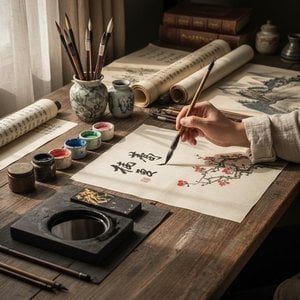
Driven by a fervent devotion to Chan (Zen) Buddhism, Kǎi eventually relinquished his official position to seek the quietude of monastic life. This transition was not merely a change in residence but a profound shift in artistic philosophy. In the solitude of the temple, away from the expectations of courtly patronage, his brushwork became even more liberated. He embraced the Xie Yi approach—a method focused on expressing the "idea" or "spirit" rather than precise form. This period of spiritual retreat allowed him to refine a technique that utilized minimal, abbreviated strokes to convey maximum emotional depth, effectively bridging the gap between calligraphy and painting.
The Legacy of the Abbreviated Stroke
The true genius of Liang Kai lies in his development of the "abbreviated brush" technique. While many artists of the Song Dynasty labored over intricate details, Kǎi mastered the art of the splash and the single, sweeping line. His works often feature a breathtaking economy of means, where a few well-placed washes of ink can suggest the mist of a mountain or the flowing robes of an immortal. This style, characterized by its spontaneous and almost childlike simplicity, was deeply influenced by his Zen practice, reflecting the Buddhist concept of sudden enlightenment and the beauty of the ephemeral.
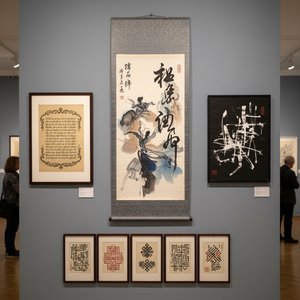
His historical significance cannot be overstated, as his influence rippled far beyond the borders of China. The expressive, ink-wash landscapes he pioneered became a cornerstone of artistic development in both China and Japan, inspiring generations of painters to seek the sublime in the unfinished and the raw. Today, when we look upon his depictions of solitary figures meditating by marshy banks or deities emerging from clouds of splashed ink, we see more than just ancient art; we witness a master who found ultimate freedom by letting go of the world, leaving behind a legacy of pure, unadulterated spirit.



 Vezi în context
 Comută pe versiunea Print
 Trimite
 Distribuie
 Detalii
 Ghid
Ghid

 Descarcă
 Produse similare
 Radiografie
 Diaporama
 Statistici

 Citește mai mult






































 Opțiunea cu sticlă este disponibilă doar pentru dimensiuni de sub 110 cm