Town Plan of Imola: Leonardo da Vinci’s Vision of Urban Harmony
The
Town plan of Imola, created by the renowned artist and polymath
Leonardo da Vinci in 1502, stands as a testament to Renaissance ingenuity—more than just a map; it’s a carefully considered embodiment of humanist ideals and military strategy. Measuring an impressive 440 x 602 cm, this pencil drawing executed with meticulous detail reveals Da Vinci’s unparalleled understanding of cartography and architectural design, reflecting his fascination with the practical application of artistic principles.
Commissioned by Cesare Borgia during a turbulent period in Italian history—a time marked by ambitious warlords vying for dominance—the plan wasn’t merely about delineating Imola’s physical boundaries. It represented Da Vinci’s profound engagement with military engineering, driven by the urgent need to fortify the city against siege and bolster Borgia’s authority. This intellectual pursuit is palpable in every line of graphite, demonstrating Da Vinci’s conviction that art could serve a vital civic purpose.
A Masterpiece of Perspective and Detail
What distinguishes this drawing from conventional maps of its era is Da Vinci’s masterful manipulation of perspective—a technique he pioneered and perfected. The resulting image possesses an almost palpable depth, inviting the viewer to step into the envisioned cityscape. Each street, building, and waterway is rendered with astonishing accuracy, showcasing Da Vinci’s obsessive attention to detail and his ability to visualize complex spatial relationships.
- Technique: Graphite pencil on paper – Da Vinci employed a precise hatching technique to convey tonal variations and create the illusion of three dimensions.
- Perspective: The drawing utilizes linear perspective, establishing vanishing points that convincingly portray depth and realism.
- Symbolism: The concentric circles representing the city’s fortifications subtly communicate Da Vinci’s preoccupation with defense and strategic planning.
Historical Context: Borgia’s Fortress
Imola’s significance lay in its strategic location within the Italian peninsula, a crossroads of power struggles between papal states and ambitious princes. Cesare Borgia recognized Da Vinci’s genius for fortification—evident in his designs for Castel Sant'Angelo—and tasked him with transforming Imola into an impregnable stronghold. This commission underscores Da Vinci’s role as not only an artist but also a visionary engineer, shaping the city’s physical landscape to reflect his intellectual convictions.
Legacy and Inspiration
Today, the Town plan of Imola continues to inspire architects and urban planners worldwide. Da Vinci’s innovative approach—integrating artistic vision with scientific observation—serves as a timeless model for creating sustainable, functional cities that prioritize both beauty and security. Its enduring appeal speaks to the fundamental human desire to understand and shape our environment.
- Current Location: Museo Vinciano, Vinci, Italy
- Influence on Modern Urban Planning: Da Vinci’s principles of fortification and spatial organization continue to inform contemporary architectural design.
Explore the beauty and intellectual depth of this extraordinary artwork at WahooArt.com for a high-quality reproduction.
Photo Description: The image is a painting of a town plan by Leonardo Da Vinci. The painting depicts the layout of a city with streets, buildings, and waterways. It appears to be an old map or drawing, possibly from the 1500's. The painting is quite detailed, showing various structures and features within the city. The image also includes some writing in the top right corner, which may provide additional information about the painting or its historical context. Overall, it is a fascinating piece of art that offers a glimpse into the urban planning and design of a bygone era.
Size: 440 x 602 cm
Date: 1502
ARTIST INFORMATION:
==================
Artist: Leonardo da Vinci
Birth Year: 1452
Death Year: 1519
Birth City: Vicenza
Birth Country: Italy
Biography:
The Enigma of Genius: Leonardo da Vinci’s Life and Legacy
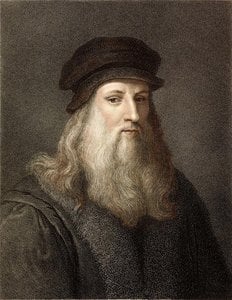
Leonardo di ser Piero da Vinci, born in 1452 near the Tuscan village of Vinci, Italy, remains arguably the most universally recognized figure of the Renaissance—a true polymath whose insatiable curiosity propelled him across disciplines, leaving an indelible mark on art, science, and engineering. While his fame initially rested on his achievements as a painter, he has also become known for his notebooks, in which he made drawings and notes on a variety of subjects, including anatomy, astronomy, botany, cartography, painting, and palaeontology. Leonardo is widely regarded to have been a genius who epitomised the Renaissance humanist ideal, and his collective works comprise a contribution to later generations of artists matched only by that of his younger contemporary Michelangelo.
Born out of wedlock to Piero da Vinci (Ser Piero da Vinci d'Antonio di ser Piero di ser Guido; 1426–1504), a Florentine legal notary, and Caterina Lippi (c. 1434–1494), from the lower class, Leonardo’s early life was unconventional, yet provided him with access to both the practical world and an appreciation for nature that would profoundly shape his artistic vision. He received a basic education in reading, writing, and arithmetic, but it was his apprenticeship under Andrea del Verrocchio in Florence that truly ignited his creative spark. Within Verrocchio’s workshop, Leonardo wasn't merely learning to paint or sculpt; he absorbed the techniques of metallurgy, mechanics, and hydraulics—skills that would prove invaluable throughout his extraordinary career.
His artistic output is astonishingly diverse, encompassing masterpieces such as The Mona Lisa, The Last Supper, Virgin of the Rocks, Saint John the Baptist, Madonna Annunciation, Adoration of the Magi, and many more. However, Leonardo’s legacy extends far beyond painting; he was a prolific inventor, engineer, anatomist, geologist, botanist, and architect—a visionary who anticipated innovations that wouldn't emerge for centuries.
He meticulously studied human anatomy through dissection, producing detailed drawings that revolutionized the understanding of the human body. He conceived designs for flying machines, tanks, submarines, and other groundbreaking inventions, demonstrating a remarkable grasp of scientific principles.
Leonardo da Vinci died in Amboise, France, in 1519, leaving behind an unparalleled legacy—a testament to the boundless potential of human intellect and creativity. His work continues to inspire artists, scientists, and thinkers today, cementing his place as one of history’s greatest geniuses.



 Previzualizare
 Comută pe Print
 Trimite
 Distribuie
 Detalii despre lucrare

 Descarcă
 Produse similare
 Radiografie
 Diapozitive automate
 Statistici


 Vezi mai mult