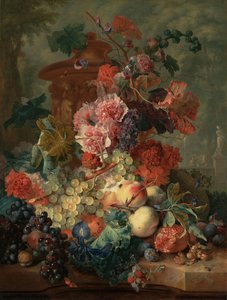
The Botanical Legacy of Justus van Huysum
In the golden light of the Dutch Golden Age, few artists captured the ephemeral splendor of nature with as much devotion and precision as Justus van Huysum. Born in Amsterdam in 1659, he emerged from a lineage of creative excellence, the son of Jan van Huysum I, a decorative painter who had brought his craft from the outskirts of Leeuwarden to the bustling artistic heart of the Netherlands. This familial foundation provided more than just a name; it offered a direct inheritance of technical skill and an intimate connection to the flourishing art market of Amsterdam. Growing up in an environment where visual creativity was a shared language, Justus was destined to refine the art of the still life into something profoundly transcendent.
The trajectory of his talent was shaped significantly by formal mentorship and early exposure to the masters of his era. In 1675, recognizing the exceptional aptitude of his son, Jan van Huysum I dispatched him to study under the renowned Nicolaes Berchem. This period of tutelage was transformative, instilling in Justus a rigorous discipline for detail and an eye for the subtle nuances of light and texture. While he possessed the versatility to explore landscapes, it was within the delicate realm of floral compositions that his true genius blossomed. He did not merely paint flowers; he sought to document their very essence, rendering petals, stems, and dew-kissed foliage with a realism so startling that it bridged the gap between fine art and botanical science.
A Masterpiece of Precision and Life
Justus van Huysum’s work is characterized by an unparalleled ability to breathe life into the static medium of oil on canvas. His compositions often feel like captured moments of perfection, where every bloom is rendered with a meticulousness that borders on the miraculous. He possessed a rare gift for capturing the tactile qualities of his subjects—the velvety softness of a rose petal, the translucent fragility of a tulip, and the vibrant, pulsing energy of a garden in full summer glory. This technical mastery was not merely about imitation but about an emotional engagement with the natural world. His paintings served as a celebration of life's fleeting beauty, inviting viewers into a serene, idealized space where nature exists in eternal, unblemished perfection.
Beyond his individual skill, Justus played a vital role in establishing a stylistic standard that would influence generations of painters. His approach to the still life genre elevated it from mere decorative ornament to a subject worthy of deep scholarly and aesthetic contemplation. By meticulously researching botanical specimens, he ensured that his work possessed an anatomical accuracy that appealed to both the connoisseur and the scientist. This intersection of art and botany allowed his work to resonate within the intellectual circles of the 17th century, where the study of nature was deeply intertwined with the pursuit of knowledge.
A Lasting Dynasty of Artistry
The life of Justus van Huysum was also one of profound familial continuity. In 1683, his marriage to Maria Elisabeth van Voorbergen anchored a domestic life that would become a cornerstone of Dutch art history. The legacy of the Van Huysum name was carried forward by his children, most notably his son Jan van Huysum, who would go on to become one of the most celebrated flower painters in history. This lineage ensured that the techniques and the aesthetic values championed by Justus—precision, luminosity, and botanical reverence—would permeate the Dutch art scene well into the 18th century.
Though he passed away in 1716, the historical significance of Justus van Huysum remains undiminished. He stands as a pivotal figure who helped define the zenith of the Dutch floral still life. His ability to weave together technical brilliance with a profound respect for the natural world created a body of work that continues to enchant collectors and historians alike. Through his brush, the fleeting blossoms of the past are preserved forever, offering an enduring testament to the beauty of the earth and the limitless potential of the human hand.



 Previzualizare
 Switch to Print
 Trimite
 Distribuie
 Detalii despre lucrare

 Descarcă
 Produse similare
 Radiografie
 Diapozitive automate
 Stats
Stats


 Vezi mai mult