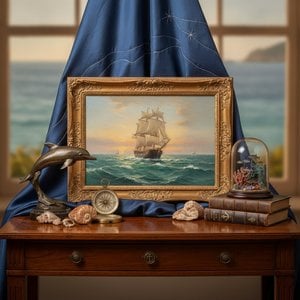
Biografie artist
A Life Forged by Sea and Canvas
John Wilson Carmichael, a name that resonates powerfully within the annals of 19th-century British marine painting, emerged from the industrious shipbuilding town of Newcastle upon Tyne in 1800. His life’s trajectory wasn't merely one of artistic pursuit; it was an extraordinary transformation – a deliberate shift from the tangible world of constructing vessels to the evocative realm of capturing their spirit on canvas. Born into a family deeply rooted in maritime tradition, as the son of a skilled shipwright, Carmichael didn’t simply observe the sea; he possessed an innate understanding of its mechanics, its mercurial moods, and the inherent dangers it presented. This intimate knowledge, gleaned through years spent apprenticed to his father, distinguished him from many of his contemporaries, imbuing his paintings with a realism and authenticity rarely found in those lacking such direct experience. Initially following in his family’s footsteps, Carmichael soon discovered an irresistible pull towards art, beginning as a drawing master – a profession demanding meticulous precision and a keen eye for detail – laying the foundation for his future success. This early training proved invaluable, allowing him to seamlessly integrate technical proficiency with burgeoning artistic talent, ultimately shaping his distinctive style.
Rising Tide: Early Successes and Establishing a Reputation
Carmichael’s ascent within the art world was marked by both unwavering dedication and fortunate opportunities. His initial works, such as *The Fight Between the Shannon and Chesapeake* (1843), immediately showcased his burgeoning ability to depict dramatic maritime events with compelling narrative force. These paintings weren't mere illustrations of naval battles; they were dynamic stories brought vividly to life on canvas – filled with tension, action, and a palpable sense of historical significance. The meticulous detail in depicting the ships’ rigging, the expressions of the sailors, and the chaotic energy of combat immediately garnered recognition, leading to prestigious commissions from institutions like Trinity House in Newcastle. Depicting coastal scenes and vital maritime infrastructure further solidified his reputation, establishing him as a respected artist within both local and national circles. His ability to capture not just the ships themselves but also the atmosphere and drama of the sea was particularly noteworthy. He frequently exhibited his work at the Northern Academy of Arts, gaining considerable acclaim before venturing into London’s more established art scene – a crucial step in securing his place among Britain's leading marine painters.
The Crimean War and National Recognition
A pivotal moment arrived with the outbreak of the Crimean War (1853-1856). Carmichael’s artistic skills were urgently sought after by the *Illustrated London News*, a rapidly growing publication eager to document the conflict visually. He was commissioned to paint scenes of naval engagements, transporting him to the Baltic Sea and immersing him in the heart of the action. This assignment culminated in *The Bombardment of Sveaborg* (1855), now housed within the National Maritime Museum – a monumental painting that powerfully captured the intensity and destructive force of naval warfare. The work’s dramatic composition, meticulous detail, and historical accuracy immediately propelled Carmichael to national recognition, transforming him from a respected regional artist into a celebrated figure across Britain. Beyond simply depicting the battle itself, Carmichael skillfully conveyed the atmosphere of chaos, fear, and heroism that characterized this pivotal moment in history. This experience not only honed his artistic technique but also deepened his understanding of historical events and their visual representation.
A Legacy of Technique and Influence
Following the Crimean War, Carmichael settled in Scarborough, a coastal town he had long admired, where he continued to paint seascapes and coastal views for the remainder of his life. He didn’t merely confine his artistic practice; he generously shared his knowledge and expertise with aspiring artists through the publication of two influential manuals: *The Art of Marine Painting in Water-Colours* (1859) and *The Art of Marine Painting in Oil-Colours* (1864). These meticulously detailed guides offered invaluable insights into his techniques, demonstrating a profound understanding of color theory, composition, and the portrayal of light on water. Carmichael’s work is characterized by an extraordinary realism – a remarkable ability to capture not just the visual appearance of ships and seascapes but also their inherent drama and emotional impact. He stands alongside E.W. Cooke and Clarkson Stanfield as one of the most significant Victorian maritime artists, leaving behind a legacy that continues to inspire and captivate viewers today. His paintings are often praised for their luminous quality, their dynamic compositions, and their ability to evoke the power and beauty of the sea.
Key Works and Artistic Significance
Carmichael’s oeuvre is rich with compelling works showcasing his mastery of marine painting. *James Wilson Carmichael and the Arrival of the Royal Squadron* (1843), a vibrant depiction of a naval fleet entering port, *Cullercoats from the South* (1845), capturing the rugged beauty of the Northumberland coastline, and *HMS Erebus and Terror in the Antarctic* (1847), illustrating a daring exploration of the Southern Ocean – are just a few examples of his diverse range. The Irwin Lighthouse, Storm Raging (1851) further demonstrates his ability to convey the drama and unpredictability of the sea. Of course, *The Bombardment of Sveaborg* remains a cornerstone of his artistic achievement, while works like Off the Dutch Coast (1858) showcase his continued exploration of light, atmosphere, and maritime life. Carmichael’s legacy extends beyond individual paintings; it resides in his ability to capture the very essence of maritime existence – the thrill of naval combat, the tranquility of coastal scenes, and the enduring power of the ocean itself. His work continues to be admired for its technical skill, artistic vision, and historical significance, securing his place as a prominent figure in 19th-century British art.



 Vezi în context
 Comută pe versiunea Print
 Trimite
 Distribuie
 Detalii
 Ghidul

 Descarcă
 Produse similare
 Radiografie
 Diaporama
 Statistici
 Citește mai mult






































 Opțiunea cu sticlă este disponibilă doar pentru dimensiuni de sub 110 cm