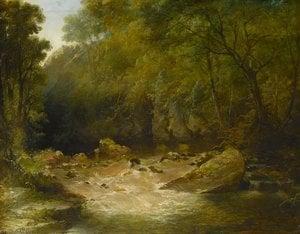
A Pioneer of the Devonshire Landscape
Born in the historic city of Exeter in 1789, John Gendall emerged as a transformative figure in the British art scene, bridging the gap between traditional landscape painting and the revolutionary dawn of lithography. His life was deeply rooted in the intellectual and cultural soil of Devon, a region that would forever serve as his primary muse. Growing up in an environment of scholarly pursuit—the son of a respected physician—Gendall possessed a refined sensibility that allowed him to perceive the subtle nuances of the natural world. His early years were not merely about observing nature, but about understanding its structure, a skill that would later allow him to master both the brush and the lithographic stone.
The trajectory of Gendall’s career was irrevocably altered by a serendipitous encounter in the bustling art markets of London. When he met Rudolf Ackermann, one of the most influential print sellers of the era, the seeds of a technical revolution were sown. Working under Ackermann, Gendall was introduced to the burgeoning medium of lithography. This process, which allowed for the reproduction of delicate drawings through stone printing, offered a new way to disseminate the beauty of the English countryside to a wider audience. His early contributions to works such as “Picturesque Tour of the Seine” demonstrated an emerging mastery over tonal depth and texture, marking his transition from a talented draftsman to a sophisticated printmaker.
The Art of Connection and Collaboration
As Gendall’s reputation grew, so too did his involvement in the professional networks that defined the nineteenth-century art world. His partnership with William Cole stands as a testament to his collaborative spirit. Together, they operated a print shop that became a vital hub for topographical and landscape art. This period of his life was characterized by an intense focus on capturing the grandeur of the Thames and the intimate, rolling hills of his native Devon. Through these collaborations, Gendall was able to merge the precision of topographical recording with a romanticized, emotive approach to light and atmosphere.
Beyond the technicalities of printmaking, Gendall’s life was anchored by a profound connection to his community. His marriage to Maria in 1824 brought a sense of domestic stability that mirrored the peacefulness found in his landscapes. He was not merely an observer of Devon; he was a builder of its cultural legacy. His instrumental role in the early development of what would become the museum at Exeter University highlights a man dedicated to the preservation and celebration of local heritage. This commitment ensured that his artistic vision was inextricably linked to the historical identity of the West Country.
Legacy of a Visual Chronicler
The significance of John Gendall lies in his ability to capture the picturesque—a movement that sought to find beauty in the rugged, the rural, and the everyday. His works serve as a visual diary of a bygone era, documenting river scenes, local life, and the shifting light of the English landscape with an authenticity that resonates even today. His mastery of lithography helped democratize art, making high-quality landscape imagery accessible to the burgeoning middle class of the Victorian era.
Reflecting on his immense contribution, one can observe several key pillars of his enduring impact:
- Technical Innovation: He was an early adopter and master of lithography, helping to refine a medium that changed printmaking forever.
- Regional Identity: His devotion to the landscapes of Devon provided a foundational visual language for the region's artistic history.
- Institutional Impact: Through his involvement in Exeter’s cultural institutions, he helped foster an environment where art and education could flourish together.
- Aesthetic Versatility: He successfully navigated the transition between the precise demands of topographical printing and the emotive qualities of landscape painting.
Today, Gendall is remembered not just as a painter, but as a pioneer who captured the soul of the British landscape during a period of profound industrial and social change.



 Previzualizare
 Comută pe versiunea Print
 Trimite prin felicitare
 Distribuie
 Detalii despre lucrare
 Ghid
Ghid

 Descarcă imaginea
 Produse similare
 Radiografie
 Galerie foto
 Q&A
Q&A Statistici


 Vezi mai mult