CONSULTAȚIE GRATUITĂ ÎN ARTE VIZUALE

x
Comandă reproducere pictată Comandă reproducere pictatăCumpără imaginea Cumpără imaginea TrimiteTrimite
Detalii despre lucrareDetalii despre lucrare Adaugă la favorite Adaugă la favorite DescarcăDescarcă SimilareSimilare RadiografieRadiografie DiaporamaDiaporama

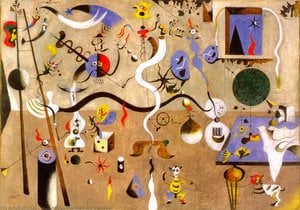
Mètamorphose

Inspired by Gaudí’s architectural forms and Miró's father’s goldsmithing craft, this piece reflects a profound connection to Catalan identity. Discover more about Joan Miró at WahooArt!

Descoperă universul vibrant al lui Joan Miró! Picturi suprarealiste și abstracte simbolizate cu forme jucăușe și culori îndrăzneațe. Pionier în arta modernă – vezi operele sale la WahooArt!

Giclée / Imprimare artistică

Print giclée sau pe canvas de calitate muzeală, cu producție rapidă și opțiuni flexibile de finisare.

P118B $10
P118H $10
P118W $10
P438Z $10
P508JH $12
P508YH $12
P805H $10
P805Z $10
P919BZ $10
P919G $10
P919XJ $10
P959ZH $10
P968JZ $12
W106C $8
W218G $10
W218JH $8
W218Y $10
W307PJ $10
W316G $10
W316PJ $8
W316Y $10
W398PJ $8
W4111J $10
W500HY $15
W500JH $15
W692G $12
W849H $8
W940BG $15
W953PJ $8

Standard
custom
CM
INCH

Alegeți dintre dimensiunile noastre prestabilite, care respectă proporțiile originale ale operei de artă.

lățime
înălțime

Puteți introduce propriile dimensiuni pentru a se potrivi unui anumit cadru sau spațiu. Dacă dimensiunea selectată nu corespunde proporțiilor imaginii originale, vom decupa lucrarea de artă sau vom extinde imaginea cu margini oglindite sau cu o culoare uniformă. Un mockup digital va fi trimis pentru aprobarea dumneavoastră înainte de începerea producției.
Vă rugăm să rețineți că previzualizarea de pe ecran nu reflectă decuparea sau extinderea reală. Doar mockup-ul va arăta cu exactitate compoziția finală.
Deși dimensiunile personalizate sunt disponibile, vă recomandăm să selectați o dimensiune din lista predefinită pentru a păstra proporțiile originale.

Livrare în întreaga lume () în 2 săptămâni, în loc de cele 4/5 săptămâni standard. (6 Iulie)

why_choose_icon
Livrare expres gratuită la nivel mondial
why_choose_icon
Pânză de in de înaltă calitate
why_choose_icon
Asigurare completă pentru transport
why_choose_icon
Garanție de rambursare a taxelor vamale
why_choose_icon
Garanția fidelității culorilor
why_choose_icon
Politica de retur de 60 de zile (doar pentru defecte)
why_choose_icon
Garanție 100% de rambursare
why_choose_icon
Reducere la comenzi multiple

Preț total

-

reproduction

Mètamorphose

Giclée / Imprimare artistică

Dimensiune reproducere

-

Preț total calculat

-

Informații rapide

  • Influences: Gaudí
  • Artist: Joan Miró
  • Movement: Surrealism
  • Year: 1935–1936
  • Medium: Gouache
  • Notable elements or techniques: Fluid application; Organic shapes
  • Artistic style: Abstract Surrealism

Descriere obiect de colecție

Mètamorphose: A Surreal Echo of Catalan Identity

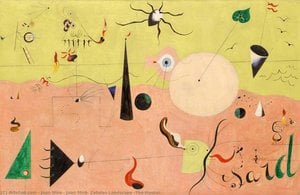
Joan Miró’s *Mètamorphose*, created between 1935 and 1936, stands as a cornerstone of Surrealist art—a testament to the artist's profound engagement with dreams, memory, and the spirit of Catalonia. More than just an aesthetically pleasing composition, it embodies a complex tapestry of symbolic references interwoven within a deceptively simple visual language. The artwork’s genesis lies in Miró’s formative years, marked by illness and initial familial reservations regarding his artistic ambitions—a backdrop that instilled in him a tenacious determination to translate intangible concepts onto canvas. Influenced subtly by the architectural grandeur of Antoni Gaudí – whose organic forms would resonate throughout Miró's later explorations – *Mètamorphose* captures a moment of creative fervor, reflecting both personal introspection and cultural heritage.

Composition & Technique: Fluid Forms Amidst Pale Light

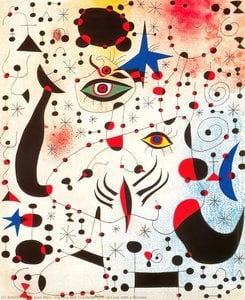
The image presents a loose and asymmetrical arrangement where figures are scattered across the canvas without adhering to strict spatial conventions. Lines flow freely, connecting elements in unexpected ways—a deliberate tactic mirroring Miró’s favored technique of gouache or watercolor applied to paper or canvas. The medium lends itself beautifully to achieving soft edges and blending colors seamlessly, resulting in an ethereal quality that enhances the dreamlike atmosphere. Notably absent is traditional perspective; shapes appear on a flat plane, fostering a shallow sense of depth—a stylistic choice characteristic of Surrealism’s rejection of realism and embrace of subconscious exploration. Careful observation reveals subtle textural variations beneath the surface, hinting at a controlled application of paint rather than visible brushstrokes.

Symbolic Resonance: Mannequin, Foliage & The Quest for Transformation

The artwork's subject matter centers around abstracted human figures—represented as simplified mannequins—intertwined with symbolic shapes and objects like foliage. These elements aren’t merely decorative; they operate as potent conveyors of meaning, reflecting Miró’s preoccupation with themes of metamorphosis and the subconscious mind. The palette is dominated by muted tones accented by splashes of orange, black, and touches of green – colors that evoke both melancholy and wonder—further amplifying the artwork's emotional impact. The repetition of circular forms contributes to a sense of cyclical time and reinforces the notion of transformation—a core concept within Surrealist thought.

Historical Context & Artistic Influence

Born in Barcelona in 1893, Miró’s artistic trajectory was shaped by the intellectual currents of his era. He emerged from a milieu steeped in Catalan traditions yet propelled forward by European avant-garde movements like Cubism and Futurism. *Mètamorphose* exemplifies Surrealist principles—a deliberate departure from rational thought—and stands as a direct response to the anxieties of the interwar period. Its visual vocabulary anticipates developments in Abstract Expressionism, demonstrating Miró’s enduring legacy as a pioneer of modern art and his profound contribution to the artistic dialogue of the 20th century.

A Window into the Surrealist Imagination

Ultimately, *Mètamorphose* invites contemplation—a journey into the realm of dreams and intuition. Its playful juxtaposition of forms and colors stimulates imaginative interpretation, prompting viewers to consider the hidden depths beneath appearances. Like all Miró’s masterpieces, it transcends mere representation, communicating an emotional resonance that speaks to universal human experiences – a captivating reminder of the transformative power of art.

Biografie artist

A Catalan Visionary: The Life and Art of Joan Miró

Joan Miró i Ferrà, born in Barcelona in 1893, stands as one of the most significant figures in 20th-century art. His journey was not merely a progression through styles but an exploration of inner worlds, translating dreams, memories, and Catalan identity onto canvas with a uniquely poetic visual language. From humble beginnings marked by illness and initial parental reservations about his artistic pursuits, Miró persevered, driven by an innate need to express the intangible—the emotions, sensations, and subconscious currents that lie beneath the surface of reality. His early life was steeped in the traditions of Barcelona, a city brimming with architectural marvels thanks to Antoni Gaudí, whose organic forms would subtly influence Miró’s later abstractions. The goldsmithing profession of his father instilled an appreciation for meticulous craftsmanship, while the rugged Catalan landscape became a recurring motif and source of inspiration throughout his career.

Early Influences and the Path to Surrealism

Miró's formal artistic training began at La Llotja in Barcelona, where he honed his skills in traditional techniques. However, it was exposure to the avant-garde movements sweeping through Paris that truly ignited his creative evolution. The vibrant colors of Fauvism and the fragmented forms of Cubism resonated deeply, prompting him to move to Paris in 1920. This period proved pivotal as he encountered artists like Pablo Picasso and began experimenting with increasingly abstract compositions. Yet, Miró didn’t simply adopt these styles; he synthesized them, forging a path toward his own distinctive aesthetic. He sought to distill forms to their essence, stripping away representational details in favor of symbolic shapes and evocative colors. This exploration led him to the Surrealist group in 1924, aligning him with artists such as Max Ernst and Salvador Dalí. While embracing the Surrealist interest in the subconscious—influenced by Sigmund Freud’s theories—Miró maintained a unique sensibility—his work was less about shocking imagery or Freudian symbolism than it was about creating a world of playful forms and poetic suggestion. He famously declared an “assassination of painting” in favour of upsetting the visual elements of established painting, rejecting academic conventions and embracing spontaneity.

The Catalan Landscape and Artistic Roots

Miró’s formative years were profoundly shaped by his surroundings. Growing up in Barcelona's Gothic Quarter instilled a deep connection to Catalan culture and folklore—themes that would permeate his artistic output throughout his life. The influence of Gaudí’s organic architecture, characterized by undulating curves and natural materials, is palpable in Miró’s compositions, reflecting a desire to capture the beauty and dynamism of the natural world. His father's profession as a goldsmith instilled an appreciation for precision and craftsmanship—skills that would translate into meticulous attention to detail in his paintings and sculptures. The Catalan landscape—particularly the Serra de Tramuntana mountains—served as a constant source of inspiration, appearing repeatedly in his artworks as stylized representations of rock formations and vegetation.

Major Artistic Achievements: From Surrealist Pioneer to International Icon

Miró’s artistic career spanned several decades, marked by prolific experimentation across diverse mediums. He achieved international acclaim for his paintings, prints, sculptures, ceramics, and murals—establishing himself as one of the foremost artists of his generation. His collaboration with Max Ernst on *grattage* techniques revolutionized printmaking, demonstrating a willingness to challenge established artistic practices. The monumental ceramic murals commissioned for UNESCO’s headquarters in Paris showcased his mastery of large-scale art projects and solidified his reputation as a visionary artist. He was awarded the Grand Prix for Graphic Work at the Venice Biennale in 1958—a testament to his enduring influence on European art. Furthermore, he received the Guggenheim International Award in 1980—recognizing his contribution to modern art history.

Legacy and Enduring Influence

Joan Miró’s legacy extends far beyond his artistic creations. He championed freedom of expression and encouraged artists to embrace imagination and intuition—values that continue to resonate with contemporary creatives. His distinctive visual language—characterized by biomorphic shapes, vibrant colors, and symbolic imagery—influenced generations of artists and designers. The Fundació Joan Miró in Barcelona and the Fundació Pilar i Joan Miró in Palma de Mallorca serve as repositories of his artistic heritage, ensuring that his vision persists for future audiences. Miró’s art remains a powerful reminder of the transformative potential of creativity—a celebration of Catalan identity and an enduring testament to the beauty of abstraction.

Joan Miró

Joan Miró

1893 - 1983 , Spania

Detalii rapide

  • Artistic Movement Or Style: Surrealism, Abstract Art
  • Artists Or Movements Influenced By This Artist: ['Fauvism']
  • Artists Who Influenced This Artist: ['Pablo Picasso']
  • Date Of Birth: 1893
  • Date Of Death: 1983
  • Full Name: Joan Miró i Ferrà
  • Nationality: Spaniol
  • Notable Artworks:
    • The Farm
    • Dutch Interiors
    • Painting
  • Place Of Birth: Barcelona, Spania
Explorați opere de artă organizate pe teme, stiluri și caracteristici.