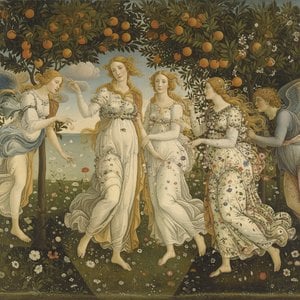
Jean-Baptiste Regnault’s “The Three Graces”: A Dance of Beauty and Myth
“The Three Graces,” painted in 1793 by Jean-Baptiste Régnault, is more than just a depiction of three beautiful women; it's an embodiment of Neoclassical ideals, a celebration of harmony, and a poignant reflection on the fleeting nature of beauty itself. Régnault, a student and later assistant to the renowned Thomas Gainsborough, masterfully captures the essence of the Greek mythos – the Charites, goddesses representing joy, elegance, and youthful charm – within a meticulously rendered landscape setting. The painting immediately draws the eye with its serene composition and the ethereal quality of the figures, bathed in soft, diffused light that seems to emanate from an unseen source.
The scene unfolds in what appears to be a tranquil garden or meadow, subtly suggested by the distant presence of two benches – a detail that invites the viewer to imagine a leisurely gathering, a moment of quiet contemplation. The women are positioned in a graceful, flowing arrangement, their bodies intertwined yet distinct, each radiating an individual aura of grace and serenity. Régnault’s skill lies not merely in his ability to capture physical beauty but also in conveying a sense of inner harmony and balance. Their poses are reminiscent of classical sculptures, echoing the ideals of proportion and symmetry that defined Neoclassical art.
A Symphony of Light and Color
Régnault’s technique is characterized by a remarkable command of light and shadow – a hallmark of his apprenticeship with Gainsborough. He employs a delicate sfumato effect, blurring the edges of the figures to create an atmosphere of softness and dreaminess. The colors are muted yet luminous, dominated by pale blues, greens, and creams, which contribute to the painting’s overall sense of tranquility. The artist skillfully uses light to sculpt the forms of the women, highlighting their curves and creating a palpable sense of volume. Notice how the light catches the folds of their drapery, adding depth and texture to the scene.
The choice of palette is particularly significant. The muted tones evoke a sense of timelessness and classical elegance, aligning with the Neoclassical movement’s fascination with antiquity. Furthermore, the subtle variations in color – from the blush of their skin to the delicate shades of their garments – create a harmonious visual experience that delights the eye.
Symbolism and Mythological Resonance
The Three Graces hold profound symbolic significance within Greek mythology. They represent not only beauty and grace but also joy, pleasure, and the essence of human flourishing. In this painting, Régnault elevates them to an almost divine status, portraying them as embodiments of ideal feminine virtues. The inclusion of the benches suggests a connection to earthly pleasures – a celebration of life’s simple joys enjoyed in the company of beauty and friendship.
The painting's historical context is crucial to understanding its deeper meaning. Created during the late 18th century, “The Three Graces” reflects the Neoclassical revival—a movement that sought to emulate the art and values of ancient Greece and Rome. This period was marked by a renewed interest in classical ideals of beauty, reason, and civic virtue, and Régnault’s painting perfectly embodies these aspirations.
A Timeless Masterpiece
“The Three Graces” is more than just a beautiful painting; it's a testament to the enduring power of art. Régnault’s masterful technique, combined with his profound understanding of classical mythology and symbolism, creates an image that continues to captivate viewers centuries later. The painting’s serene beauty, its harmonious composition, and its evocative atmosphere invite us to contemplate the nature of beauty, pleasure, and the human condition. It remains a poignant reminder of the timeless appeal of Neoclassical art and Régnault's place as a significant, yet often overlooked, figure in British artistic history.



 Vezi în context
 Comandă pictură realizată manual
 Trimite
 Distribuie
 Detalii
 Ghid
Ghid

 Descarcă
 Produse similare
 Radiografie
 Diaporama
 Statistici


 Citește mai mult






































 Opțiunea cu sticlă este disponibilă doar pentru dimensiuni de sub 110 cm