Comandă printul Comandă printulCumpără imaginea Cumpără imaginea TrimiteTrimite
Detalii despre lucrareDetalii despre lucrare Adaugă la favorite Adaugă la favorite DescarcăDescarcă Produse similareProduse similare Diapozitive automateDiapozitive automate

Apollo

Experience the serene divinity of Houdon's Apollo sculpture, a masterful Neoclassical embodiment of Enlightenment reason; discover this timeless piece for your collection.

Descoperă sculpturile neoclasice ale lui Jean Antoine Houdon (1741-1828), maestru în reprezentarea realistă a unor figuri emblematice ale iluminismului precum George Washington și Voltaire – opere impresionante care au definit epoca!

Reproducere pictată manual în ulei

Pictură în ulei pe pânză, realizată manual de artiștii noștri la dimensiunea și ramele dorite de dumneavoastră, pe comandă. (Comandă printul Comandă printulCumpără imaginea Cumpără imaginea)

Standard
personalizat
CM
INCH

Alegeți dintre dimensiunile noastre prestabilite, care respectă proporțiile originale ale operei de artă.

lățime
înălțime

Puteți introduce propriile dimensiuni pentru a se potrivi unui anumit cadru sau spațiu. Dacă dimensiunea selectată nu corespunde proporțiilor imaginii originale, vom decupa opera de artă sau vom extinde pictura cu elemente suplimentare pictate manual. O simulare digitală vă va fi trimisă pentru aprobare înainte de începerea producției.
Vă rugăm să rețineți că previzualizarea de pe ecran nu reflectă decuparea sau extinderea reală. Doar macheta va arăta cu exactitate compoziția finală.
Deși sunt disponibile dimensiuni personalizate, vă recomandăm să selectați o dimensiune din lista predefinită pentru a păstra proporțiile originale.

Exemple de elemente ce pot fi personalizate: Înlocuiți fața cu fotografia clientului; Adăugați un animal de companie (de exemplu, înlocuiți pisica cu un câine); Includeți un mesaj ascuns în fundal; Schimbați peisajul sau elementele din fundal.
După plasarea comenzii, echipa WahooArt.com va contacta clientul prin e-mail pentru instrucțiuni și îi va furniza o previzualizare a machetei

Livrare în întreaga lume () în 3-4 săptămâni, în loc de cele 5 săptămâni standard. (6 Septembrie). Fără compromisuri în ceea ce privește calitatea.

why_choose_icon
Livrare expres gratuită la nivel mondial
why_choose_icon
Pânză de in de înaltă calitate
why_choose_icon
Asigurare completă pentru transport
why_choose_icon
Garanție de rambursare a taxelor vamale
why_choose_icon
Garanția fidelității culorilor
why_choose_icon
Politica de retur în 100 de zile (doar pentru defecte)
why_choose_icon
Garanție de rambursare 100%
why_choose_icon
Ofertă pentru comenzi multiple

Preț total

$ 272

reproduction

Apollo

Tehnică de reproducere

Dimensiune reproducere

-

Preț total calculat

$ 272

Informații rapide

  • Subject or theme: Divine Apollo
  • Year: 1790
  • Medium: Marble
  • Title: Apollo
  • Artistic style: Lifelike portraiture
  • Movement: Neoclassicism
  • Artist: Jean-Antoine Houdon

Test de cultură artistică

Fiecare întrebare are un singur răspuns corect.

Întrebare 1:
Which of the following best describes Jean-Antoine Houdon’s artistic approach?
Întrebare 2:
The Apollo statue is believed to be inspired by which ancient artwork?
Întrebare 3:
What historical period does Jean-Antoine Houdon primarily represent in his work?
Întrebare 4:
Based on the image description, what material is the statue primarily made of?
Întrebare 5:
What does the pedestal suggest about the Apollo statue’s intended presentation?

A Glimpse of Divinity: Jean-Antoine Houdon’s Apollo

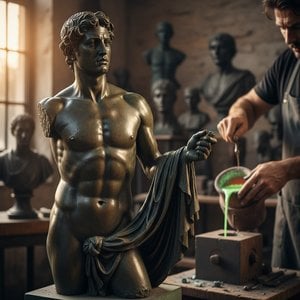
The image before us – a strikingly direct portrayal of a male figure stripped bare, yet radiating an almost unbearable serenity – is not merely a sculpture; it's a distillation of the Enlightenment’s yearning for reason and beauty. This is Jean-Antoine Houdon’s Apollo, rendered in a style that defies easy categorization, existing instead as a potent synthesis of Neoclassical precision and a deeply human sensibility. Completed around 1790, during a period of immense social and political upheaval in France, the statue offers a poignant counterpoint to the turbulence of the era – a quiet assertion of order amidst chaos.

The Sculptor’s Vision: Houdon and the Enlightenment

Jean-Antoine Houdon (1741-1828) was more than just a sculptor; he was a keen observer of his time, deeply invested in the intellectual currents shaping France. Born in Versailles, he benefited from an early artistic education at the prestigious Académie Royale de Peinture et de Sculpture, where he honed his skills under masters like Slodtz and Lemoyne. However, Houdon’s true innovation lay not in mimicking established styles but in forging a distinctly personal approach. He sought to capture the *inner* life of his subjects – their intellect, character, and emotional state – believing that sculpture could reveal more than just physical likeness. This pursuit is powerfully evident in Apollo; the statue isn't simply a representation of a god, but an embodiment of his divine attributes: strength, wisdom, and a profound sense of self-possession.

Technique and Material: Bronze’s Enduring Embrace

Houdon masterfully employed the technique of lost-wax casting in bronze to create this remarkable piece. This method, favored by ancient Greek sculptors, allowed for an astonishing level of detail and refinement. The surface of Apollo is remarkably smooth, almost tactile, yet simultaneously retains a subtle texture that speaks to the sculptor’s meticulous hand. Note the delicate musculature, the carefully rendered folds of drapery (though deliberately minimal), and the intense focus in the eyes – all hallmarks of Houdon's signature style. The choice of bronze itself is significant; it was considered a material of nobility and permanence, mirroring the enduring qualities he sought to imbue within his subject.

Symbolism and Inspiration: Echoes of Belvedere

Apollo’s pose – standing with one hand raised in a gesture of command and the other holding an object suggestive of a spear or bow – immediately connects him to classical mythology. However, Houdon's Apollo is not a heroic warrior; he possesses a contemplative stillness that transcends mere representation. Crucially, this statue draws inspiration from the *Apollo Belvedere*, a Roman copy of a Greek original by Leochares, housed in the Pio Clementino Museum in Vatican City. This ancient masterpiece, dating back to the 3rd century BCE, served as a foundational model for Western depictions of Apollo – a god associated with light, music, poetry, and prophecy. Houdon’s work subtly echoes this classical ideal while imbuing it with his own distinctly modern sensibility.

A Legacy of Serenity: Apollo in the Modern Home

More than two centuries after its creation, Jean-Antoine Houdon's Apollo continues to resonate. Its quiet dignity and profound sense of inner strength offer a welcome respite from the frenetic pace of contemporary life. Reproductions of this iconic sculpture are highly sought after by collectors and interior designers alike, bringing a touch of classical elegance and contemplative beauty to any space. The statue’s ability to evoke both intellectual curiosity and emotional serenity makes it a timeless addition to any collection – a reminder that even in the midst of uncertainty, the pursuit of knowledge, beauty, and inner peace remains eternally relevant.


Biografie artist

A Sculptor of the Enlightenment

Jean-Antoine Houdon, born in Versailles in 1741, stands as a pivotal figure bridging the Rococo and Neoclassical eras—a sculptor whose work embodies the intellectual fervor and evolving aesthetic sensibilities of the eighteenth century. His life unfolded amidst dramatic shifts in French society, from the waning opulence of the monarchy through the revolutionary upheaval and Napoleonic ascendance. Yet, Houdon remained remarkably consistent in his artistic vision: to capture not merely a likeness, but the very essence of his subjects—their intellect, character, and inner lives—in enduring marble and bronze. This dedication stemmed from an early aptitude for sculpture, nurtured by formal training at the Académie Royale de Peinture et de Sculpture beginning in 1752 under esteemed sculptors like René-Michel Slodtz, Jean-Baptiste Lemoyne, and Jean-Baptiste Pigalle. His subsequent enrollment at the École Royale des Élèves Protégés from 1761 to 1764 solidified his foundation, culminating in a triumphant win of the Prix de Rome competition in 1761—an award that granted him invaluable study time with classical art firsthand in Italy, an experience profoundly shaping his aesthetic sensibilities.

The Art of Verisimilitude and Psychological Insight

Houdon’s sculptures are immediately recognizable for their breathtaking realism and meticulous attention to detail. He wasn't content with simply replicating physical features; he sought to penetrate the surface, revealing the personality and intellect within. This commitment to verisimilitude arose from a deep fascination with anatomy—evident in his celebrated *Muscleman Sideview* bronze sculpture—and an unwavering dedication to observation. Unlike many contemporaries who idealized their subjects, Houdon embraced imperfections, believing they contributed to a more truthful and compelling portrayal. He employed innovative techniques, including taking casts directly from life, allowing him to capture minute details with unparalleled accuracy. This approach was particularly evident in his portrait busts, which became his signature achievement. These weren’t merely static representations; they were dynamic studies of character, imbued with psychological depth and emotional resonance. Houdon's ability to convey not just *how* someone looked, but *who* they were, set him apart. He achieved this through subtle nuances in expression, posture, and the rendering of details like the eyes—often carved with a slight concavity to capture the play of light and suggest inner thought. His meticulous attention to detail extended beyond mere physical representation; he painstakingly studied musculature, bone structure, and facial expressions to convey not only appearance but also temperament and intellect.

Immortalizing an Era: A Pantheon of Enlightenment Figures

The breadth of Houdon’s clientele reads as a veritable who's who of the Enlightenment. He immortalized some of the most influential thinkers, writers, politicians, and leaders of his time. His terracotta portrait of Denis Diderot captures the philosopher’s intellectual intensity and unconventional spirit with remarkable sensitivity. Benjamin Franklin, portrayed during his diplomatic mission to France, appears as a man of wisdom and pragmatism, his gaze both shrewd and benevolent. Jean-Jacques Rousseau, sculpted with characteristic empathy, embodies both the passion and melancholy that defined his philosophy. Perhaps most famously, Houdon sculpted Voltaire—creating multiple versions of the celebrated writer, including a dynamic seated figure for the Comédie-Française that captures his wit and intellectual energy. Beyond these intellectual giants, Houdon also received commissions from royalty, notably Louis XVI, and rising political figures like Napoleon Bonaparte. However, it was his sculpture of George Washington, commissioned by the Virginia General Assembly, that secured his place in American iconography. This life-size marble statue—based on meticulous measurements and a life mask taken during Washington’s presidency—became the definitive image of the nation's first president, serving as the model for countless engravings and reproductions, even appearing on U.S. postage stamps for decades. He also sculpted Thomas Jefferson, furthering cementing his legacy across the Atlantic.

Technique and Innovation: Mastering Marble and Bronze

Houdon’s sculptural technique was revolutionary for its time. Rejecting traditional methods of idealized representation, he pioneered a new approach rooted in observation and anatomical accuracy. His method involved painstakingly studying cadavers—a controversial practice at the time—to gain an understanding of human musculature and bone structure. He utilized a process known as *L'Écorché*, which involved stripping away layers of flesh to reveal underlying muscle tissue, achieving unprecedented realism. This technique demanded immense patience and skill, but it allowed Houdon to capture not only physical form but also the subtle nuances of expression and emotion. Furthermore, he mastered bronze casting—a challenging medium that required precise calculations and meticulous craftsmanship. His bronzes are renowned for their fluidity and dynamism, capturing movement and conveying a sense of vitality rarely achieved in marble sculpture. He skillfully employed techniques like *lost wax casting*, ensuring exceptional detail and tonal variation.

Legacy and Enduring Influence

Jean-Antoine Houdon’s impact on the world of sculpture is undeniable. He elevated portraiture to an art form capable of profound psychological insight and historical documentation. His dedication to realism, combined with his ability to capture the essence of his subjects, set a new standard for sculptural representation. Throughout his life, he received widespread recognition, being named a Chevalier de la Légion d'Honneur in 1804 and a Chevalier de l’Empire in 1809—testaments to his esteemed status within French society. Even in his later years, Houdon continued to create significant works, demonstrating an unwavering commitment to his craft until his death in Paris on July 15, 1828. His sculptures remain highly valued today, not only for their artistic merit but also for the invaluable glimpses they provide into the lives and times of the Enlightenment era. Houdon’s work serves as a powerful reminder of the enduring power of art to capture the human spirit and preserve it for generations to come. His influence can be seen in the works of countless artists who followed, solidifying his position as a master sculptor whose legacy continues to inspire awe and admiration.
Jean-Antoine Houdon

Jean-Antoine Houdon

1741 - 1828 , Franța

Detalii rapide

  • Artistic Movement Or Style: Neoclassical Realism
  • Artists Or Movements Influenced By This Artist: ['Canova']
  • Artists Who Influenced This Artist:
    • Slodtz
    • Lemoyne
    • Pigalle
  • Date Of Birth: 1741
  • Date Of Death: 1828
  • Full Name: Jean-Antoine Houdon
  • Nationality: France
  • Notable Artworks:
    • George Washington statue
    • Voltaire
    • Benjamin Franklin
  • Place Of Birth: Versailles, France
Explorați opere de artă organizate pe teme, stiluri și caracteristici.