

Printuri giclée sau pe canvas de calitate muzeală, cu proces de producție rapid și opțiuni flexibile de finisare. ( Comandă pictură realizată manual Comută pe Imagine Digitală)





























Alegeți dintre dimensiunile noastre prestabilite, care respectă proporțiile originale ale operei de artă.

Introduceți lățimea și înălțimea necesare pentru a se potrivi ramei sau peretelui dumneavoastră. O printare poate fi doar tăiată, niciodată extinsă dincolo de dimensiunea imaginii originale, astfel încât o dimensiune cu o formă diferită va pierde o parte din imagine. Vă trimitem o simulare digitală pentru aprobare înainte de a imprima orice. Imaginea afișată pe această pagină nu prezintă tăierea reală — doar simularea arată acest lucru.
Livrare în întreaga lume () în 2 săptămâni, în loc de cele 4/5 săptămâni standard. (8 Noiembrie)
untitled (5187)
Dimensiune reproducere
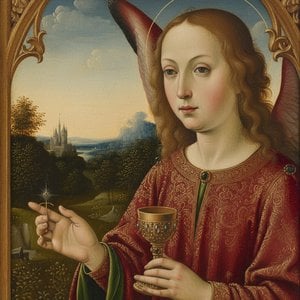
In the quiet corners of fifteenth-century Flanders, a revolution was unfolding, not through the clash of swords, but through the delicate application of oil on panel. Jan van Eyck, a master whose name remains synonymous with the dawn of the Northern Renaissance, captured this transformative era in his untitled masterpiece (5187). This painting is far more than a mere depiction of a religious scene; it is an invitation to step through a portal into a world where the divine and the earthly are inextricably linked. As one gazes upon the composition, there is an immediate sense of profound stillness, a meditative atmosphere that draws the viewer into a sacred dialogue between the figures and the light that bathes them.
The scene unfolds before a doorway, a threshold that serves as a powerful metaphor for spiritual transition. A woman, draped in a vibrant, commanding red—a hue traditionally evocative of both royal dignity and divine grace—stands as the focal point of this devotion. She holds aloft a book, perhaps a sacred scripture, her posture suggesting a moment of deep contemplation or the sharing of holy wisdom. Beside her, a figure in somber black provides a grounding contrast, creating a visual balance that mirrors the duality of human existence: the earthly struggle and the spiritual aspiration. The presence of birds, perched subtly within the frame, adds a layer of naturalistic grace, reminding us that even the smallest creatures are part of this divine tapestry.
What truly elevates this work to the status of a cornerstone of Early Netherlandish art is Van Eyck’s pioneering mastery of the oil medium. Before his innovations, artists primarily relied on tempera, which often resulted in flat, opaque surfaces. Van Eyck, however, utilized glazing techniques—the meticulous layering of thin, translucent washes of pigment over thicker undercoats. This process allowed light to penetrate the paint layers and reflect back from within, creating an unprecedented luminosity and a sense of "inner glow" that seems to emanate from the woman’s very skin and the heavy textures of the books.
This technical brilliance allows for an astonishing level of detail that captivates the eye and rewards prolonged study. One can almost feel the weight of the leather bindings on the shelves, the crispness of the paper, and the soft way light dances across the surfaces. For the collector or interior designer, this level of detail offers a profound depth; a high-quality reproduction of such a piece does not merely decorate a wall—it provides a focal point of intellectual and sensory richness, bringing a sense of historical weight and quiet sophistication to any curated space.
Beyond the technical marvels lies a rich, coded language of symbolism that was central to the fifteenth-century mind. Every element in "Untitled (51 187)" is a deliberate choice intended to provoke thought. The books scattered throughout the scene, some resting on shelves and others held in trembling hands, serve as symbols of knowledge, piety, and the pursuit of divine truth through study. The interplay between the red and black garments further reinforces themes of passion and mourning, or life and death, creating a narrative tension that keeps the viewer emotionally engaged.
To possess or display a work inspired by Van Eyck is to embrace a legacy of meticulous observation and spiritual depth. This painting serves as a testament to a time when art was a bridge between the seen and the unseen. Whether viewed as an academic triumph of the Northern Renaissance or as a breathtaking piece of decorative fine art, the work continues to inspire awe, offering a timeless sanctuary of peace and beauty for the modern home.
În general, "untitled (5187)" este înregistrată ca având o balanced. Luminozitatea percepută descrie cât de deschisă sau întunecată pare lucrarea.
"untitled (5187)" de Jan van Eyck poate fi vizualizată sub formă de diaporama pe pagina dedicată operei, Galerie foto.
Valorile înregistrate pentru "untitled (5187)" de Jan van Eyck sunt: luminozitate de balanced, luminanță de Soft Shadow.


1390 - 1441 , Țările de Jos
Embark on a journey through the luminous world of Early Netherlandish art. Discover the revolutionary oil techniques, microscopic realism, and sacred symbolism used by masters like Jan van Eyck to redefine Western art history in this expert-led guide.

Delve into the luminous revolution of Early Netherlandish painting. Unveil how Jan van Eyck and Flemish masters pioneered oil techniques to achieve unparalleled depth, sacred symbolism, and breathtaking realism, forever shaping the legacy of Western art history.
 Previzualizare
 Trimite prin felicitare
 Distribuie
 Detalii despre lucrare
 Ghid
Ghid

 Descarcă imaginea
 Produse similare
 Radiografie
 Galerie foto
 Întrebări și răspunsuri
 Statistici

 Vezi mai mult









 Opțiunea cu sticlă este disponibilă doar pentru dimensiuni de sub 110 cm


