

Obțineți un fișier gata de imprimare care depășește cu mult calitatea previzualizării web. Fiecare imagine digitală pe care o vindem provine dintr-un master de înaltă rezoluție din baza noastră de date — având, de regulă, o lățime între 5.000 și 15.000 de pixeli — astfel încât să puteți printa în format mare, să decupați strâns sau să reproduceți detalii fine cu încredere.
Niciun fișier nu părăsește studioul nostru fără să fie tratat. Un expert digital verifică nuanțele de culoare în raport cu pictura originală și le corectează acolo unde este necesar, apoi îmbunătățește claritatea și detaliile folosind instrumente profesionale de retușare — rămânând întotdeauna fidel gestului pictural și stilului artistului. Rezultatul este o imagine care seamănă cu tabloul propriu-zis, nu cu o scanare filtrată.
Aprobați înainte de finalizare: expertul nostru vă va trimite imaginea prin e-mail în termen de 72 de ore pentru revizuire. Nu sunteți mulțumit? Solicitați îmbunătățiri sau corecturi, ori cereți o restituire a plății dacă calitatea nu este pe măsura așteptărilor.
Aceasta este calitatea pe care se bazează editorii, studiourile de design, galeriile și tipăriturile.
Descărcați un fișier la rezoluție înaltă pentru afișare personală, imprimare și proiecte creative. ( Comută pe versiunea Print Comandă pictură realizată manual)
Când alegeți WahooArt.com, nu primiți doar o simplă imagine – primiți o operă de artă digitală îmbunătățită profesional, creată cu precizie și susținută de o garanție de satisfacție. Iată tot ceea ce primești odată cu comanda ta, în mod automat:
Fișierul imaginii digitale la rezoluție înaltă vă va fi trimis prin e-mail în termen de 72 de ore de la finalizarea comenzii – gata pentru utilizare imediată.
Opera ta de artă este optimizată profesional prin intermediul unor instrumente AI avansate și al editării manuale, asigurând un nivel maxim de detalii, claritate și acuratețe a culorilor.
Ai șters sau ai pierdut din greșeală fișierul? Nu îți face griji – ți-l vom retrimite oricând, gratuit.
Bucură-te instant de noua ta operă de artă, fără taxe vamale, taxe de import sau costuri de livrare – descărcările digitale sunt întotdeauna fără taxe.
Asigurăm o reflectare cât mai fidelă a culorilor originale în imaginea ta digitală, prin utilizarea unor instrumente profesionale și a proceselor de gestionare a culorii.
Dacă nu sunteți mulțumit de imaginea digitală achiziționată, o vom revizui sau vă vom returna 100% în termen de 100 de zile – fără nicio întrebare.
Nu ești mulțumit? Primești rambursarea integrală în termen de 100 de zile de la primirea fișierului digital – fără nicio întrebare.
Cumpără 3 imagini, economisește 10% - Cumpără 5, economisește 15% - Cumpără 10+, economisește 20%. Ideal pentru proiecte creative, galerii și agenții.

Born in the industrial heart of South Shields, Northumberland, in 1815, James Putty Garbutt emerged as a profound voice within the British landscape tradition. His life and artistry were inextricably linked to the rugged, salt-sprayed edges of the English coastline, a region where the meeting of land and sea provides a constant, dramatic spectacle. Growing up in the Victorian era—a period defined by a dual fascination with scientific precision and Romantic idealism—Garbutt developed a way of seeing that balanced meticulous observation with deep emotional resonance. His early years were shaped significantly by his father, William GarBT, a painter specializing in marine subjects, who provided the foundational training that would allow James to master the complex interplay of light, water, and atmosphere.
The development of Garbutt’s style was a journey of capturing the ephemeral. While his roots were firmly planted in the classical traditions of his upbringing, his brushwork often leaned toward the Impressionistic, utilizing loose, expressive strokes to convey the movement of waves and the shifting textures of the sky. He possessed a rare ability to employ tonal modulation, using a palette dominated by muted blues, deep greens, and earthy ochres to evoke the serene yet powerful grandeur of the Northumberland coast. His work was never merely a topographical record; rather, it was an attempt to translate the very soul of the maritime environment onto canvas, capturing the way light pierces through heavy clouds or how the tide transforms a familiar harbor into something otherworldly.
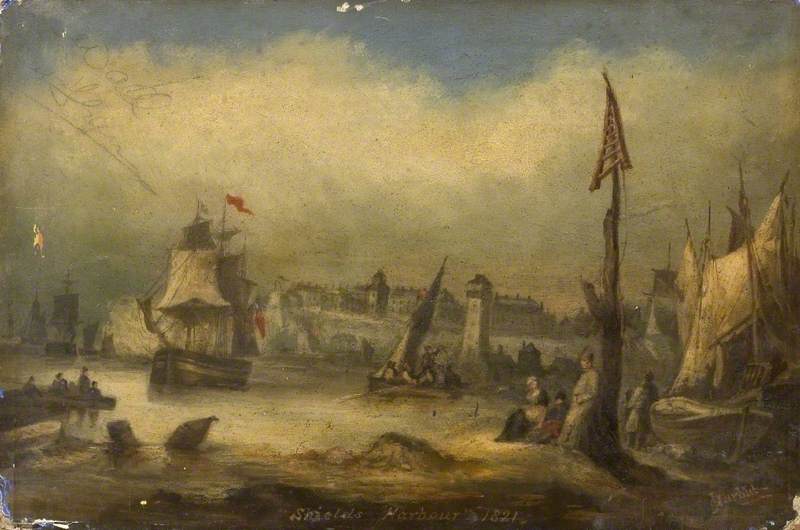
Garbutt’s most enduring achievements lie in his ability to render the atmospheric weight of the British seaside. His celebrated works, such as 'Shields Harbour' (1879), serve as masterclasses in composition and light. In this monumental piece, one can witness the artist's skill in creating a sense of depth through the use of an orange-hued, cloudy sky that casts a warm, dramatic glow over the bustling maritime activity below. By integrating small, dynamic details—such as birds in flight or the subtle movement of boats—he breathed life into his scenes, ensuring they felt like living, breathing moments captured in time rather than static images.
His artistic lineage is clearly visible in the way he navigated the influences of the great masters. The sweeping, emotive power of J.M.W. Turner and the grounded, naturalistic observations of John Constable acted as guiding stars for his technique. From Turner, he inherited a fascination with the sublime and the transformative power of light; from Constable, he drew a commitment to the authentic character of the landscape. This synthesis allowed him to create works that were both technically sophisticated and deeply evocative, cementing his reputation as a master of atmospheric perspective.
The historical significance of James Putty Garbutt extends beyond the mere beauty of his paintings; he remains a vital link to the maritime identity of North East England. His oeuvre serves as a visual archive of a bygone era, documenting the vitality of harbors like Shields during the height of the Victorian period. Through his eyes, we see not just landscapes, but the pulse of coastal commerce and the quiet dignity of the sea.
Today, Garbutt’s legacy is preserved in esteemed collections, including the South Shields Museum and Art Gallery, where his works continue to inspire awe. His contribution to British landscape art remains a testament to the power of observing one's surroundings with both a scientific eye and a romantic heart. To study Garbutt is to rediscover the timeless allure of the coast, rendered with a sensitivity that transcends the century in which he lived.
 Previzualizare
 Trimite prin felicitare
 Distribuie
 Detalii despre lucrare
 Ghid
Ghid

 Descarcă imaginea
 Produse similare
 Radiografie
 Galerie foto
 Întrebări și răspunsuri
 Statistici
 Vezi mai mult


