Biografie artist
A Life Embraced by the Waves
Ivan Konstantinovich Aivazovsky, born Hovhannes Aivazian in 1817, was more than a painter of seascapes; he was a conduit to the ocean’s soul. His very existence seemed inextricably linked to the Black Sea—a vast, unpredictable expanse that would forever dominate his artistic vision and fuel an extraordinary career spanning nearly six decades. Born in the Crimean port city of Feodosia, Aivazovsky didn't merely observe the sea; he felt it – its raw energy, sublime beauty, and inherent danger becoming the very essence of his art. From a young age, this connection was nurtured, initially by local architect Jacob Koch who recognized the boy’s talent, then blossoming within the rigorous academic environment of the Imperial Academy of Arts in Saint Petersburg. Yet, formal training alone couldn't account for the depth of Aivazovsky’s understanding; it was the constant presence of salt-laced air and the cries of gulls that truly shaped his artistic sensibility. His Armenian heritage also played a significant role, as he was baptized at the St. Sargis Armenian Church in Feodosia and maintained strong cultural ties throughout his life, occasionally incorporating Armenian themes into his expansive body of work. This dual identity—a Crimean-born Armenian artist deeply connected to both Russian and Armenian traditions—shaped his unique perspective and informed his artistic choices.
The Early Years and Artistic Foundations
Aivazovsky’s early years in Feodosia were formative, providing him with an unparalleled connection to the sea. The rugged coastline, the vibrant port life, and the ever-changing moods of the Black Sea served as constant inspiration. His family's modest circumstances fostered a strong work ethic and instilled in him a deep appreciation for the simple beauty of his surroundings. Recognizing his exceptional talent at a young age, Jacob Koch, a local architect, encouraged Aivazovsky’s artistic pursuits, providing him with basic instruction and fostering his nascent abilities. This early mentorship proved crucial, laying the foundation for his future success. Subsequently, he enrolled in the Imperial Academy of Arts in Saint Petersburg, where he received formal training in classical painting techniques. While adhering to academic standards, Aivazovsky never fully embraced rigid formalism, retaining a rebellious streak that would later manifest in his innovative approach to color and composition. His time at the academy exposed him to the works of established masters, but it was his own experiences—his intimate knowledge of the sea—that ultimately shaped his artistic style.
A Journey Through Europe and the Rise of a Naval Artist
In 1840, Aivazovsky embarked on a transformative journey through Europe, seeking new landscapes and artistic influences. Italy proved particularly influential, immersing him in the vibrant colors and dramatic light of the Mediterranean region. He spent several years studying with renowned Italian artists, absorbing their techniques and expanding his palette. This period marked a significant shift in his style—he began to experiment with looser brushstrokes and brighter colors, moving away from the more restrained approach of academic painting. Upon returning to Russia, Aivazovsky’s artistic trajectory took an unexpected turn when he was appointed as the main painter of the Russian Navy in 1845. This appointment provided him with unprecedented access to naval life—ships, sailors, battles, and firsthand observations—transforming his art forever. He became intimately acquainted with maritime culture, lending an unparalleled authenticity to his depictions of naval scenes. The role afforded him a unique opportunity to document significant historical events, such as the Battle of Navarino, solidifying his reputation as a leading artist of his time.
Masterpieces and Artistic Style
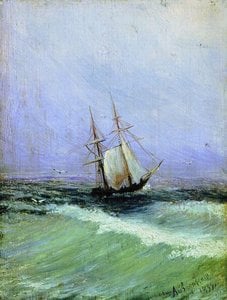
Aivazovsky’s paintings are instantly recognizable for their romantic sensibility and technical brilliance. He possessed an extraordinary ability to capture the fleeting effects of light on water—the shimmering reflections, the dramatic contrasts between dark and light, and the ethereal beauty of a stormy sea. His seascapes are not merely representations of physical reality; they are emotional experiences—evocations of awe, wonder, and even terror. Key works such as *The Ninth Wave* (1850) exemplify his mastery of atmospheric perspective and dramatic composition, depicting a harrowing scene of shipwreck survivors battling the relentless power of the ocean. Other notable paintings include *Seascape with Full Moon*, which captures the magical quality of moonlight on the water, and *A Ship in a Stormy Sea*, showcasing his ability to convey the raw energy of a violent storm. Aivazovsky’s use of color was particularly innovative—he employed a vibrant palette of blues, greens, and whites to create luminous effects that seemed to shimmer with life. He often worked en plein air, directly from nature, capturing fleeting light effects. His technique involved applying paint in thin layers, building up the image gradually and creating a sense of depth and atmosphere.
Legacy and Enduring Influence
Ivan Konstantinovich Aivazovsky stands as one of the greatest masters of marine art in Russian history—a legacy cemented by his technical skill, emotional depth, and prolific output. His paintings are celebrated not only for their aesthetic beauty but also for their ability to evoke powerful emotions and capture the essence of the sea. He significantly contributed to the development of Russian landscape painting, influencing generations of artists with his innovative techniques and dramatic compositions. Aivazovsky’s work continues to resonate with audiences worldwide, exhibited in museums and galleries across the globe. His paintings are a testament to the enduring power of nature and the human spirit—a reminder of our vulnerability in the face of the elements and our capacity for resilience and hope. He wasn't simply a painter of seascapes; he was a poet of the ocean, translating its moods, mysteries, and majesty onto canvas with unparalleled skill and passion. His influence can still be seen in contemporary marine art, demonstrating the lasting impact of this remarkable artist.



 Vezi în context
 Comandă pictură realizată manual
 Trimite
 Distribuie
 Detalii
 Guide
Guide

 Descarcă
 Produse similare
 Radiografie
 Diaporama
 Statistici


 Citește mai mult






































 Opțiunea cu sticlă este disponibilă doar pentru dimensiuni de sub 110 cm