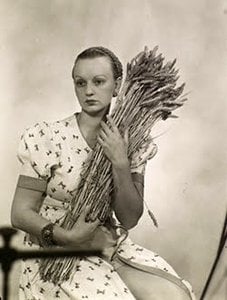
Biografie artist
A Life Between Worlds: The Enigmatic Ithell Colquhoun
Born in the distant landscapes of Shillong, Assam, British India, in 1906, Margaret Ithell Colquhoun embarked on a life that would defy easy categorization. Her early years were marked by a profound sense of displacement—a common experience for children of the Raj sent back to England for education. This initial severance from her birthplace instilled within her a lifelong fascination with liminal spaces, both geographical and psychological, which would deeply inform her artistic vision. Educated at Cheltenham Ladies’ College, she demonstrated an early inclination towards esoteric studies, particularly the Kabbalah and occultism—interests that blossomed alongside her burgeoning talent for art. Her formal training continued at the Cheltenham School of Arts and Crafts, followed by a pivotal period at the prestigious Slade School of Fine Art in London (1927-1930), where she studied under Henry Tonks and Randolph Schwabe. It was here, amidst the rigorous academic environment, that Colquhoun began to hone her technical skills while simultaneously nurturing her burgeoning spiritual curiosity.
Surrealist Affiliations and Esoteric Explorations
Colquhoun’s artistic development initially manifested in large-scale depictions of flora, rendered with almost photographic precision. These early works showcased a remarkable command of technique and an intense fascination with the natural world, yet they hinted at something more—a desire to penetrate beneath the surface of visible reality. A transformative moment arrived during her time in Paris in 1931, where she encountered the burgeoning Surrealist movement and was profoundly influenced by artists like Salvador Dalí. This encounter ignited a passion for exploring the subconscious mind and harnessing the power of automatism as a means of artistic expression. She engaged with the psychomorphological works of Roberto Matta and Gordon Onslow-Ford, further refining her understanding of these innovative techniques. By 1939, Colquhoun had become an active participant in the British Surrealist Group, exhibiting alongside prominent figures like Roland Penrose. However, her unwavering commitment to occult research ultimately led to a rift with the group and her expulsion in 1940 by E.L.T. Mesens—a testament to her refusal to compromise her deeply held beliefs. Undeterred, Colquhoun continued to explore Surrealist principles independently, developing innovative automatic techniques such as superautomatism, stillomanay, parsemage, and entoptic graphomania, meticulously documenting them in her article “The Mantic Stain.” These explorations weren’t merely stylistic exercises; they were integral to her quest for accessing deeper levels of consciousness.
Bridging Art and the Occult
Throughout her life, Colquhoun's fascination with the occult deepened, leading her to become a member of both the Druidic Order and the Order of the Stella Matutina. She immersed herself in esoteric traditions, viewing them not as separate from art but as inextricably linked—a means of unlocking hidden truths and expressing profound spiritual insights. Her artwork increasingly reflected these interests, seamlessly blending Surrealist techniques with symbolic imagery drawn from mythology, alchemy, and various spiritual practices. After the 1950s, she was often categorized as a ‘fantamagiste,’ an unorthodox Surrealist focused on occult themes—a label she embraced, recognizing it as a fitting description of her unique artistic vision. Beyond painting, Colquhoun also demonstrated a talent for writing, publishing poetry – including *Grimoire of the Entangled Thicket* and *Ozmazone* – and travel writings documenting her experiences in Ireland and Cornwall. These literary endeavors further illuminated her complex worldview and provided additional avenues for expressing her esoteric explorations.
Cornwall, Legacy, and Rediscovery
In 1946, Colquhoun established a studio near Penzance, Cornwall, while maintaining a residence in London. She eventually settled permanently in Cornwall in 1957, where she lived until her death on April 11, 1988. This move to the rugged Cornish coastline proved pivotal, providing both physical and spiritual sustenance for her artistic endeavors. Throughout the latter part of her life, Colquhoun continued to create art and write prolifically, remaining largely independent of mainstream artistic trends. Her work remained a testament to her unique blend of Surrealism and occultism—a synthesis that challenged conventional boundaries and defied easy categorization. In recent years, there has been a growing recognition of Colquhoun’s significance as an artist and esoteric thinker. Scholars like Amy Hale have highlighted her contributions to 20th-century subcultures and her pioneering exploration of the intersection between art, magic, and consciousness. Ithell Colquhoun stands as a compelling figure who defied easy categorization. Her work challenges conventional boundaries between artistic movements and spiritual practices, offering a unique perspective on the complexities of modernism and the enduring power of esoteric traditions. She is increasingly recognized as one of the most interesting and prolific esoteric thinkers and artists of the twentieth century—a visionary whose legacy continues to inspire and intrigue. Her art remains a potent reminder that the boundaries between the visible and invisible worlds are often more porous than we perceive.



 Vezi în context
 Comandă pictură realizată manual
 Trimite
 Distribuie
 Detalii
 Ghidul

 Descarcă
 Produse similare
 Radiografie
 Diaporama
 Statistici

 Citește mai mult






































 Opțiunea cu sticlă este disponibilă doar pentru dimensiuni de sub 110 cm