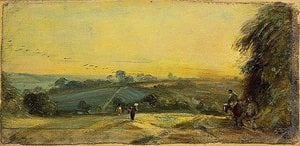
The Pioneer of the Open Air: The Life and Legacy of Henry Mark Anthony
In the grand tapestry of Victorian British art, few threads are as vital yet subtly woven as that of Henry Mark Anthony. A master of light and atmosphere, Anthony stands as a transformative figure who bridged the gap between traditional studio landscapes and the revolutionary en plein air movement. Born in 1817 at Rusholme Lane, Manchester, his early years were shaped by a blend of Welsh heritage and an burgeoning artistic curiosity. Following his family's move to Cowbridge, Glamorgan, his initial creative sparks were fanned by an apprenticeship under Dr. Harrison, an amateur artist who recognized the young boy's innate sensitivity to the natural world. This early foundation in meticulous observation would later become the hallmark of his mature style.
The trajectory of Anthony’s career took a decisive turn when he moved to London around 1833. It was during this period of profound exploration that his artistic identity truly began to coalesce. Supported by newfound patronage, he embarked on extensive travels across the European continent, venturing through the Netherlands, France, Ireland, and Spain. These journeys were far more than mere sightseeing; they were rigorous academic pursuits. At the Hague and within the prestigious Académie des Beaux-Arts in Paris, Anthony immersed himself in the techniques of masters such as Paul Delaroche, Ary Scheffer, and Horace Vernet. However, it was his time in Fontainebleau in 1837 that would forever alter his brushwork. Immersed in the ethos of the Barbizon School, he drew deep inspiration from the works of Jean-Baptiste-Camille Corot and Jules Dupré, learning to capture not just the geography of a place, but its very soul through direct engagement with the elements.
A Revolution of Light and Technique
What set Henry Mark Anthony apart from his contemporaries was his courageous rejection of the static, controlled environment of the studio in favor of the unpredictable beauty of the outdoors. He is widely credited with being among the first British artists to introduce the French plein-air style to the London art scene. This method required a radical shift in technique—a need for speed, spontaneity, and an acute awareness of fleeting atmospheric effects. His canvases began to breathe with the moisture of English mist and the warmth of Mediterranean sun, capturing textural nuances that had previously been lost in more formal compositions.
Critics of his era often drew favorable comparisons between Anthony and the legendary John Constable, noting a shared devotion to the sublime beauty of the landscape. His ability to render the ephemeral—the way light filters through a canopy of trees or how shadows stretch across a meadow—gave his work an emotional resonance that captivated audiences. This mastery of atmosphere was not merely a technical feat but a poetic one, as he sought to translate the transient moments of nature into permanent visual poetry. His frequent exhibitions at prestigious institutions such as the Royal Academy, the British Institution, and the Society of British Artists solidified his reputation as a leading voice in the Romantic movement.
Historical Significance and Lasting Influence
The impact of Henry Mark Anthony extended far beyond his own canvases. By bringing the sensibilities of the Barbizon School to Britain, he helped pave the way for subsequent generations of landscape painters. His commitment to the careful observation of nature resonated deeply with the Pre-Raphaelite Brotherhood; he maintained a close friendship with Ford Madox Brown and earned the admiration of artists who sought a similar truth in their depictions of the natural world. His work served as a vital link between the classical traditions of the early 19th century and the more modern, impressionistic approaches that would follow.
Throughout his life, Anthony’s achievements were marked by both critical acclaim and institutional recognition. Notable milestones include:
- Membership in the Society of British Artists: Elected in 1845, a testament to his standing among his peers.
- Award-Winning Artistry: Winning the prestigious £50 prize in 1854 for his evocative work Nature's Mirror.
- A Global Perspective: The integration of diverse European landscapes—from the rugged coasts of Wales to the plains of Spain—into a unified British aesthetic.
- Legacy in Museums: His works are now preserved in esteemed collections, including the National Museum of Wales, the Walker Art Gallery, and the Manchester Art Gallery.
When Henry Mark Anthony passed away in Hampstead in 1886, he left behind a transformed landscape painting tradition. He had successfully taught the British eye to look closer at the world, to find the extraordinary within the ordinary, and to appreciate the profound beauty found in a single, sun-drenched moment captured directly from the earth.



 Previzualizare
 Comută pe versiunea Print
 Trimite prin felicitare
 Distribuie
 Detalii despre lucrare
 Ghid
Ghid

 Descarcă imaginea
 Produse similare
 Radiografie
 Galerie foto
 Q&A
Q&A Statistici

 Vezi mai mult