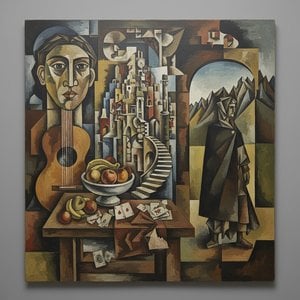
Biografie artist
Early Life and the Seeds of Artistic Rebellion
Gino Severini emerged into the world on April 7, 1883, in the picturesque Tuscan town of Cortona, Italy. His beginnings were humble; his father a junior court official, his mother a dressmaker – a background that instilled in him both a sensitivity to form and an awareness of societal structures. Formal education proved ill-fitting for the young Severini’s restless spirit. Expelled at fifteen alongside classmates for a youthful indiscretion involving stolen exam papers, he found himself cast adrift from conventional schooling. This expulsion, however, wasn't a derailment but rather a catalyst, freeing him to pursue his burgeoning artistic inclinations independently while working as a shipping clerk. The move to Rome in 1899 marked a turning point; it was there, amidst the ancient ruins and vibrant street life, that he began formal art classes, quickly becoming captivated by the shimmering effects of Divisionism – a technique championed by artists like Giacomo Balla and Umberto Boccioni, who would soon become pivotal figures in his artistic journey. These formative years laid the essential groundwork for Severini’s eventual embrace of Futurism, igniting within him a desire to capture the dynamism of modern life.
## Embracing the Velocity of Futurism
The invitation to join Filippo Tommaso Marinetti and Umberto Boccioni in the burgeoning Futurist movement proved transformative for Severini. He became a signatory of the *Manifesto of the Futurist Painters* in 1910, aligning himself with a revolutionary ideology that celebrated speed, technology, and the intoxicating energy of modernity. This wasn’t merely an artistic choice; it was a philosophical commitment to shattering tradition and forging a new aesthetic language for a rapidly changing world. Severini played a crucial role in disseminating Futurist ideas internationally, notably organizing the movement's first exhibition outside Italy at Galerie Bernheim-Jeune in Paris in 1912. His work during this period, exemplified by paintings like *North-South* (1915), embodies the Futurist obsession with capturing motion and energy through fragmented forms and a vibrant, almost explosive palette. Unlike some of his colleagues who focused on machines, Severini often chose the form of the dancer to express Futurist theories of dynamism in art. He was particularly adept at rendering lively urban scenes, for example in *Dynamic Hieroglyph of the Bal Tabarin* (1912) and *The Boulevard* (1913). During the First World War he produced some of the finest Futurist war art, notably his *Italian Lancers at a Gallop* (1915) and *Armoured Train* (1915).
## A Synthesis of Styles: Cubism and Beyond
Severini’s artistic style was never confined by rigid dogma; it was a constantly evolving synthesis of influences. While deeply rooted in the Futurist aesthetic, his work also demonstrated a profound engagement with Cubism, particularly after his pivotal visit to Paris in 1911. He absorbed elements of geometric abstraction and fragmented perspectives, incorporating them into his compositions to create dynamic arrangements that conveyed a sense of simultaneity and movement. Artists like Umberto Boccioni, Carlo Carrà, and Giovanni Francesco Romanelli were significant influences, but Severini’s unique vision allowed him to forge his own path. *Waltz*, for instance, showcases this masterful fusion of styles – the swirling energy of dance rendered through a Cubist lens, resulting in a painting that feels both chaotic and harmonious. Following the First World War, a shift occurred in Severini's artistic direction, mirroring a broader “return to order” prevalent throughout Europe. He explored classical themes and forms, yet retained his distinctive use of color and composition, demonstrating an ability to adapt and evolve without abandoning his core aesthetic principles.
## Notable Achievements and Legacy
Severini’s contribution to Italian art extended beyond his paintings; he was a prolific writer on art theory, articulating Futurist ideas with clarity and conviction. He championed the exploration of new artistic languages and challenged conventional notions of beauty—a stance that resonated powerfully with the intellectual currents of his time. His work gained recognition through major exhibitions, including the Rome Quadrennial, securing him prestigious awards from prominent institutions. Today, Gino Severini’s paintings are housed in museums across Europe and America, serving as enduring symbols of Futurism and Cubism's transformative impact on 20th-century art history. He remains a vital link between the past and present, reminding us of the importance of artistic experimentation and the courage to embrace radical visions—a legacy that continues to inspire artists and scholars alike.



 Comandă reproducere pictată
 Trimite
 Distribuie
 Detalii despre lucrare

 Descarcă
 Similare
 Radiografie
 Diaporama


 Vezi mai mult






































 Opțiunea cu sticlă este disponibilă doar pentru dimensiuni de sub 110 cm