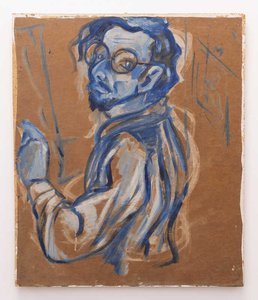
The Alchemist of the Avant-Garde: The Life and Vision of Gianni Bertini
Gianni Bertini (1922–2010) was far more than a mere painter; he was a restless architect of the visual imagination, a man who navigated the turbulent currents of the postwar era with an unyielding curiosity. Born in Pisa, Italy, Bertini’s early intellectual formation was rooted in the precision of mathematics—a discipline that would later manifest in his meticulous manipulation of textures and layers. This scientific rigor did not stifle his creativity but rather provided the structural foundation upon which he built a complex, multi-layered aesthetic. His journey took him from the historical echoes of the Italian Renaissance to the vibrant, experimental heart of Paris in 1951, a transition that allowed him to bridge the gap between classical grandeur and the burgeoning anxieties of modern consumer culture.
His artistic evolution was marked by a profound refusal to remain tethered to any single movement. While his early years saw him exploring figurative and geometric abstraction, he soon found himself drawn to the visceral energy of Arte Nucleare and the gestural freedom of informal painting. In works such as La Toile de Penelope, created alongside his wife Licia Monesi, Bertini demonstrated a remarkable ability to weave together disparate elements—using textile collage and irregular stitching to evoke both the ancient myth of the weaver and the raw, expressionist textures of the mid-century avant-garde. This period of his life was characterized by a deep engagement with mythology, using figures like Oedipus and Artemis not merely as subjects, but as vessels for exploring a reconstructed humanism in a world recovering from the scars of war.
Technological Innovation and the Invention of Mec-Art
What truly set Bertini apart from his contemporaries was his audacious embrace of the machine. At a time when many artists sought refuge in the purity of the brushstroke, Bertini looked toward the burgeoning technologies of mass media. He became a pioneer of material transfer and photomechanical screen printing, techniques that allowed him to imprint images directly onto canvas using specialized adhesives. This process created a visual language that was strikingly contemporary—reminiscent of the Pop Art movement seen in the works of Warhol, yet imbued with a much sharper, more critical edge regarding the impact of mass production on the human psyche.
This fascination with the mechanical led to his development of Mec-Art, a concept that merged graphic experimentation with industrial processes. His work often featured:
- Material Transfer: The seamless integration of photographic elements and found imagery into the painted surface.
- Screen Printing: A mastery of photomechanical methods to create complex, layered compositions.
- Graphic Synthesis: The use of stamped letters, numbers, and typographic elements to disrupt traditional narrative flow.
Through these methods, Bertini achieved a style that was both tactile and ephemeral, capturing the frantic energy of the 20th century through a lens of controlled experimentation.
A Legacy of Resistance and Interdisciplinary Brilliance
Beyond the canvas, Bertini was a central figure in the interdisciplinary dialogues of the postwar avant-garde. He moved fluidly between the worlds of visual art, poetry, and performance, collaborating closely with experimental poets like Henri Chopin and participating in the radical actions of Nouveau Réalisme. His "bertinizations" represented an attempt to infuse everyday reality with a heightened, often surrealist, iconography, challenging the boundaries between high art and the mundane objects of consumer life.
His historical significance lies in his role as a bridge-builder—between science and art, between ancient myth and modern technology, and between the Italian tradition and the French experimental scene. Even as he explored the mechanical, he never lost sight of the human element; his work remained a profound investigation into the soul's struggle within an increasingly mechanized world. Today, the retrospective exhibitions of his work, such as those held in Lecce, continue to reveal the complexity of a man who refused to be categorized, celebrating a legacy defined by tireless research, aesthetic courage, and an eternal quest for the new.



 Previzualizare
 Comandă pictură realizată manual
 Trimite prin felicitare
 Distribuie
 Detalii despre lucrare
 Ghid
Ghid

 Descarcă imaginea
 Produse similare
 Radiografie
 Galerie foto
 Statistici

 Vezi mai mult






































 Opțiunea cu sticlă este disponibilă doar pentru dimensiuni de sub 110 cm