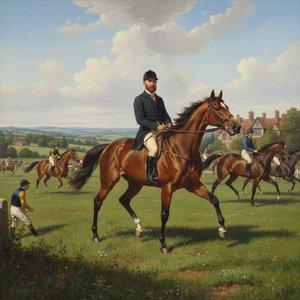
Frederick McCubbin’s “Camel’s Hump”: A Window into the Australian Landscape
“Camel’s Hump,” painted in 1912 by Frederick McCubbin, is more than just a depiction of a mountain; it's a profound meditation on the evolving relationship between humanity and the vast, untamed landscapes of Australia. This iconic work, now housed within the National Gallery of Victoria, offers a captivating glimpse into the Heidelberg School’s artistic philosophy – a movement that sought to capture the essence of Australian life through direct observation and a deeply felt connection with the bush.
The painting immediately draws the eye with its harmonious composition. A meandering river snakes through a verdant valley, flanked by rolling hills culminating in the imposing silhouette of Camel’s Hump itself. The artist masterfully employs atmospheric perspective – softening distant details and utilizing subtle gradations of color to create a sense of depth and vastness. McCubbin's technique is distinctly Impressionistic, characterized by loose brushstrokes and an emphasis on capturing fleeting moments of light and shadow. He eschews meticulous detail in favor of conveying the overall mood and feeling of the scene – a quiet reverence for the natural world.
The Significance of Camel’s Hump
The choice of subject matter is particularly revealing. Camel’s Hump, with its distinctive twin peaks, has long held a place in Australian folklore and Indigenous storytelling. The Abenaki people, who first encountered the mountain, named it “Moziozagan,” meaning “moose’s shoulder,” reflecting its resemblance to a resting moose. Later European settlers adopted variations of this name – “The Resting Lion” and eventually, “Camel’s Hump” – highlighting the ongoing process of cultural interpretation and naming within Australia's evolving identity. McCubbin’s painting serves as a visual record of this landscape, imbued with a sense of both familiarity and mystery.
Beyond its local significance, Camel’s Hump represents a broader theme in McCubbin’s work: the pioneering spirit of Australia and the challenges faced by those who sought to carve out a life amidst the wilderness. The presence of a lone figure on the riverbank – likely a stockman or settler – subtly suggests this human element within the vast landscape, inviting contemplation about the individual's place in the Australian narrative.
Symbolism and Emotional Resonance
The painting’s muted palette—dominated by earthy greens, browns, and blues—evokes a sense of tranquility and solitude. The light, diffused and soft, contributes to this feeling of peaceful contemplation. However, beneath the surface serenity lies a subtle undercurrent of melancholy – a recognition of the harsh realities of life in the bush and the enduring power of nature. McCubbin’s work often explores themes of isolation, loss, and the struggle for survival, reflecting the experiences of many early Australian settlers.
“Camel’s Hump” is not simply a landscape painting; it's a poignant portrait of a nation in transition. It encapsulates the Heidelberg School’s commitment to portraying authentic Australian life while simultaneously offering a profound reflection on the relationship between humanity and its environment. The work continues to resonate with viewers today, reminding us of the enduring beauty and complexity of the Australian bush.
Întrebări și răspunsuri
În ce an a fost creată „Camel's Hump”?
Opera "Camel's Hump" de Frederick McCubbin a fost creată în 1912.
A rămas "Camel's Hump" în țara de origine a artistului său?
Da - opera de artă este păstrată în țara de origine a artistului. Țara natală a Frederick McCubbin este Australia, iar muzeul care păstrează originalul operei „Camel's Hump” se află în Australia.
Pot vedea "Camel's Hump" de Frederick McCubbin sub diferite lumini?
Pagina Raze X a operei "Camel's Hump" de Frederick McCubbin este un vizualizator interactiv care vă permite să parcurgeți onze straturi optice ale imaginii lucrării, inclusiv o perspectivă de tip radiografie.



 Previzualizare
 Comandă pictură realizată manual
 Trimite prin felicitare
 Distribuie
 Detalii despre lucrare
 Ghid
Ghid

 Descarcă imaginea
 Produse similare
 Radiografie
 Galerie foto
 Statistici


 Vezi mai mult






































 Opțiunea cu sticlă este disponibilă doar pentru dimensiuni de sub 110 cm