A Study in Motion: Frederic Remington’s White Horse of the Plains
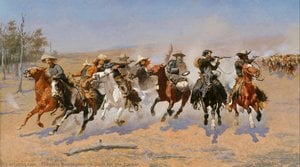
Frederic Remington's "Untitled horse study 5," painted in 1899, isn’t merely a depiction of a horse; it’s a distilled essence of the American West—a poignant echo of a vanishing era. This remarkable work, housed within the Art Institute of Chicago, offers a glimpse into the artist’s profound understanding of his subject and his masterful ability to capture both the physical form and the spirit of the wild frontier. The painting presents a solitary white horse, rendered with an almost palpable sense of movement, traversing a vast, open grassy field under a muted sky. It's a scene that speaks volumes about resilience, solitude, and the enduring connection between man and beast in a landscape defined by its raw beauty and unforgiving nature.
Remington’s artistic journey was far from conventional. Born in Canton, New York, to a family steeped in American history – his great-grandfather had fought in the Revolutionary War, and his cousin was George Washington – he initially resisted his family's expectations of a military career. Instead, drawn by tales of cowboys and Native Americans, he embarked on a deliberate path toward portraying the West, immersing himself in its culture and observing its inhabitants with meticulous detail. This painting exemplifies that dedication; every line, every shade of grey and brown, speaks to Remington’s deep respect for his subject.
The Language of Line and Light
Remington's technique is characterized by a remarkable blend of realism and expressive brushwork. He employed a dry-brush method, utilizing short, broken strokes to build up the form of the horse with incredible precision. The texture of the horse’s coat—the subtle variations in tone that suggest muscle beneath skin—is rendered with astonishing accuracy. Yet, it's not simply a photographic representation; Remington deliberately avoids smooth surfaces, imbuing the painting with a sense of dynamism and immediacy. Notice how the light catches on the horse’s flank, creating highlights that emphasize its form and suggesting movement even in stillness.
The color palette is restrained—primarily browns, greys, and muted blues—reflecting the vastness and austerity of the landscape. This deliberate lack of vibrant hues forces the viewer to focus on the interplay of light and shadow, further enhancing the painting’s sense of depth and atmosphere. The background, a hazy expanse of sky and field, serves as a powerful counterpoint to the horse's solidity, emphasizing its isolation and vulnerability.
Symbolism and the Vanishing West
“Untitled horse study 5” is more than just a portrait of an animal; it’s a potent symbol of the American West on the cusp of transformation. The lone horse embodies the spirit of self-reliance, endurance, and the deep connection between humans and the natural world that defined frontier life. Remington's work often depicted Native Americans and cowboys, but this piece focuses on the animal itself – a key element in the westward expansion and the lives of those who inhabited it. The horse represents both utility and freedom, reflecting the complex relationship between settlers and the land.
Painted in 1899, the work captures a fleeting moment in time—a period when the West was rapidly changing under the pressures of settlement and industrialization. Remington’s art served as a powerful record of this era, preserving images of a way of life that was increasingly threatened by progress. The painting's quiet dignity speaks to a lost world, prompting reflection on the enduring legacy of the American frontier.
A Timeless Masterpiece
Frederic Remington’s “Untitled horse study 5” remains a captivating and profoundly moving work of art. Its masterful technique, evocative symbolism, and poignant portrayal of the American West continue to resonate with viewers today. Reproductions of this iconic image offer an opportunity to bring this powerful vision into any space, serving as a reminder of the beauty, resilience, and enduring spirit of the frontier.



 Previzualizare
 Comută pe Print
 Trimite
 Distribuie
 Detalii despre lucrare

 Descarcă
 Produse similare
 Radiografie
 Diapozitive automate
 Statistici


 Vezi mai mult