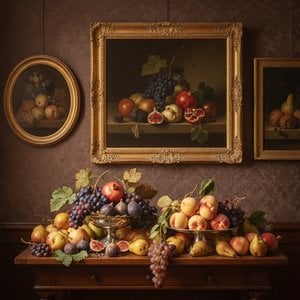
A Baroque Celebration of Earth's Bounty
To stand before Frans Snyders’ "Fruit and Vegetable Stall" is to step directly into the vibrant heart of 17th-century Flemish commerce. This monumental oil on canvas, a true testament to the Baroque obsession with material richness, does more than merely depict produce; it captures an entire sensory experience. The sheer abundance presented—piles of jewel-toned fruits nestled beside earthy vegetables—speaks volumes about the prosperity and daily life of the era. Snyders masterfully transforms a humble market stall into a grand spectacle of color and texture, inviting the viewer to inhale the imagined scent of ripe grapes and sun-warmed stone.
Mastery in Still Life: Technique and Detail
Snyders’ technical prowess is breathtakingly evident throughout this composition. His handling of light and shadow, or chiaroscuro, is nothing short of miraculous. Light does not simply fall upon the stall; it seems to emanate from within the objects themselves, catching the waxy sheen on a peach or illuminating the deep purple of hanging grapes. Observe the meticulous rendering of the white cloths draped over the tables; they serve as perfect foils, allowing the saturated hues of the produce—the crimson of apples, the verdant depth of leaves—to achieve maximum impact. This level of hyper-realism demands an almost scientific observation from the artist, yet it is imbued with a painterly grace that elevates mere documentation to high art.
The Human Element and Narrative Depth
What elevates this piece beyond a simple still life is the inclusion of human figures, which injects narrative tension into the scene. In the foreground, the woman in the striking red dress acts as an immediate focal point, her gaze drawn downward to the bounty before her, suggesting a moment paused mid-transaction. Further back, the man attending the counter, his hand resting near the scale, anchors the commerce aspect of the painting. These figures are not merely props; they guide our eye through the composition, inviting us to participate in the implied exchange—the careful weighing, the selection, the joyful acquisition of earthly goods.
Symbolism of Abundance and Life Cycle
Art historically, such depictions were rarely just about food. They are profound meditations on abundance, prosperity, and the cyclical nature of life itself. The overflowing bounty symbolizes material wealth and God's generosity, themes deeply resonant in Baroque culture. Furthermore, the inclusion of various types of produce—from hardy root vegetables to delicate grapes—can subtly suggest the passage of seasons and the continuity of life. For the modern collector or designer, this painting offers more than decoration; it is a conversation piece that speaks to nourishment, craftsmanship, and enduring vitality.
Bringing the Market Home: Reproduction for Your Space
For those wishing to capture the grandeur of this masterpiece within your own walls, acquiring a high-quality reproduction allows you to immerse yourself in Snyders' world without leaving your home. Imagine the rich, saturated colors echoing against contemporary decor, or lending an antique, scholarly air to a formal dining room. The scale of the original—a commanding 201 x 333 cm—suggests its power on a grand wall, and reproductions allow you to curate that monumental feeling in a way perfectly suited to your architectural vision.



 Vezi în context
 Comandă pictură realizată manual
 Trimite
 Distribuie
 Detalii
 Ghid
Ghid

 Descarcă
 Produse similare
 Radiografie
 Diaporama
 Statistici


 Citește mai mult






































 Opțiunea cu sticlă este disponibilă doar pentru dimensiuni de sub 110 cm