Printuri giclée sau pe canvas de calitate muzeală, cu proces de producție rapid și opțiuni flexibile de finisare. ( Comandă pictură lucrată manual Cumpără imaginea)





























Alegeți dintre dimensiunile noastre prestabilite, care respectă proporțiile originale ale operei de artă.

Puteți introduce propriile dimensiuni pentru a se potrivi unui anumit cadru sau spațiu. Dacă dimensiunea selectată nu corespunde proporțiilor imaginii originale, vom decupa lucrarea de artă sau vom extinde imaginea cu margini oglindite sau cu o culoare uniformă. Un mockup digital va fi trimis pentru aprobarea dumneavoastră înainte de începerea producției.
Vă rugăm să rețineți că previzualizarea de pe ecran nu reflectă decuparea sau extinderea reală. Doar mockup-ul va arăta cu exactitate compoziția finală.
Deși dimensiunile personalizate sunt disponibile, vă recomandăm să selectați o dimensiune din lista predefinită pentru a păstra proporțiile originale.
Livrare în întreaga lume () în 2 săptămâni, în loc de cele 4/5 săptămâni standard. (7 Septembrie)


Pear Compotoir
Dimensiune reproducere
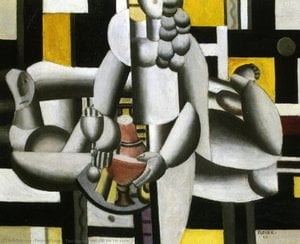
In the vibrant landscape of early twentieth-century modernism, few works capture the rhythmic pulse of a changing world as evocatively as Fernand Léger’s “Pear Compotoerb,” painted in 1923. This is not merely a still life of fruit resting upon a table; it is an audacious declaration of Cubist principles applied to the most mundane of subjects. Created during a period of intense artistic experimentation following the devastation of World War I, the painting embodies a burgeoning fascination with industrialization and its profound influence on human perception. While the Impressionists sought to capture the fleeting, ethereal qualities of light and atmosphere, Léger deliberately confronts the viewer with something far more grounded and structural. He presents a world where the organic and the mechanical begin to merge, inviting us to see the beauty in the geometric and the strength in the simplified form.
To gaze upon this masterpiece is to witness the Cubist breakthrough in its most energetic state. Léger rejects traditional illusionistic techniques that strive for photographic accuracy, opting instead to dissect reality into interlocking planes. The pear itself is rendered not as a soft, yielding object, but as a series of overlapping geometric shapes—a visual puzzle that challenges our ingrained understanding of space. This technique was deeply personal to Léger; it reflected his belief that art should engage with the underlying structure of reality, mirroring the repetitive patterns and angular contours found in the factories and urban landscapes of the burgeoning machine age. By presenting objects from multiple viewpoints simultaneously, he breaks the stagnant Renaissance perspective, creating a sense of movement and depth that feels both modern and revolutionary.
Beyond its structural complexity, “Pear Compotoir” possesses an emotional resonance driven by a strikingly vibrant color palette. Dominated by bold reds, sunny yellows, and lush greens, the hues are far from arbitrary. Léger utilized color strategically to convey energy and dynamism; the reds evoke the heat and intense movement of industrial furnaces, while the contrasting tones create a visual tension that keeps the eye dancing across the canvas. This use of primary and secondary colors serves to celebrate the strength and unapologetic beauty of modern life. For the collector or interior designer, this painting offers more than just a historical window; it provides a powerful focal point capable of injecting vitality into any contemporary space.
The composition—featuring a carefully arranged collection of a bowl of fruit, a cup, a spoon, and a bottle—functions as a study in Tubism, a style pioneered by Léger himself. Characterized by cylindrical, robust forms, this approach finds profound aesthetic truth in the sleek curves and structural integrity of objects. There is a certain poetic weight to the way the chair is positioned in front of the table, grounding the abstract elements within a recognizable domestic setting. This balance between the abstract and the tangible makes the work incredibly accessible, allowing it to resonate with viewers who seek art that is both intellectually stimulating and visually captivating. Owning a high-quality reproduction of this work means bringing a piece of the industrial revolution's heart into one's home—a celebration of progress, form, and the enduring power of the human gaze.


1881 - 1955 , Franța

Explore the profound evolution of Cubist still life, from Cézanne's structural foundations to the fragmented brilliance of Braque and Léger. Discover how geometric abstraction redefined reality through a sophisticated lens of form, color, and modern artistic mastery.

Explore the profound spiritual depth of geometric abstraction. From Malevich's Suprematism to modern masters, our expert guide reveals how pure form and color command presence in fine art collections.

Explore the profound evolution of Neo-Abstract art. Discover how bold geometric forms, vibrant chromatic depth, and tactile textures redefine modern expression for the discerning collector seeking sophisticated, high-impact masterpieces for contemporary interiors.

 Previzualizare
 Trimite
 Distribuie
 Detalii despre lucrare

 Descarcă
 Produse similare
 Radiografie
 Diapozitive automate

 Vezi mai mult







 Opțiunea cu sticlă este disponibilă doar pentru dimensiuni de sub 110 cm