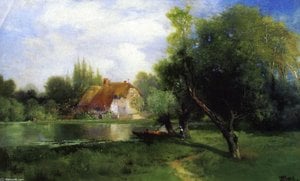
Biografie artist
Early Life and Artistic Beginnings
Eugène Louis Boudin, born in the picturesque coastal town of Honfleur, France, in 1824, was destined to be inextricably linked to the sea from his very first breath. His father, a respected harbor pilot, instilled within him an early and profound appreciation for the ever-changing moods, the dramatic shifts in light, and the captivating beauty of the maritime world—a love that would become the bedrock of Boudin’s artistic vision. Unlike many of his contemporaries who pursued formal academic training, young Eugène embarked on a more unconventional path, beginning his working life at the tender age of ten as a cabin boy aboard a steamboat traversing between Le Havre and Honfleur. It was during these voyages—amongst the rhythmic churn of the paddle wheels and the salty spray of the waves—that he first felt an irresistible compulsion to capture those fleeting, ephemeral impressions of light and water with quick sketches in the margins of his books – the nascent stirrings of a lifelong passion for art. The family’s subsequent move to Le Havre, where his father established a thriving stationery shop and picture-framing business, further immersed Boudin within an artistic environment. He diligently worked alongside his father, eventually branching out to open his own small shop—a venture that brought him into contact with a vibrant community of local artists, including the influential Constant Troyon and Jean-François Millet, who recognized his burgeoning talent and generously encouraged his artistic pursuits. These early encounters proved pivotal, gently steering him away from the confines of commerce and firmly establishing his path towards a dedicated life devoted to painting.
Developing a Unique Style: Plein Air Painting and Influences
Boudin’s artistic development was profoundly shaped by a confluence of key influences—a delicate balance between tradition and innovation. A watershed moment arrived with his introduction to Johan Jongkind, a Dutch painter who passionately championed the revolutionary practice of *en plein air* painting – capturing nature directly from life outdoors. This groundbreaking approach allowed Boudin to translate the ephemeral qualities of light and atmosphere with an unprecedented immediacy and sensitivity. He embraced this technique wholeheartedly, rapidly developing a remarkable skill in rendering the subtle nuances of sky, sea, and shoreline—transforming fleeting moments into enduring works of art. His style also drew inspiration from the masterful techniques of the 17th-century Dutch masters, particularly their meticulous attention to detail, their sophisticated use of atmospheric perspective, and their ability to evoke a profound sense of realism. Boudin’s pastels, characterized by their delicate layering of color and economical brushwork, quickly gained recognition among his peers and critics. The artist's dedication to capturing the essence of light and atmosphere was further solidified through interactions with other prominent figures in the Parisian art scene, including Troyon and Isabey.
Impressionism and Early Recognition
Boudin’s artistic journey intersected with the burgeoning Impressionist movement during a crucial period of transition. While he never fully identified as an “Impressionist” in the strict sense of the term, his work shared many characteristics with this revolutionary style—a focus on capturing fleeting moments, an emphasis on light and color, and a rejection of traditional academic conventions. He participated in the first Impressionist exhibition of 1874, showcasing several of his evocative beach scenes and seascapes alongside Claude Monet, Edgar Degas, and other pioneering artists. This participation marked a significant step towards recognition for Boudin’s innovative approach to painting. Notably, Charles Baudelaire, the celebrated poet and critic, played a pivotal role in elevating Boudin's reputation by praising his ability to convey the essence of a scene with remarkable economy and sensitivity—a testament to the artist’s profound understanding of light and atmosphere. Boudin’s work was lauded for its honesty and directness, capturing the beauty of everyday life with an almost effortless grace.
Major Works and Artistic Themes
Throughout his prolific career, Eugène Boudin produced a vast body of work that is characterized by a deep connection to the sea and coastal landscapes of Normandy—his beloved homeland. “Still Life with Lobster on a White Tablecloth”, now housed at the High Museum of Art in Atlanta, exemplifies his somber yet noble approach to still life painting, imbued with a sense of quiet contemplation and an appreciation for the simple pleasures of life. His beach scenes, populated with figures engaged in leisurely pursuits—fishing, strolling along the shore, or simply basking in the sun—capture the vibrancy and vitality of seaside life with remarkable detail and sensitivity. “Honfleur, the Saint Catherine Market Place” showcases his skill at depicting bustling urban environments bathed in the warm glow of natural light, capturing the energy and dynamism of a thriving port town. Boudin’s paintings consistently explored themes of transience, atmosphere, and the profound interplay between humanity and nature—a reflection of his deep connection to the world around him. He possessed an exceptional ability to convey the subtle shifts in weather and light, creating works that evoke a powerful sense of place and mood, transporting the viewer directly into the heart of the scene.
Final Years and Enduring Legacy
In his later years, Boudin continued to travel extensively, seeking inspiration in Belgium, the Netherlands, and southern France—each journey enriching his artistic vision and expanding his repertoire of subjects. He also made several visits to Venice, captivated by its unique light, its intricate architecture, and its timeless beauty. Despite facing increasing health challenges, he remained remarkably productive, consistently exhibiting his work, mentoring younger artists, and refining his distinctive style. Eugène Louis Boudin passed away in 1898 at Deauville, overlooking the English Channel that had so profoundly shaped his life and art—a fitting end for a man who dedicated his entire existence to capturing its beauty on canvas. His legacy extends far beyond his own paintings; the Eugène Boudin Prize, awarded by the Société Nationale des Beaux-Arts, stands as a lasting tribute to his enduring influence on generations of artists—a testament to his profound contribution to French art and culture. Today, his works are celebrated in museums across the globe, including the Musée d’Orsay in Paris, where several of his most iconic paintings—such as “Landscape with Sunset”—are proudly displayed for all to admire. Boudin's remarkable career serves as a powerful reminder of the transformative power of observation, the enduring beauty of nature, and the timeless allure of the sea.



 Vezi în context
 Comandă pictură realizată manual
 Trimite
 Distribuie
 Detalii

 Descarcă
 Produse similare
 Radiografie
 Diaporama
 Statistici

 Citește mai mult






































 Opțiunea cu sticlă este disponibilă doar pentru dimensiuni de sub 110 cm