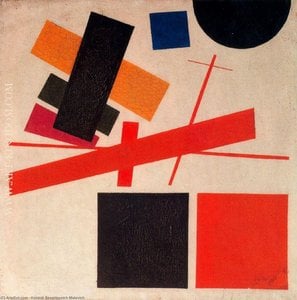
El Lissitzky's "Wendingen": A Geometric Symphony of Form and Space
El Lissitzky’s “Wendingen,” created in 1921, is a striking example of early abstract art, deeply rooted in the Constructivist and Suprematist movements. This artwork isn't merely a painting but a cover design for the Dutch magazine "Wendingen," dedicated to modern architecture and design. It embodies Lissitzky’s vision of “Proun,” a concept aiming to synthesize architecture, engineering, and art into a dynamic visual language.
Subject Matter & Style: A Dialogue Between Geometry and Dynamism
The artwork eschews representational imagery, instead presenting a purely abstract composition of geometric forms. Sharp angles, intersecting lines, and flat planes dominate the canvas, creating a sense of structured dynamism. Rectangles, circles, and diagonal lines interact to generate spatial tension and visual pathways.
“Wendingen” clearly reflects the principles of Constructivism, emphasizing functional design and geometric abstraction. It also draws from Suprematism, Malevich’s movement focused on pure artistic feeling through basic geometric forms. Lissitzky's unique approach integrates these influences, creating a style that is both rigorously structured and emotionally resonant.
The piece was designed as a cover for a magazine dedicated to modern architecture. This context highlights the artwork’s purpose: not just aesthetic beauty but also communication and visual impact within a design-focused publication. The stylized lettering of “WENDINGEN” integrated into the composition further emphasizes this functional aspect.
Technique & Materials: Precision and Clarity
Lithography, a printing technique that allows for precise lines and tonal variations, was ideal for reproducing the artwork’s sharp geometric forms and limited color palette. Lissitzky employed lithography on paper.
The color scheme is deliberately restrained, featuring strong contrasts between red, gray, black, and beige against a neutral background. This simplicity enhances the clarity of the geometric shapes and prevents visual clutter. The texture appears smooth and flat, characteristic of a printed surface.
Historical Context & Symbolism: A Vision for a New Era
Created in 1921, “Wendingen” emerged from the aftermath of World War I and the Russian Revolution. It reflects the era’s desire for radical change and innovation across all fields – art, architecture, and society.
“Proun” concept aimed to transcend traditional artistic boundaries by uniting art, technology, and architecture. “Wendingen” serves as a visual manifestation of this ambition, suggesting a harmonious integration of these disciplines.
The artwork’s geometric forms can be interpreted as symbols of progress, order, and the potential for a new, rational world. The dynamic arrangement of shapes suggests movement and energy, reflecting the optimism and forward-looking spirit of the early 20th century.
Emotional Impact & Legacy: A Timeless Expression of Modernity
Despite its abstract nature, “Wendingen” evokes a sense of visual harmony and balance. The carefully arranged geometric forms create a pleasing composition that is both intellectually stimulating and aesthetically satisfying.
Lissitzky’s work has had a lasting impact on graphic design, typography, and architectural aesthetics. “Wendingen” remains an iconic example of early modernism, inspiring generations of artists and designers.
Photo Description: --Overall Impression-- The artwork is a geometric abstract composition dominated by sharp angles and flat planes. It’s a square format painting with a predominantly beige background that serves as a neutral stage for the bold shapes and colors. The piece exemplifies Cubist and Constructivist influences, prioritizing form and structure over realistic representation. Compositionally, it's highly structured, utilizing intersecting lines and right angles to create a sense of dynamism and spatial tension. The subject matter is purely abstract; there are no recognizable objects or figures. Lines are used extensively – straight, diagonal, and slightly curved – defining the edges of the shapes and creating visual pathways across the canvas. Shapes are primarily rectangular and circular, with a strong emphasis on geometric precision. The texture appears smooth and flat, indicative of a printed surface rather than a sculpted one. Lighting is even and diffused, lacking any dramatic shadows or highlights. Perspective is deliberately flattened, eliminating traditional depth cues. Depth is achieved through overlapping planes and the suggestion of receding lines, but it’s not realistically rendered. The color palette is limited yet impactful, featuring strong contrasts between red, gray, black, and beige. The lettering ‘WENDINGEN’ in a stylized serif font is integrated into the composition on the left side. Symbolically, the artwork likely represents an exploration of form, structure, and spatial relationships – core tenets of early 20th-century abstraction. The technique appears to be primarily brushwork with a focus on clean lines and precise shapes. Materials used are likely oil paints on canvas.
Size: Unknown
Date: 1921
ARTIST INFORMATION:
==================
Artist: El Lissitzky
Birth Year: 1890
Death Year: 1941
Birth City: Pochinki
Birth Country: Russia
Biography:
A Revolutionary Vision: The Life and Art of El Lissitzky
El Lissitzky, born Lazar Markovich Lissitzky in 1890 in Pochinok, a small Jewish community 50 kilometres (31 mi) southeast of Smolensk, Russian Empire. His father Mordukh (Mark) Zalmanov was well-educated travel agent who knew English and German languages, “in his spare time he translated Heine and Shakespeare”. He emigrated to America, but returned to Russia as his wife's rabbi advised against emigration. Lissitzky's mother Sarah strictly observed Jewish religious traditions. From 1891 to 1898 Lissitzky's family lived in Vitebsk, where Lazar's brother and sister were born.
Întrebări și răspunsuri
La ce vârstă a creat El Lissitzky opera „Wendingen”?
El Lissitzky avea 31 ani când a creat "Wendingen" în 1921. Vârsta este calculată pe baza anului nașterii artistului, 1890.
Cum se corelează culorile din "Wendingen" de El Lissitzky cu emoția transmisă de aceasta?
În "Wendingen", culorile Tonalități pământii acompaniază o senzație Reflectivă.
Ce culoare domină compoziția lucrării "Wendingen" de El Lissitzky?
Cachi (#e6c596) este culoarea dominantă a operei "Wendingen" de El Lissitzky.
Din ce epocă datează "Wendingen"?
Perioada istorică a operei "Wendingen" de El Lissitzky este Era modernă. Această clasificare plasează lucrarea în contextul istoriei artei.
Cine este artistul din spatele "Wendingen"?
Artistul din spatele operei „Wendingen” este El Lissitzky. Lucrarea este catalogată sub numele lui El Lissitzky.
În ce an a fost creată "Wendingen" de El Lissitzky?
Crearea operei "Wendingen" de El Lissitzky datează din 1921.
Unde pot vedea o previzualizare a „Wendingen”?
Pentru a vizualiza o previzualizare a unei reproduceri a operei "Wendingen" de El Lissitzky, accesați pagina Previzualizare a lucrării.



 Vezi în context
 Comută pe versiunea Print
 Trimite
 Distribuie
 Detalii
 Ghidul

 Descarcă
 Produse similare
 Radiografie
 Diaporama
 Statistici


 Citește mai mult






































 Opțiunea cu sticlă este disponibilă doar pentru dimensiuni de sub 110 cm