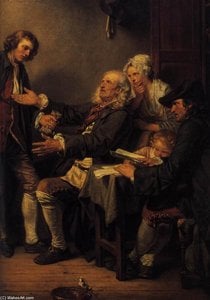
Edward Bird: A Pioneer of Naturalistic Painting
Edward Bird (1772 – 1819) stands as a singular figure in British art history, primarily recognized for his pivotal role in establishing the Bristol School and his distinctive approach to blending genre painting with historical themes. Born in Wolverhampton, amidst the burgeoning industrial landscape of Staffordshire, Bird’s artistic journey commenced not within formal academies but rather within the practical framework of his father's carpentry trade—a formative experience that instilled a meticulous attention to detail and an unwavering dedication to craftsmanship. This early grounding would prove instrumental in shaping his subsequent artistic endeavors.
- Early Influences: Bird’s initial artistic inclinations were nurtured by the precision demanded by japanning, the decorative art of applying enamel paint onto tea trays—a technique that instilled a profound appreciation for meticulous execution and textural nuance.
- George Cumberland's Patronage: Crucially, Bird benefited from the generosity of George Cumberland, an influential art collector and connoisseur whose expansive library served as a conduit to artistic inspiration drawn from the Old Masters. Cumberland’s unwavering belief in Bird’s talent fostered intellectual curiosity and broadened his understanding of artistic traditions.
- Sir David Wilkie's Rivalry: Like many artists of his time, Bird engaged in a spirited rivalry with Sir David Wilkie—a celebrated genre painter whose stylistic dominance challenged Bird to forge his own path. Despite this competitive dynamic, their relationship evolved into one of mutual respect and admiration for each other’s artistic vision.
The Bristol School: Collaboration and Innovation
Bird's artistic trajectory gained momentum in Bristol, where he joined forces with a cohort of fellow artists—Edward Villiers Rippingille, Nathan Cooper Branwhite, John King, and Thomas Stothard—forming what would become known as the Bristol School. This informal collective transcended conventional academic boundaries, fostering an environment characterized by spirited debate and reciprocal encouragement. The Bristol School championed a distinctive naturalistic style, prioritizing fresh color palettes and astute observation of everyday life—a stylistic hallmark that profoundly impacted subsequent generations of artists. Regular evening sketching sessions and excursions into the surrounding countryside nurtured both technical skill and a shared artistic ethos. Notably, Bird’s collaboration with Francis Danby solidified the school's reputation for capturing the essence of British landscapes and fostering a collective pursuit of artistic excellence.
Historical Painting: Capturing Dramatic Narrative
Recognizing his burgeoning talent in historical painting—a genre demanding both technical virtuosity and compelling storytelling—Bird embarked on ambitious projects that showcased his ability to convey emotion and dynamism. His most celebrated works included “The Field of Chevy Chase,” “The Day After the Battle,” and “The Crucifixion”—each meticulously rendered with painstaking detail and imbued with palpable dramatic intensity. These paintings cemented Bird’s legacy as a master of genre and history painting, establishing him as one of Britain's foremost artistic voices during his era.
Legacy and Artistic Style
Edward Bird’s enduring influence extends beyond the aesthetic beauty of his canvases—it resides in his pioneering role in shaping the Bristol School’s stylistic trajectory and fostering a tradition of naturalistic representation that continues to resonate with artists today. His meticulous attention to detail, combined with his masterful use of color and composition, ensured that his paintings would endure as timeless expressions of artistic vision. Bird's legacy is cemented by his election as Associate of the Royal Academy in 1812 and Full Member in 1815—honors bestowed upon him for his exceptional contribution to British art history.



 Vezi în context
 Comută pe versiunea Print
 Trimite
 Distribuie
 Detalii
 Ghidul

 Descarcă
 Produse similare
 Radiografie
 Diaporama
 Statistici
 Citește mai mult






































 Opțiunea cu sticlă este disponibilă doar pentru dimensiuni de sub 110 cm