A Dance of Psyche and Eros: Exploring Munch’s Intimate Vision
This captivating work by Edvard Munch, titled *Amor och Psyche*, delves into the timeless myth of Cupid (Amor) and Psyche, a story steeped in allegory about love, loss, and the journey to self-discovery. Rendered with the hallmarks of Expressionism, the painting presents not a literal depiction of the classical tale, but rather an intensely emotional interpretation of its core themes. The composition focuses on two figures locked in a close embrace – or perhaps a moment of fraught tension – their forms elongated and somewhat indistinct, contributing to a sense of vulnerability and mystery. Munch eschews precise representation for expressive power, prioritizing the conveyance of inner states over outward appearances.
Expressionistic Technique & Emotional Resonance
Munch’s technique is immediately striking. The artwork is characterized by loose, gestural brushstrokes and a dynamic layering of paint that creates a palpable texture. This tactile quality draws the viewer in, inviting them to experience the raw emotion embedded within the canvas. The color palette – dominated by warm oranges, browns, and blacks – evokes both passion and melancholy. These hues swirl around the figures, creating a chaotic yet compelling atmosphere. The flattened perspective further intensifies the emotional impact, eliminating spatial depth and focusing attention solely on the interaction between the two subjects.
This is not merely a painting; it’s an embodiment of feeling. The obscured faces are particularly poignant, suggesting hidden identities or perhaps the internal struggles that often accompany love and intimacy.
Munch & The Weight of Human Experience
To understand *Amor och Psyche*, one must consider Edvard Munch's life and artistic philosophy. Born in 1863, Munch endured profound personal tragedies – the early deaths of his mother and sister from tuberculosis, and a lifelong fear of inherited mental illness. These experiences profoundly shaped his worldview and fueled his art with themes of mortality, anxiety, and psychological distress. As a pioneer of Expressionism, Munch rejected traditional artistic conventions in favor of expressing subjective emotions.
He sought to depict not what he saw, but what he felt. This painting exemplifies that approach, offering a glimpse into the complexities of human relationships and the enduring power of myth as a vehicle for exploring universal truths. The work resonates with Munch’s broader oeuvre, echoing the emotional intensity found in his most famous piece, *The Scream*.
Symbolism & Interior Design Considerations
Beyond its immediate emotional impact, *Amor och Psyche* is rich in symbolic meaning. The myth itself represents the soul's (Psyche’s) arduous journey to love and enlightenment, overcoming obstacles and ultimately achieving union with Eros. In Munch’s interpretation, this journey appears fraught with difficulty, hinting at the challenges inherent in any intimate connection.
- The swirling background can be interpreted as representing the turbulent emotions that often accompany love.
- The obscured faces suggest a loss of identity or a struggle for self-discovery within the relationship.
- The warm color palette, while inviting, also carries undertones of passion and potential pain.
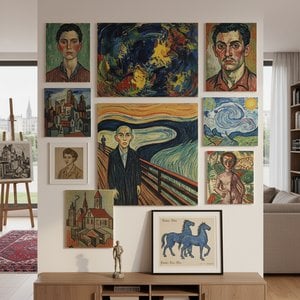
As an interior design element, a high-quality reproduction of this artwork would add depth and sophistication to any space. Its dramatic composition and emotive power make it a compelling focal point for living rooms, bedrooms, or studies. The warm color palette complements a variety of décor styles, from modern minimalist to bohemian chic. It’s a piece that invites contemplation and sparks conversation – a true testament to the enduring legacy of Edvard Munch.



 Previzualizare
 Comută pe Print
 Trimite
 Distribuie
 Detalii despre lucrare

 Descarcă
 Produse similare
 Radiografie
 Diapozitive automate
 Statistici

 Vezi mai mult






































 Opțiunea cu sticlă este disponibilă doar pentru dimensiuni de sub 110 cm