CONSULTAȚIE GRATUITĂ ÎN ARTE VIZUALE

x
Comandă reproducere pictată Comandă reproducere pictatăCumpără imaginea Cumpără imaginea TrimiteTrimite
DetailsDetails Adaugă la favorite Adaugă la favorite DescarcăDescarcă SimilareSimilare X-RayX-Ray DiaporamaDiaporama

Perseus and Andromeda

Experience Rococo elegance with Charles-André van Loo's Perseus and Andromeda, a graceful mythological triumph from the 18th century; discover this masterpiece today.

Descoperă arta lui Charles-André van Loo (Carle van Loo), pictor rococo influent în Franța secolului XVIII. Celebrare eleganță și detalii bogate în portrete, scene mitologice și aristocrație! Vizualizează operele sale originale pe WahooArt!

Giclée / Imprimare artistică

Print giclée sau pe canvas de calitate muzeală, cu producție rapidă și opțiuni flexibile de finisare.

P118B $10
P118H $10
P118W $10
P438Z $10
P508JH $12
P508YH $12
P805H $10
P805Z $10
P919BZ $10
P919G $10
P919XJ $10
P959ZH $10
P968JZ $12
W106C $8
W218G $10
W218JH $8
W218Y $10
W307PJ $10
W316G $10
W316PJ $8
W316Y $10
W398PJ $8
W4111J $10
W500HY $15
W500JH $15
W692G $12
W849H $8
W940BG $15
W953PJ $8

Standard
custom
CM
INCH

Alegeți dintre dimensiunile noastre prestabilite, care respectă proporțiile originale ale operei de artă.

lățime
înălțime

Puteți introduce propriile dimensiuni pentru a se potrivi unui anumit cadru sau spațiu. Dacă dimensiunea selectată nu corespunde proporțiilor imaginii originale, vom decupa lucrarea de artă sau vom extinde imaginea cu margini oglindite sau cu o culoare uniformă. Un mockup digital va fi trimis pentru aprobarea dumneavoastră înainte de începerea producției.
Vă rugăm să rețineți că previzualizarea de pe ecran nu reflectă decuparea sau extinderea reală. Doar mockup-ul va arăta cu exactitate compoziția finală.
Deși dimensiunile personalizate sunt disponibile, vă recomandăm să selectați o dimensiune din lista predefinită pentru a păstra proporțiile originale.

Livrare în întreaga lume () în 2 săptămâni, în loc de cele 4/5 săptămâni standard. (2 Iulie)

why_choose_icon
Livrare expres gratuită la nivel mondial
why_choose_icon
Pânză de in de înaltă calitate
why_choose_icon
Asigurare completă pentru transport
why_choose_icon
Garanție de rambursare a taxelor vamale
why_choose_icon
Garanția fidelității culorilor
why_choose_icon
Politica de retur de 60 de zile (doar pentru defecte)
why_choose_icon
Garanție 100% de rambursare
why_choose_icon
Reducere la comenzi multiple

Preț total

-

reproduction

Perseus and Andromeda

Giclée / Imprimare artistică

Dimensiune reproducere

-

Preț total calculat

-

Informații rapide

  • Subject or theme: Mythology; Heroic Narrative
  • Title: Perseus and Andromeda
  • Artistic style: Elegant Rococo
  • Medium: Oil on canvas
  • Artist: Charles-André van Loo
  • Movement: Rococo
  • Location: Private Collection

Test de cunoștințe despre artă

Fiecare întrebare are un singur răspuns corect.

Întrebare 1:
What mythological story is depicted in Charles-André van Loo’s ‘Perseus and Andromeda’?
Întrebare 2:
Charles-André van Loo’s style is primarily associated with which artistic movement?
Întrebare 3:
The painting portrays Perseus as slaying what creature?
Întrebare 4:
What artistic technique is prominently used in ‘Perseus and Andromeda’ to convey elegance and grandeur?
Întrebare 5:
In what historical period was Charles-André van Loo active as a painter?

Descriere obiect de colecție

Perseus and Andromeda: A Triumph of Mythological Grace

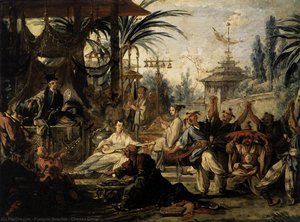
Charles-André van Loo’s “Perseus and Andromeda” stands as a quintessential emblem of Rococo artistry—a visual feast celebrating aristocratic grandeur and imbued with profound mythological symbolism. Painted circa 1740, this monumental canvas captures the heroic tale of Perseus slaying Medusa to rescue Andromeda from the monstrous Cetus, cementing its place within the artistic canon of Louis XV’s reign.

  • Subject Matter: The painting meticulously portrays the dramatic confrontation between Perseus and Medusa. Perseus, depicted with unwavering resolve, wields his sword against the Gorgon’s serpentine gaze—a symbol of terror and transformation—while Andromeda lies vulnerable at Cetus's feet, awaiting deliverance. Supporting figures underscore the narrative’s importance, highlighting divine intervention and human courage.
  • Style: Van Loo’s masterful command of Rococo style is immediately apparent. The composition exudes elegance and fluidity, prioritizing decorative ornamentation over strict realism. Delicate pastel hues dominate the palette—primarily blues and golds—creating an atmosphere of ethereal beauty and conveying a sense of aristocratic refinement characteristic of the period.
  • Technique: Executed with meticulous brushwork and layering of glazes, Van Loo’s technique exemplifies the Rococo penchant for textural richness. The artist skillfully captures the dynamism of the scene through subtle movements and drapery folds, enhancing the visual impact and conveying a palpable sense of drama. Attention to detail extends beyond mere representation; it aims to evoke emotion and immerse the viewer in the narrative's unfolding events.
  • Historical Context: Commissioned during Louis XV’s opulent court, “Perseus and Andromeda” reflects the prevailing artistic tastes of the era—a desire for idealized beauty and a fascination with classical mythology. The painting served as a powerful visual statement reinforcing royal authority and glorifying heroic deeds.
  • Symbolism: Beyond its narrative depiction, the artwork resonates with deeper symbolic meanings. Perseus embodies courage and intellect, overcoming formidable obstacles through cunning and bravery—values revered by the French monarchy. Andromeda represents innocence and vulnerability, rescued from peril by divine grace—a motif frequently employed in Rococo art to convey moral virtue.

A hand-painted reproduction of “Perseus and Andromeda” offers an unparalleled opportunity to experience the sublime artistry of Charles André van Loo. Its luminous colors, intricate detailing, and evocative composition continue to inspire admiration and captivate collectors worldwide. Bring this masterpiece into your home or office and immerse yourself in the timeless beauty of Rococo art.

Opere de artă similare


Biografie artist

Early Life and Training

Charles André van Loo, born February 15, 1705, in Nice, France, was the youngest son of Louis-Abraham van Loo, a celebrated Dutch painter who had established himself in France during the Baroque era. His elder brother, Jean Baptiste van Loo, equally accomplished and influential, nurtured his artistic talent from an early age, shaping him into one of the foremost figures of the Rococo movement. The family’s lineage traced back to Jacob van Loo, a Flemish artist who had emigrated to Amsterdam in the seventeenth century, marking them as inheritors of a rich artistic tradition. Initially trained in Turin under Benedetto Luti—a renowned sculptor and teacher—van Loo continued his studies in Rome during 1712-1714, immersing himself in the vibrant intellectual and artistic atmosphere of the papal city. He benefited immensely from the tutelage of Pierre Legros, a master of disegno (drawing) who instilled in him meticulous observation skills and an unwavering commitment to classical principles. These formative years laid the groundwork for his distinctive style—characterized by elegance, grace, and painstaking detail—which would define his entire artistic career. Returning to Paris in 1723, van Loo swiftly ascended the ranks of the Académie royale de peinture et de sculpture, securing first prize for drawing—a prestigious honor that signaled his prodigious talent. This achievement cemented his position as one of the academy’s brightest pupils and foreshadowed his future success as a historical painter. The Académie's curriculum emphasized humanist ideals and artistic virtuosity, fostering a generation of artists dedicated to elevating art as a reflection of human intellect and beauty.

Artistic Career and Notable Works

Charles André van Loo quickly established himself as a prolific artist, tackling diverse subjects with unwavering dedication—portraits, mythological scenes, historical narratives, allegories, and genre depictions—all rendered in the opulent style emblematic of Rococo. His artistic vision was profoundly influenced by his father’s legacy, particularly Jean Baptiste’s masterful handling of light and color, as well as his brother’s profound understanding of composition and theatricality. Among van Loo's most celebrated achievements are monumental canvases that capture pivotal moments in European history—most notably *Halt of the Hunt*, commissioned by King Louis XV to commemorate a royal hunt, which exemplifies the grandeur and dynamism characteristic of the Rococo aesthetic. Equally impressive is his depiction of Marie Leszczynska, Queen of France, portraying her with regal dignity and capturing the subtleties of aristocratic portraiture. Furthermore, he produced breathtaking mythological paintings—such as *Jupiter and Antiope*, demonstrating an exceptional grasp of classical iconography and artistic technique—and captivating genre scenes that offer glimpses into everyday life amidst lavish ornamentation. His oeuvre includes masterpieces like *Venus and Amor*, a sensual portrayal of divine love executed with exquisite delicacy and color harmony; *Perseus and Andromeda*, illustrating the heroic tale of Perseus slaying Medusa to rescue Andromeda from sea monsters, showcasing his skill in conveying narrative emotion through visual imagery; and *Mademoiselle Clairon as Medea*, a miniature portrait imbued with dramatic intensity—a testament to van Loo’s ability to distill complex emotions into compact compositions. Moreover, he achieved international renown for his engravings—particularly *The Rape of Proserpine*, which became one of the most popular prints of its time and solidified his reputation as a master printmaker. His artistic versatility extended beyond painting and engraving; he designed elaborate decorations for royal palaces and contributed significantly to the embellishment of Parisian interiors, shaping the visual landscape of the Enlightenment era.

Patronage and Royal Recognition

Charles André van Loo enjoyed considerable patronage from influential figures—including Madame de Pompadour, Louis XV’s mistress—who recognized his artistic genius and commissioned him to undertake ambitious projects. This royal favor elevated his social standing and ensured that his work would be showcased in the most prestigious venues of the court. In 1762, he was appointed First Painter to King Louis XV—a position of immense prestige and responsibility—reflecting the monarchy’s unwavering faith in his artistic talent and securing him a prominent place among the leading artists of his time. His dedication to duty and excellence earned him the Order of Saint Michael—a symbol of royal honor—affirming his contribution to French culture and acknowledging his unwavering commitment to upholding artistic standards. Throughout his life, van Loo remained steadfast in his pursuit of artistic perfection, producing a vast body of work that continues to inspire admiration for its beauty and technical mastery.

Influences and Legacy

Van Loo’s artistic sensibilities were shaped by the prevailing intellectual currents of his era—particularly the humanist philosophy championed by Descartes and Leibniz—which emphasized reason and observation as pathways to understanding the natural world. He drew inspiration from classical art and literature, adopting techniques honed by Michelangelo Buonarroti and Raphael Sanzio—masters who had established new paradigms for artistic expression. Despite facing competition from fellow Rococo artists like François Boucher—who possessed a distinctive style characterized by softer brushstrokes and pastel hues—van Loo maintained his own unwavering aesthetic vision. His meticulous attention to detail, combined with an innate understanding of composition and theatricality, profoundly influenced the modern French school of painting—establishing him as one of its foremost proponents and securing his enduring legacy as a pivotal figure in European art history.
Charles André van Loo

Charles André van Loo

1705 - 1765 , Franța

Detalii rapide

  • Artistic Movement Or Style: Rococo painting
  • Artists Or Movements Influenced By This Artist: ['Modern French school']
  • Artists Who Influenced This Artist:
    • Benedetto Luti
    • Pierre Le Gros
  • Date Of Birth: Feb 15, 1705
  • Full Name: Charles-André van Loo
  • Nationality: French
  • Notable Artworks:
    • Venus and Amor
    • Halt of the Hunt
    • Portrait of Marie Leszczynska
    • Jupiter and Antiope
    • Self Portrait
  • Place Of Birth: Nice, France
Explorați opere de artă organizate pe teme, stiluri și caracteristici.