Michelangelo Merisi da Caravaggio: A Window Into Suffering
Michelangelo Merisi da Caravaggio, universally known as Caravaggio (1571–1610), stands as one of the most influential figures in Baroque painting—a movement that revolutionized artistic expression and captivated audiences across Europe. Born in Milan amidst a period marked by plague and familial loss, Caravaggio’s formative years instilled within him an unwavering empathy for human vulnerability and resilience—themes that would permeate his canvases throughout his prolific career.
His early artistic training under Simone Peterzano, a former pupil of Titian, provided him with foundational knowledge of Renaissance technique. However, it was in Rome, arriving around 1592, where Caravaggio truly blossomed, forging an unparalleled path that defied convention and established his distinctive style as the cornerstone of Baroque art.
- Early Milanese Period (1576–1592): Caravaggio’s father, Fermo Merixio, served as household administrator to the marquess of Caravaggio, shaping young Michelangelo's worldview amidst a backdrop of aristocratic patronage and artistic fervor.
- The Apprenticeship: His four-year apprenticeship with Peterzano honed his skills in perspective and idealized representation—a deliberate contrast to the Mannerist preoccupation with illusionism that dominated the art scene at the time.
- Rome – The Crucible of Genius: Caravaggio’s arrival in Rome coincided with a surge of artistic innovation, exposing him to luminaries like Titian and Giorgione, fostering his fascination for naturalistic detail and influencing his stylistic choices.
Caravaggio's revolutionary approach to painting centered on *tenebrism*, a technique characterized by dramatic contrasts between light and darkness—a masterful manipulation of chiaroscuro that elevated realism beyond mere visual accuracy. He eschewed meticulous preparatory sketches, preferring to work directly onto the canvas with rapid brushstrokes, capturing fleeting moments of emotion and psychological intensity.
His subjects were often drawn from biblical narratives and mythological tales, yet Caravaggio imbued them with palpable human drama—a profound engagement with the complexities of faith, morality, and suffering. Unlike his contemporaries who sought to portray idealized figures or grand historical events, Caravaggio focused on portraying ordinary individuals grappling with extraordinary circumstances.
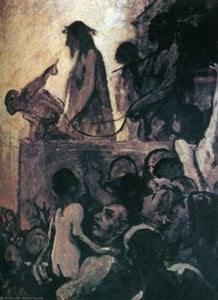
Consider *Ecce Homo*, arguably Caravaggio’s most iconic work. Painted circa 1605/06 or 1609 and currently residing in the Palazzo Bianco of Genoa, this arresting image transcends mere depiction; it's a profound meditation on human emotion, faith, and the unsettling nature of power.
The painting’s impact stems from Caravaggio’s masterful use of chiaroscuro—a technique that sculpts light and shadow with breathtaking precision. Notice how the illumination concentrates upon Jesus’s face and torso, highlighting his wounds and conveying an expression of sorrowful acceptance. The enveloping darkness amplifies the drama, creating a theatrical atmosphere that compels viewers to confront the moral ambiguities inherent in the scene.
Beyond its visual splendor, *Ecce Homo* is rich in symbolism—the crown of thorns representing Christ’s suffering during crucifixion; the man holding him down embodying Pilate's complicity and the crowd’s demand for execution. Caravaggio’s deliberate choice of composition and his unflinching portrayal of human vulnerability underscore the painting’s enduring relevance as a commentary on power, guilt, and redemption.
Caravaggio’s legacy extends far beyond his artistic innovations—he fundamentally altered the conventions of Baroque painting, inspiring generations of artists to embrace dramatic lighting and psychological realism. His influence can be discerned in the works of Rubens, Ribera, Bernini, Velázquez, and Rembrandt—artists who recognized Caravaggio as a prophet of their own time.
The Palazzo Bianco’s display of *Ecce Homo* offers an unparalleled opportunity to experience Caravaggio's genius firsthand—a testament to his enduring ability to provoke contemplation and inspire awe. Reproductions strive to capture only a fraction of the original painting’s transformative power, inviting viewers to engage with its profound exploration of human suffering and faith.
Întrebări și răspunsuri
Pot viziona "Ecce Homo" sub formă de diaporama cu ecran întreg?
Diaporama pentru "Ecce Homo" poate fi vizualizată pe pagina Diapozitive a operei de artă.
Care sunt tehnica și data creației pentru "Ecce Homo" de Caravaggio?
„Ecce Homo” a fost creat în 1606 folosind tehnica Ulei pe pânză. Materialul și data descriu modul și momentul în care a fost realizată originalul.
Care este formatul pentru "Ecce Homo"?
"Ecce Homo" de Caravaggio este o compoziție de tip Portret. Proporțiile merită verificate înainte de a alege dimensiunea printului.



 Vezi în context
 Comandă pictură realizată manual
 Trimite
 Distribuie
 Detalii
 Ghidul

 Descarcă
 Produse similare
 Radiografie
 Diaporama
 Statistici


 Citește mai mult






































 Opțiunea cu sticlă este disponibilă doar pentru dimensiuni de sub 110 cm