


Printuri giclée sau pe canvas de calitate muzeală, cu proces de producție rapid și opțiuni flexibile de finisare. ( Comandă pictură lucrată manual Cumpără imaginea)





























Alegeți dintre dimensiunile noastre prestabilite, care respectă proporțiile originale ale operei de artă.

Puteți introduce propriile dimensiuni pentru a se potrivi unui anumit cadru sau spațiu. Dacă dimensiunea selectată nu corespunde proporțiilor imaginii originale, vom decupa lucrarea de artă sau vom extinde imaginea cu margini oglindite sau cu o culoare uniformă. Un mockup digital va fi trimis pentru aprobarea dumneavoastră înainte de începerea producției.
Vă rugăm să rețineți că previzualizarea de pe ecran nu reflectă decuparea sau extinderea reală. Doar mockup-ul va arăta cu exactitate compoziția finală.
Deși dimensiunile personalizate sunt disponibile, vă recomandăm să selectați o dimensiune din lista predefinită pentru a păstra proporțiile originale.
Livrare în întreaga lume () în 2 săptămâni, în loc de cele 4/5 săptămâni standard. (6 Septembrie)


untitled (453)
Dimensiune reproducere
Amedeo Modigliani's 'Untitled (453)' is not merely a portrait; it’s an embodiment of profound sadness and quiet contemplation, a quintessential expression of the artist’s signature style. The painting immediately arrests the viewer with its stark simplicity – a man in a top hat and red beard, his face rendered with Modigliani's instantly recognizable elongated features and subtly slanted eyes. This isn’t a celebratory depiction; rather, it’s a study in vulnerability, captured through a carefully considered composition and a masterful manipulation of light and shadow. The black background serves not as an absence but as a deliberate intensification of the subject’s presence, drawing all attention to his expressive face and the palpable weight of his emotion.
Born in Livorno in 1884, Amedeo Modigliani’s life was tragically short but intensely productive. His artistic journey was profoundly shaped by a complex interplay of personal hardship – recurring illnesses and financial instability – and an intellectual environment steeped in the works of Nietzsche, Baudelaire, and Lautréamont. These influences fueled his desire to break from academic conventions, leading him to develop a highly individual style characterized by elongated figures, stylized features, and a haunting sense of melancholy. ‘Untitled (453)’ exemplifies this perfectly; it’s a distillation of Modigliani's preoccupation with the human condition – specifically, the experience of loneliness and yearning that permeated his art.
Modigliani’s technique is immediately apparent in the painting’s smooth, almost porcelain-like surface. He employed a layering method, building up thin glazes of oil paint to achieve this luminous effect. The brushwork is delicate yet precise, particularly evident in the rendering of the man's facial features – the subtle curve of his nose, the firm line of his mouth, and the expressive intensity of his eyes. The composition itself is remarkably balanced, with the subject occupying a significant portion of the frame from left to right, creating an intimate and almost claustrophobic effect. This deliberate restraint amplifies the emotional impact of the image.
'Untitled (453)' resonates deeply because it taps into universal themes of isolation and introspection. The red beard, a recurring motif in Modigliani’s work, can be interpreted as a symbol of passion or perhaps even mourning. The man's sad expression invites the viewer to contemplate their own experiences with loss and longing. The overall effect is one of quiet dignity amidst profound sadness – a testament to Modigliani’s ability to capture the essence of human emotion with remarkable sensitivity. This painting speaks volumes about the artist's personal struggles, offering a poignant glimpse into his soul.
Artist: Amedeo Clemente Modigliani (1884-1920)
Amedeo Clemente Modigliani, a name synonymous with haunting beauty and melancholic grace, remains one of the most beloved and tragically romantic figures of early 20th-century art. Born in Livorno, Italy, in 1884 into a family steeped in Sephardic Jewish heritage, his life was marked by both profound artistic vision and persistent hardship. Frequent illness shadowed his youth – pleurisy and typhoid fever became unwelcome companions – perhaps instilling within him a sensitivity to fragility that would permeate his work.
Though born into relative comfort, the family’s financial fortunes waned, adding another layer of complexity to the young Modigliani's formative years. It was a childhood punctuated by intellectual stimulation, thanks to his mother and grandfather who introduced him to the works of Nietzsche, Baudelaire, and Lautréamont, laying the groundwork for an artistic sensibility that would reject conventional norms.
The pull of Paris proved irresistible, and in 1906, Modigliani embarked on a journey that would define his career. The city was then a crucible of artistic innovation, teeming with revolutionary ideas and challenging conventions. He immersed himself in the vibrant art scene, encountering giants like Pablo Picasso and Constantin Brâncuși, figures who profoundly shaped his aesthetic trajectory. Initially drawn to the burgeoning Cubist movement, Modigliani quickly found its rigid geometry too constricting for his expressive needs. His artistic spirit yearned for something more lyrical, more deeply rooted in human emotion.
He began a period of intense experimentation, absorbing influences from African sculpture – particularly its elongated forms and simplified features – and the archaic grace of Italian Renaissance art. This fascination with African art would become a cornerstone of his distinctive style, informing his sculptural endeavors and shaping his artistic vision.
Modigliani’s signature style emerged as a unique synthesis of these diverse inspirations. His portraits, arguably his most celebrated works, are instantly recognizable for their elongated faces and necks, almond-shaped eyes devoid of pupils, and an overall sense of serene melancholy. These were not merely likenesses; they were explorations of the inner life, capturing a profound psychological depth in each subject. He stripped away extraneous detail, focusing on essential forms to convey emotion with remarkable economy.
His nudes, often controversial during his lifetime, possess a similar quality – a quiet dignity and vulnerability that transcends mere physical representation. The figures are not overtly sensual but rather imbued with a sense of timeless beauty and existential longing. Modigliani’s masterful manipulation of line—a technique he honed through meticulous observation and relentless practice—became synonymous with his artistic idiom.
Modigliani’s personal life was as turbulent as his artistic journey. He struggled with poverty and addiction throughout much of his career, often relying on the generosity of friends and patrons. His relationship with Jeanne Hébuterne, a young artist herself, became the central emotional anchor in his life. They shared a deep love and mutual artistic understanding, but their happiness was tragically short-lived.
The pressures of poverty, Modigliani’s declining health, and Jeanne's pregnancy created an unbearable strain. In 1920, devastated by the birth of their daughter and overwhelmed by despair, Jeanne took her own life. Just days later, Modigliani succumbed to tubercular meningitis at the age of only 35.
Despite facing little recognition during his lifetime, Amedeo Modigliani’s work experienced a dramatic surge in popularity after his death. His paintings and sculptures began to command increasingly high prices, and his distinctive style exerted a profound influence on subsequent generations of artists. He became an icon of the bohemian spirit, embodying the struggles and triumphs of a lost generation grappling with modernity and existential questions.
Today, Modigliani’s works are held in prestigious museums around the world, including the Osaka City Museum of Modern Art, the Musée d'Art Moderne de la Ville de Paris, and numerous private collections. His portraits continue to captivate viewers with their haunting beauty and emotional resonance, serving as a poignant reminder of a life lived on the edge – a life etched in longing, passion, and an unwavering commitment to artistic truth.

1884 - 1920 , Italia
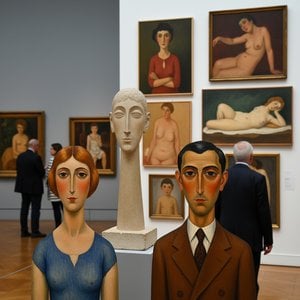
Descoperă cele mai frumoase 25 de opere Modigliani! Explorează portrete expresive, sculpturi unice și nuduri iconice. Află povestea fiecărei picturi și adaugă eleganță locuinței tale cu replici de artă de lux pe WahooArt.com.

Explore the rich symbolism of the red dress in art history! From ancient power displays to iconic portraits like Cézanne’s 'Madame Cezanne', discover the cultural and artistic significance behind this captivating color. Expert analysis & insights.
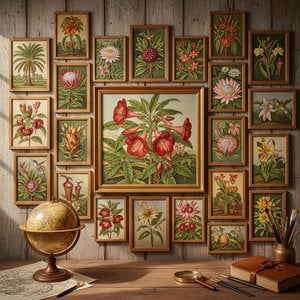
Descoperă cele mai frumoase 25 de picturi ale lui Marianne North, o pionieră a artei botanice victoriene. Explorează acuarelele vibrante și peisajele exotice care au capturat natura într-un stil unic. Reproduceri artă de calitate muzeală disponibile pe WahooArt.com!

Descoperă cele mai iconice 25 de opere Joan Miró! Explorează biografiile, tehnicile și simbolismul din spatele picturilor abstracte, suprarealiste și catalane. Găsește inspirație pentru decorul tău cu reproduceri artă de calitate superioară pe WahooArt.com.
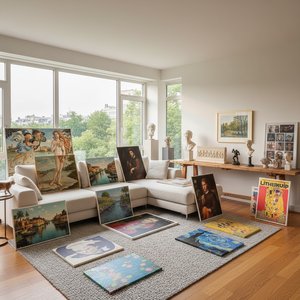
Descoperă top 25 de capodopere din Staatliche Museen Berlin! Explorează istoria artei, de la Nefertiti și picturi impresioniste la sculpturi clasice. Găsește inspirație pentru decorul tău și reproduceri de artă calitate superioară pe WahooArt.com.

 Previzualizare
 Trimite
 Distribuie
 Detalii despre lucrare

 Descarcă
 Produse similare
 Radiografie
 Diapozitive automate

 Vezi mai mult







 Opțiunea cu sticlă este disponibilă doar pentru dimensiuni de sub 110 cm


