Previzualizare Previzualizare AR Comută pe versiunea Print Comută pe Imagine Digitală Trimite prin felicitare
Detalii despre lucrare Ghid Adaugă la favorite Descarcă imaginea Produse similare Radiografie Galerie foto Statistici

Constant Leopold

Discover Amedeo Modigliani's hauntingly beautiful 'Constant Leopold.' Explore the tragic life & iconic style of this Italian painter, known for elongated figures and expressive eyes. Own a stunning reproduction today.

Descoperă arta fascinantă a lui Amedeo Modigliani (1884-1920): portrete iconice și sculpturi definite de forme încordate, ochii expresivi și o frumusețe tragică emoționantă. Explorează moștenirea acestui artist unic!

Reproducere pictată manual în ulei

Pictură în ulei pe pânză, pictată manual de artiștii noștri la dimensiunea și ramele dorite de dumneavoastră, pe comandă. ( Comută pe versiunea Print Comută pe Imagine Digitală)

Corner sample of the P118B picture frame: polistiren turnat, 5 cm wide and 3 cm thick
P118B lei10
Corner sample of the P118H picture frame: polistiren turnat, 5 cm wide and 3 cm thick
P118H lei10
Corner sample of the P118W picture frame: polistiren turnat, 5 cm wide and 3 cm thick
P118W lei10
Corner sample of the P438Z picture frame: polistiren turnat, 5.5 cm wide and 3.5 cm thick
P438Z lei10
Corner sample of the P508JH picture frame: polistiren turnat, 7 cm wide and 3.5 cm thick
P508JH lei12
Corner sample of the P508YH picture frame: polistiren turnat, 7 cm wide and 3.5 cm thick
P508YH lei12
Corner sample of the P805H picture frame: polistiren turnat, 5 cm wide and 3.5 cm thick
P805H lei10
Corner sample of the P805Z picture frame: polistiren turnat, 5 cm wide and 3.5 cm thick
P805Z lei10
Corner sample of the P919BZ picture frame: polistiren turnat, 7 cm wide and 3.5 cm thick
P919BZ lei10
Corner sample of the P919G picture frame: polistiren turnat, 7 cm wide and 3.5 cm thick
P919G lei10
Corner sample of the P919XJ picture frame: polistiren turnat, 7 cm wide and 3.5 cm thick
P919XJ lei10
Corner sample of the P959ZH picture frame: polistiren turnat, 5 cm wide and 3 cm thick
P959ZH lei10
Corner sample of the P968JZ picture frame: polistiren turnat, 6 cm wide and 4 cm thick
P968JZ lei12
Corner sample of the W106C picture frame: lemn masiv, 5 cm wide and 3 cm thick
W106C lei8
Corner sample of the W218G picture frame: lemn masiv, 5 cm wide and 3 cm thick
W218G lei10
Corner sample of the W218JH picture frame: lemn masiv, 5 cm wide and 3 cm thick
W218JH lei8
Corner sample of the W218Y picture frame: lemn masiv, 5 cm wide and 3 cm thick
W218Y lei10
Corner sample of the W307PJ picture frame: lemn masiv, 6 cm wide and 3 cm thick
W307PJ lei10
Corner sample of the W316G picture frame: lemn masiv, 6 cm wide and 3 cm thick
W316G lei10
Corner sample of the W316PJ picture frame: lemn masiv, 6 cm wide and 3 cm thick
W316PJ lei8
Corner sample of the W316Y picture frame: lemn masiv, 6 cm wide and 3 cm thick
W316Y lei10
Corner sample of the W398PJ picture frame: lemn masiv, 5 cm wide and 3 cm thick
W398PJ lei8
Corner sample of the W4111J picture frame: lemn masiv, 6.5 cm wide and 3.5 cm thick
W4111J lei10
Corner sample of the W500HY picture frame: lemn masiv, 7 cm wide and 5 cm thick
W500HY lei15
Corner sample of the W500JH picture frame: lemn masiv, 7 cm wide and 5 cm thick
W500JH lei15
Corner sample of the W692G picture frame: lemn masiv, 8 cm wide and 4 cm thick
W692G lei12
Corner sample of the W849H picture frame: lemn masiv, 5 cm wide and 3 cm thick
W849H lei8
Corner sample of the W940BG picture frame: lemn masiv, 7.5 cm wide and 4.5 cm thick
W940BG lei15
Corner sample of the W953PJ picture frame: lemn masiv, 6 cm wide and 3.5 cm thick
W953PJ lei8

Standard
personalizat
CM
INCH

Alegeți dintre dimensiunile noastre prestabilite, care respectă proporțiile originale ale operei de artă.

lățime
înălțime

Introduceți lățimea și înălțimea necesare pentru a se potrivi ramei sau peretelui dumneavoastră. Această lucrare este pictată manual, așa că, pentru o dimensiune cu o formă diferită, artistul poate picta puțin mai mult în jurul imaginii sau poate tăia puțin din margini — dumneavoastră decideți. Vă vom trimite o simulare digitală pentru aprobare înainte de a începe pictarea. Imaginea afișată pe această pagină nu reprezintă rezultatul real — doar simularea este reprezentativă.

Exemple de elemente ce pot fi personalizate: Înlocuiți fața cu fotografia clientului; Adăugați un animal de companie (de exemplu, înlocuiți pisica cu un câine); Includeți un mesaj ascuns în fundal; Schimbați peisajul sau elementele din fundal.
După plasarea comenzii, echipa WahooArt.com va contacta clientul prin e-mail pentru instrucțiuni și îi va furniza o previzualizare a machetei

Livrare în întreaga lume () în 3-4 săptămâni, în loc de cele 5 săptămâni standard. (28 Octombrie). Fără compromisuri în ceea ce privește calitatea.

Livrare expres gratuită la nivel mondial
Pânză de in de înaltă calitate
Asigurare completă pentru transport
Garanție de rambursare a taxelor vamale
Garanția fidelității culorilor
Politica de retur în 100 de zile (doar pentru defecte de fabricație)
Garanție de rambursare 100%
Ofertă pentru comenzi multiple

Preț total

lei 1265

Constant Leopold

Tehnică de reproducere

Dimensiune reproducere

-

Preț total calculat

lei 1265

Informații rapide

  • Subject or theme: Contemplation
  • Influences:
    • Nietzsche
    • Baudelaire
  • Medium: Painting
  • Artistic style: Melancholic grace

Test de cunoștințe despre artă

Fiecare întrebare are un singur răspuns corect.

Întrebare 1:
Based on the image description, what is the primary expression conveyed by the man in the portrait?
Întrebare 2:
The image description suggests that the man's attire implies what setting?
Întrebare 3:
Which of the following best describes Amedeo Modigliani's artistic style, as reflected in this portrait?
Întrebare 4:
Considering Modigliani's biography, what was a significant challenge he faced throughout his life?
Întrebare 5:
The image description mentions other people in the background. What can be inferred about their importance within the scene?

Amedeo Modigliani’s ‘Constant Leopold’: A Portrait of Melancholy and Mystery

Amedeo Clemente Modigliani's “Constant Leopold,” painted in 1919, is not merely a portrait; it’s an exquisitely rendered distillation of melancholy, a visual embodiment of the artist’s own turbulent life and profound sense of longing. This captivating work, now housed within the Museu de Arte in São Paulo, offers a glimpse into the world of Leopold Zborowski, a wealthy Polish art collector who profoundly shaped Modigliani's career and personal existence – a relationship characterized by both intense admiration and heartbreaking dependence.

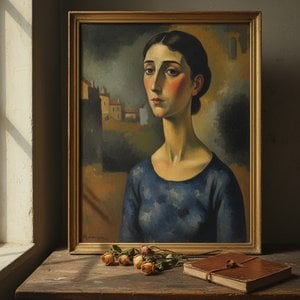
The painting immediately draws the viewer in with its subject’s direct gaze. Constant Leopold, a man distinguished by his prominent mustache and beard, sits poised before us, his expression a carefully calibrated blend of seriousness and quiet contemplation. His attire – a dark suit and tie – speaks to an era of formality, yet there's an underlying sense of detachment, as if he exists slightly outside the conventional boundaries of social interaction. Modigliani masterfully employs a muted palette of browns, grays, and ochres, creating a somber atmosphere that perfectly complements the subject’s mood. The background, subtly populated with indistinct figures, serves to further isolate Leopold, emphasizing his central importance within the frame.

The Language of Longing: Modigliani's Distinctive Style

Modigliani’s artistic signature is instantly recognizable – a style deeply rooted in the expressive distortions and elongated forms that defined his oeuvre. Here, those characteristics are particularly pronounced. The subject’s face is subtly stretched, his features refined to an almost skeletal elegance, echoing the influence of classical sculpture while simultaneously conveying a sense of vulnerability. His eyes, large and almond-shaped, hold a haunting quality, reflecting both intelligence and a deep well of sadness. The artist's technique is characterized by loose, expressive brushstrokes, particularly evident in the rendering of the clothing and background – a deliberate contrast to the meticulously detailed face that anchors the composition.

Notably, Modigliani’s use of color is restrained, prioritizing tonal variations over vibrant hues. This subdued approach contributes significantly to the painting's overall mood of quiet introspection. The subtle gradations of light and shadow create a sense of depth and volume, while simultaneously reinforcing the subject’s isolation. The artist skillfully employs chiaroscuro – the dramatic contrast between light and dark – to draw attention to Leopold’s face and heighten the emotional impact of the portrait.

Historical Context & The Complex Relationship with Zborowski

“Constant Leopold” was created during a pivotal period in Modigliani's life. He had relocated to Paris in 1906, immersing himself within the vibrant artistic circles of Montmartre and seeking patronage from influential figures like Paul Rosenberg and, crucially, Leopold Zborowski. Zborowski, a shrewd art dealer with considerable wealth, became a vital lifeline for Modigliani, providing him with financial support and access to the Parisian art market – though their relationship was fraught with tension and dependency.

The painting itself is believed to be a reflection of this complex dynamic. Zborowski’s presence looms large in Modigliani's life, offering both opportunity and a constant reminder of his own precarious position. The portrait can be interpreted as an attempt by Modigliani to capture the essence of Zborowski – a man of considerable influence yet burdened by a palpable sense of loneliness and regret. The subtle suggestion of sadness in Leopold’s eyes mirrors the artist's own feelings towards his patron, hinting at a mixture of gratitude and resentment.

Symbolism & Emotional Resonance

Beyond its technical brilliance, “Constant Leopold” resonates with profound symbolic weight. The elongated features, characteristic of Modigliani’s style, can be seen as metaphors for the artist's own yearning for beauty and his struggle to reconcile his artistic vision with the realities of a challenging life. The subject’s direct gaze invites contemplation, prompting viewers to consider not only Leopold’s individual story but also the broader themes of isolation, longing, and the elusive nature of human connection.

Ultimately, “Constant Leopold” is a hauntingly beautiful portrait that transcends mere representation. It's a testament to Modigliani’s artistic genius – a poignant exploration of melancholy, mystery, and the enduring power of art to capture the complexities of the human spirit. A hand-painted reproduction offers an unparalleled opportunity to experience this masterpiece firsthand, bringing its evocative atmosphere into your own space.

Întrebări și răspunsuri

Ce utilizare și ce spațiu sunt recomandate pentru "Constant Leopold" de Modigliani?

„Constant Leopold” este recomandat pentru Statement, iar spațiul ideal de expunere este o Living Room.

Ce atmosferă transmite "Constant Leopold"?

"Constant Leopold" de Modigliani este descris prin atmosfera sa Romantic. Această clasificare poate ajuta la integrarea lucrării într-un anumit decor.

Unde pot fi achiziționate copii pictate manual ale operei "Constant Leopold" de Modigliani?

„Constant Leopold” este disponibil ca o reproducere pictată manual în ulei pe pânză de in. Comanda poate fi plasată pe pagina de Reproducere pictată în ulei, cu posibilitatea de a alege dimensiunea dorită.


Biografie artist

A Life Etched in Longing: The World of Amedeo Modigliani

Amedeo Clemente Modigliani, a name synonymous with haunting beauty and melancholic grace, remains one of the most beloved and tragically romantic figures of early 20th-century art. Born in Livorno, Italy, in 1884 into a family steeped in Sephardic Jewish heritage, his life was marked by both profound artistic vision and persistent hardship. Frequent illness shadowed his youth – pleurisy and typhoid fever became unwelcome companions – perhaps instilling within him a sensitivity to fragility that would permeate his work.

Though born into relative comfort, the family’s financial fortunes waned, adding another layer of complexity to the young Modigliani's formative years. It was a childhood punctuated by intellectual stimulation, thanks to his mother and grandfather who introduced him to the works of Nietzsche, Baudelaire, and Lautréamont, laying the groundwork for an artistic sensibility that would reject conventional norms.

The pull of Paris proved irresistible, and in 1906, Modigliani embarked on a journey that would define his career. The city was then a crucible of artistic innovation, teeming with revolutionary ideas and challenging conventions. He immersed himself in the vibrant art scene, encountering giants like Pablo Picasso and Constantin Brâncuși, figures who profoundly shaped his aesthetic trajectory. Initially drawn to the burgeoning Cubist movement, Modigliani quickly found its rigid geometry too constricting for his expressive needs. His artistic spirit yearned for something more lyrical, more deeply rooted in human emotion.

He began a period of intense experimentation, absorbing influences from African sculpture – particularly its elongated forms and simplified features – and the archaic grace of Italian Renaissance art. This fascination with African art would become a cornerstone of his distinctive style, informing his sculptural endeavors and shaping his artistic vision.

The Sculpted Soul: Style and Innovation

Modigliani’s signature style emerged as a unique synthesis of these diverse inspirations. His portraits, arguably his most celebrated works, are instantly recognizable for their elongated faces and necks, almond-shaped eyes devoid of pupils, and an overall sense of serene melancholy. These were not merely likenesses; they were explorations of the inner life, capturing a profound psychological depth in each subject. He stripped away extraneous detail, focusing on essential forms to convey emotion with remarkable economy.

His nudes, often controversial during his lifetime, possess a similar quality – a quiet dignity and vulnerability that transcends mere physical representation. The figures are not overtly sensual but rather imbued with a sense of timeless beauty and existential longing. Modigliani’s masterful manipulation of line—a technique he honed through meticulous observation and relentless practice—became synonymous with his artistic idiom.

Notable Works

  • Nude Bust (35 x 26 cm): A quintessential example of Modigliani’s elongated forms and expressive style, showcasing his mastery of the human figure.
  • Reclining Nude with Loose Hair: Demonstrates his ability to capture the essence of femininity with a delicate balance of sensuality and vulnerability.
  • Seated Female Nude (92 x 60 cm): A powerful depiction of the female form, characterized by its simplified shapes and serene composure.
  • Portrait of Jeanne Hebuterne: Numerous portraits capturing his lover and muse, revealing a poignant emotional depth and intimate connection.

A Life Marked by Shadows

Modigliani’s personal life was as turbulent as his artistic journey. He struggled with poverty and addiction throughout much of his career, often relying on the generosity of friends and patrons. His relationship with Jeanne Hébuterne, a young artist herself, became the central emotional anchor in his life. They shared a deep love and mutual artistic understanding, but their happiness was tragically short-lived.

The pressures of poverty, Modigliani’s declining health, and Jeanne's pregnancy created an unbearable strain. In 1920, devastated by the birth of their daughter and overwhelmed by despair, Jeanne took her own life. Just days later, Modigliani succumbed to tubercular meningitis at the age of only 35.

Legacy of a Lost Generation

Despite facing little recognition during his lifetime, Amedeo Modigliani’s work experienced a dramatic surge in popularity after his death. His paintings and sculptures began to command increasingly high prices, and his distinctive style exerted a profound influence on subsequent generations of artists. He became an icon of the bohemian spirit, embodying the struggles and triumphs of a lost generation grappling with modernity and existential questions.

Today, Modigliani’s works are held in prestigious museums around the world, including the Osaka City Museum of Modern Art, the Musée d'Art Moderne de la Ville de Paris, and numerous private collections. His portraits continue to captivate viewers with their haunting beauty and emotional resonance, serving as a poignant reminder of a life lived on the edge – a life etched in longing, passion, and an unwavering commitment to artistic truth.

Modigliani

Modigliani

1884 - 1920 , Italia

Detalii rapide

  • Artistic Movement Or Style: Expresionism
  • Artists Or Movements Influenced By This Artist: ['Modernism']
  • Artists Who Influenced This Artist:
    • Brâncuși
    • Picasso
  • Date Of Birth: 12 iulie 1884
  • Date Of Death: 24 ianuarie 1920
  • Full Name: Amedeo Clemente Modigliani
  • Nationality: Italian
  • Notable Artworks:
    • Nud Bust
    • Reclining Nude
    • Seated Female Nude
  • Place Of Birth: Livorno, Italia
Explorați opere de artă organizate pe teme, stiluri și caracteristici.