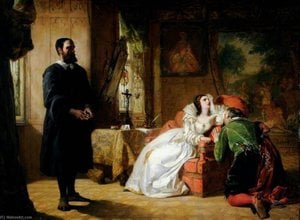
Early Life and Artistic Beginnings
William Powell Frith’s journey into the world of art began in a surprisingly modest setting: Aldfield, a small village nestled near Ripon in North Yorkshire, England. Born on January 9, 1819, he was the son of an innkeeper, a profession that initially seemed far removed from the realm of artistic creation. However, his father recognized and nurtured a nascent talent within young William, recognizing a keen eye for detail and a natural inclination towards visual representation.
Unlike many artists who benefited from privileged backgrounds, Frith’s early education was somewhat rudimentary. He received instruction in basic literacy and arithmetic before transitioning to the teachings of a local church school. Yet, it was his father's astute observation that steered him toward a more formal artistic training. This pivotal decision marked a turning point, setting him on a path towards becoming one of Britain’s most celebrated genre painters.
Frith’s initial aspirations leaned towards the practical profession of an auctioneer, a common pursuit for young men in his era. However, his father, recognizing his son's artistic potential, gently encouraged him to pursue his passion. This guidance led Frith to enroll at Sass’s Academy in Charlotte Street, London – a prestigious institution renowned for its rigorous training and exposure to the latest artistic trends. There, he honed his skills under the tutelage of accomplished instructors, laying the foundation for his future success.
Influences and Artistic Style
Frith's artistic development was profoundly shaped by several key influences, most notably the work of Sir David Wilkie, a prominent painter known for his captivating depictions of domestic scenes. Wilkie’s ability to capture the nuances of everyday life with remarkable realism and detail served as a significant model for Frith. He particularly admired Wilkie's approach to portraying social interactions within public spaces – a theme that would become central to Frith’s own artistic vision.
Furthermore, Frith was deeply impacted by the literary works of Charles Dickens, whose vivid descriptions of London life provided him with rich source material. He frequently drew inspiration from Dickens' novels and short stories, translating their scenes and characters onto canvas with meticulous precision. This collaboration between literature and art is evident in many of his most celebrated paintings.
Frith’s artistic style was characterized by an extraordinary level of detail and a commitment to realism. He meticulously observed the world around him, capturing the appearance of clothing, architecture, and human expressions with remarkable accuracy. His compositions often featured numerous figures arranged within complex, crowded scenes – a hallmark of his distinctive approach. He skillfully employed photographic studies, particularly those created by Robert Howlett, to ensure that every element in his paintings was rendered with utmost precision.
Notable Works and Artistic Achievements
William Powell Frith’s career produced a remarkable body of work, each painting offering a unique glimpse into Victorian society. Among his most iconic creations are Ramsgate Sands (1854), a vibrant depiction of seaside life that captures the energy and excitement of a popular resort town; The Derby Day (1858), a sprawling panorama of the Epsom Downs Racecourse, teeming with elegantly dressed spectators and spirited horses; and The Railway Station (1862), a detailed portrayal of Paddington Station, showcasing the bustling activity of London’s transportation hub.
His painting *The Sleeping Model* (1853) holds particular significance as his Diploma work at the Royal Academy. This piece demonstrated his technical mastery and artistic vision, solidifying his position within the art world. Another notable work is *The Crossing Sweeper* (1858), a poignant scene that starkly contrasts the opulence of the wealthy with the poverty of the working class – a commentary on social inequality that resonated deeply with Victorian audiences.
Frith’s success was not merely artistic; it was also commercial. His paintings were immensely popular, attracting large crowds to exhibitions and generating significant revenue. He became one of the most commercially successful artists of his time, a testament to his talent and the appeal of his subject matter.
Later Years and Legacy
As he matured, Frith continued to produce works that reflected both his artistic skill and his social awareness. His later paintings often explored themes of wealth, poverty, and morality, offering critical observations on Victorian society. He wrote two autobiographies, *My Autobiography* (1887) and *Further Reminiscences* (1888), providing valuable insights into his life, artistic process, and the cultural context in which he worked.
Frith remained active as an artist until his death on November 2, 1909, at the age of 90. He continued to exhibit his work throughout his later years, maintaining a strong presence within the British art scene. His legacy endures as one of the most important genre painters of the Victorian era, celebrated for his meticulous realism, social commentary, and captivating depictions of everyday life.
His paintings continue to be exhibited in museums and galleries around the world, offering a valuable window into 19th-century England. Frith’s work serves as a reminder of the power of art to document history, explore social issues, and capture the essence of human experience.



 Visualizar na parede
 Alternar para Impressão
 Compartilhar
 Compartilhar
 Detalhes
 Guia
Guia

 Baixar imagem
 Semelhantes
 Raio X
 Ver diaporama
 Q&A
Q&A Estatísticas

 Ler mais






































 A opção de vidro está disponível apenas para tamanhos inferiores a 110 cm