Obtenha um arquivo pronto para impressão que vai muito além da visualização na web. Cada imagem digital que vendemos provém de um arquivo mestre de alta resolução em nosso banco de dados — geralmente entre 5.000 e 15.000 pixels de largura — para que você possa imprimir em grandes formatos, realizar cortes precisos ou reproduzir detalhes minuciosos com total confiança.
Nenhum arquivo sai do nosso estúdio sem passar por um cuidadoso processo de revisão. Um especialista digital verifica as cores em relação à pintura original e as corrige se necessário, aumentando então a clareza e o detalhe com ferramentas profissionais de retoque — sempre mantendo a fidelidade às pinceladas e ao estilo do artista. O resultado é uma imagem que se assemelha à pintura, e não a um scan com filtros.
Aprovação antes da finalização: nosso especialista enviará a imagem por e-mail em até 72 horas para sua revisão. Não ficou satisfeito? Solicite melhorias ou correções, ou peça o reembolso caso a qualidade não atenda às suas expectativas.
Esta é a qualidade em que confiam editoras, estúdios de design, galerias e gráficas.
Baixe um arquivo de alta resolução para exibição pessoal, impressão e projetos criativos. ( Alternar para Impressão Comprar pintura feita à mão)
Ao escolher o WahooArt.com, você não está apenas adquirindo uma imagem — você está recebendo uma obra de arte digital profissionalmente aprimorada, elaborada com precisão e com garantia de satisfação. Aqui está tudo o que acompanha seu pedido, automaticamente:
O seu arquivo de imagem digital em alta resolução será enviado por e-mail em até 72 horas após o pedido — pronto para uso imediato.
Sua obra de arte é otimizada profissionalmente por meio de ferramentas avançadas de IA e edição manual, garantindo o máximo de detalhes, clareza e precisão de cores.
Apagou ou perdeu o seu ficheiro acidentalmente? Não se preocupe – nós reenviamos para si a qualquer momento, gratuitamente.
Desfrute da sua obra de arte instantaneamente, sem taxas alfandegárias, impostos ou custos de entrega — downloads digitais são sempre isentos de taxas.
Garantimos que sua imagem digital reflita as cores originais com a maior fidelidade possível, utilizando ferramentas profissionais e gerenciamento de cores.
Se não estiver satisfeito com a sua imagem digital, nós a revisaremos ou reembolsaremos 100% dentro de 100 dias — sem perguntas.
Não está satisfeito? Receba o reembolso total em até 100 dias após o recebimento do seu arquivo digital — sem perguntas.
Compre 3 imagens, economize 10% - Compre 5, economize 15% - Compre 10+, economize 20%. Ideal para projetos criativos, galerias e agências.
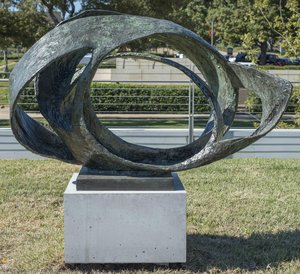
William Kenneth Armitage’s “Figure Lying on Its Side (Version V)” isn’t merely a sculpture; it’s a distilled essence of human experience, rendered in the cool, enduring solidity of bronze. Completed in 1957, this piece stands as a pivotal work within Armitage's oeuvre, embodying his signature style – a deliberate simplification of the human form coupled with an underlying current of unease and existential questioning. The sculpture immediately commands attention not through overt drama, but through its quiet intensity; it’s a study in restraint, inviting prolonged contemplation rather than immediate judgment.
Armitage, emerging from the austerity of post-war Britain, was deeply influenced by the anxieties of his time. His work reflects this, eschewing traditional heroic representations and instead focusing on the vulnerability inherent within the human condition. The figure itself is remarkably ambiguous – neither definitively male nor female, young nor old – existing in a state of suspended animation, caught between repose and imminent movement. This deliberate lack of specificity allows viewers to project their own emotions and experiences onto the sculpture, fostering a deeply personal connection.
Armitage's style is often described as “Geometry of Fear,” a term coined by critics to capture the way he employed sharp angles and fragmented forms to convey a sense of disorientation and psychological tension. “Figure Lying on Its Side” exemplifies this perfectly. The figure’s limbs are elongated, almost skeletal, creating a feeling of precariousness and vulnerability. The subtle curve of the torso is countered by the rigid lines of the chair-like structure attached to its side – an element that simultaneously grounds the sculpture and reinforces its sense of confinement. The bronze itself, chosen for its durability and ability to capture minute details, contributes significantly to the work’s impact; it possesses a tactile quality that invites touch while simultaneously conveying a sense of permanence.
Interestingly, Armitage drew inspiration from ancient art forms, particularly Cycladic sculpture – the enigmatic, abstract figures found on the Greek islands. These primitive forms, devoid of narrative and imbued with an almost ritualistic quality, resonate within Armitage’s work, suggesting a connection to primal human emotions and beliefs. The deliberate simplification of the figure echoes this ancient aesthetic, stripping away extraneous detail to reveal the core essence of form.
The chair-like appendage attached to the figure’s side is particularly intriguing. It can be interpreted as a symbol of societal constraints, representing the pressures and expectations that shape our lives. Alternatively, it might suggest a yearning for connection or support – a desire to anchor oneself in a world often characterized by isolation. The figure's prone position further reinforces this sense of vulnerability, suggesting a state of surrender or perhaps even resignation.
Furthermore, the sculpture’s monochrome palette—a stark contrast against the warm tones of bronze—heightens its emotional impact. The absence of color forces viewers to focus on the form itself, intensifying the feeling of unease and prompting deeper reflection. The work is not about depicting a specific narrative; instead, it invites us to confront our own anxieties and uncertainties.
“Figure Lying on Its Side (Version V)” remains a powerful testament to Armitage’s artistic vision – a poignant exploration of the human condition rendered in bronze. It's a work that rewards repeated viewing, revealing new layers of meaning with each encounter. Reproductions of this sculpture offer an accessible way to experience its profound emotional resonance, bringing its quiet intensity into homes and galleries alike. Its enduring appeal lies not in grand gestures or dramatic displays, but in its ability to capture the subtle complexities of human existence – a reminder that even in moments of vulnerability, there is beauty and significance to be found.
Reproduções pintadas à mão de "Figure lying on its side (Version V)", de William Kenneth Armitage podem ser adquiridas no este site: uma reprodução a óleo pintada à mão sobre tela de linho, através da sua página de encomendas Reprodução Pintada à Mão.
"Figure lying on its side (Version V)" foi realizada em 1957, dentro do movimento Geometry of Fear.
"Figure lying on its side (Version V)" é classificada como Recognized entre as obras do Geometry of Fear no catálogo.


1916 - 2002 , United Kingdom
 Compartilhar
 Compartilhar
 Detalhes
 Guia
Guia

 Baixar imagem
 Semelhantes
 Ver diaporama
 Perguntas e Respostas
 Estatísticas


 Ler mais