


Impressão giclée ou em tela de qualidade de museu, com produção rápida e opções flexíveis de acabamento. ( Comprar pintura feita à mão Comprar imagem)





























Escolha entre os nossos tamanhos pré-definidos que respeitam as proporções originais da obra de arte.

Você pode inserir suas próprias dimensões para se ajustar a uma moldura ou espaço específico. Se o tamanho selecionado não corresponder às proporções da imagem original, iremos recortar a obra de arte ou estender a imagem com uma borda espelhada ou preenchimento sólido. Um mockup digital será enviado para sua aprovação antes do início da produção.
Por favor, observe que a visualização na tela não reflete o recorte ou a extensão real. Apenas o mockup mostrará com precisão a composição final.
Embora tamanhos personalizados estejam disponíveis, recomendamos selecionar uma dimensão da lista predefinida para preservar as proporções originais.
Entrega mundial () em 2 semanas, em vez das 4/5 semanas padrão. (6 Setembro)


Tureen com tampa, recipiente interno e suporte
Tamanho da Reprodução

Thomas Germain (1673–1748) stands as the undisputed titan of Parisian silversmithing during the opulent Rococo era—a period defined by extravagant ornamentation, playful asymmetry, and a fervent embrace of nature’s beauty. Born in Paris to Pierre Germain, whose artistic legacy remains elusive, young Thomas initially pursued painting, honing his skills in Rome between 1687 and 1702 where he swiftly transitioned into the craft of goldsmithing, establishing himself as a true artisan. This formative experience instilled within him an unwavering dedication to meticulous technique and a profound understanding of sculptural principles—qualities that would permeate his entire oeuvre. His early years in Italy allowed him to absorb the dramatic energy of Baroque sculpture, a foundation that would later enable him to manipulate precious metals with the fluidity of a painter's brush.
Returning to Paris in 1720, Germain ascended to the prestigious rank of Maître (master), securing his position as Orfèvre du Roi—the King’s Goldsmith. This appointment was more than a mere title; it was a gateway to the very heart of French power. Granted apartments within the Palais du Louvre in 1723, Germain operated at the epicenter of European luxury. His workshop became a sanctuary of creation where he served Louis XV and the French royal family with unparalleled devotion. From the delicate gold mustard pots used in intimate royal breakfasts to the grand, ceremonial objects destined for foreign thrones, his work embodied the prestige of the Bourbon monarchy. His influence was truly international, as his exquisite silver pieces traveled to the courts of Spain, Naples, and Portugal, leaving an indelible mark on the decorative arts of the entire continent.
The genius of Germain resided not merely in replicating established styles but in elevating them to breathtaking heights. He possessed a rare ability to blend the structural rigor of his training with the whimsical, organic motifs that defined the Rococo spirit. His work often featured:
Beyond his functional masterpieces, Germain’s impact reached into the very fabric of Parisian architecture and culture. His involvement in the reconstruction of Saint-Louis-du-Louvre demonstrated a versatility that few craftsmen could claim. Even the great philosopher Voltaire recognized his extraordinary talent, immortalizing Germain's "divine hand"* in verse. When he passed away in 1748, his contribution to French artistry was so profound that the King of France himself ordered a requiem mass to be sung in his honor. Today, the surviving pieces of Thomas Germain—from his legendary hunting-themed surtout de table to his delicate royal rattles—remain as shimmering testaments to a man who transformed cold metal into the living pulse of the Rococo age.

1673 - 1748 , France

Descubra as 10 obras-primas do Rococó! Explore a elegância de Fragonard, Boucher e Watteau. A arte do século XVIII ganha vida com cores pastel e detalhes luxuosos. Encontre reproduções de alta qualidade em WahooArt.com.

Explore the dramatic evolution from Baroque's intense chiaroscuro to Rococo's golden elegance. Our expert guide decodes the shift from high-drama shadows to playful, ornate grace for art enthusiasts and collectors seeking deep historical insight.

Explore the profound differences between Baroque drama and Rococo elegance. Our expert guide delves into art history, chiaroscuro, and the evolution of European masterpieces for collectors and enthusiasts seeking deep historical context.
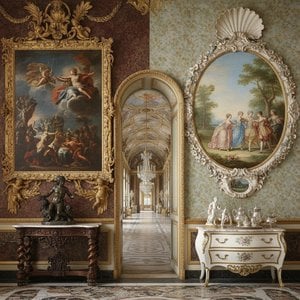
Embark on a cultural journey through the dramatic grandeur of Baroque and the delicate grace of Rococo art. Discover the history, techniques, and timeless beauty of these magnificent eras with our expert-led exploration of European masterpieces.
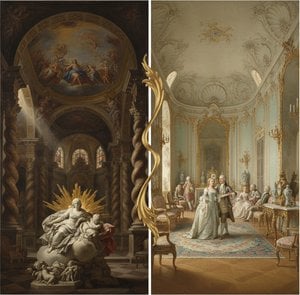
Explore the captivating evolution from Baroque's drama to Rococo's grace! Discover key artists, characteristics & lasting influence of these art movements with expert insights at WahooArt.

 Visualizar na parede
 Compartilhar
 Compartilhar
 Detalhes

 Baixar imagem
 Semelhantes
 Raio X
 Slideshow

 Ler mais







 A opção de vidro está disponível apenas para tamanhos inferiores a 110 cm


