A Glimpse of Venetian Grace: Unveiling Marietta Robusti’s “Venetian Woman”
The world of 16th-century Venice pulsed with artistic fervor, a crucible where innovation and tradition intertwined to produce some of the most enduring masterpieces in Western art. Within this vibrant milieu emerged Marietta Robusti, daughter of the legendary Tintoretto, a woman whose talent was often overshadowed by circumstance yet whose singular vision shines through in works like “Venetian Woman” (attributed), a captivating portrait that offers a rare glimpse into the life and artistry of a remarkable female artist.
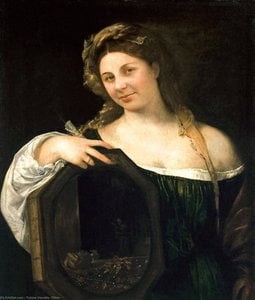
This intimate half-length painting, likely executed on canvas around 1560, immediately draws the viewer into its world. The subject, a Venetian noblewoman or woman of considerable status, is presented with an understated elegance that speaks volumes about her bearing and social standing. Her gaze, direct and engaging, establishes a powerful connection with the observer – a hallmark of Renaissance portraiture designed to convey both dignity and personality. The composition itself is deceptively simple: a focus on the face and upper torso, framed by a dark, almost theatrical background that serves only to heighten the subject’s presence. The careful arrangement of her hands—one resting gently on her chest, the other subtly gesturing—adds layers of nuance to her expression, hinting at both composure and perhaps a touch of vulnerability.
A Symphony of Color and Light: Technique and Style
“Venetian Woman” is a masterful example of late Renaissance style, deeply rooted in the artistic traditions of Venice while simultaneously exhibiting a subtle shift towards Mannerism. The color palette is rich and warm, dominated by deep reds, earthy browns, and creamy whites – tones characteristic of Venetian painting at this time. Dürer’s influence is evident in the meticulous attention to detail, particularly in the rendering of fabrics and textures. Note the delicate layering of glazes—thin applications of oil paint that create a luminous quality, capturing the subtle sheen of silk and velvet. The use of soft lines contributes to an overall sense of realism, while strategically placed shadows define the contours of her face and body, lending depth and volume.
The lighting is diffused and directional, originating from the left side of the composition. This creates a gentle interplay of light and shadow that sculpts her features and adds drama to the scene. The artist’s skillful manipulation of perspective—a relatively flat approach typical of portraits of this era—further enhances the sense of realism while maintaining an elegant formality.
Whispers of Symbolism: Unpacking the Details
Beyond its aesthetic beauty, “Venetian Woman” is laden with symbolic elements that offer clues to her social status and perhaps even her personal life. The pearl necklace she wears—a common motif in Venetian portraiture—has been interpreted as a symbol of purity or marital status, though interpretations can vary. The rich fabrics and elaborate jewelry suggest wealth and privilege, reflecting the subject’s position within Venetian society. Some scholars have speculated that the dark background may represent the shadows of her past, while the light emanating from the figure symbolizes hope and prosperity.
Interestingly, the painting's attribution to Marietta Robusti is itself a fascinating story. For centuries, her work was largely overlooked, overshadowed by the fame of her father, Tintoretto. Despite this historical erasure, recent scholarship has begun to recognize her unique artistic voice and contribution to Venetian art. The portrait’s existence serves as a poignant reminder of the challenges faced by female artists during the Renaissance—obstacles that often prevented them from receiving the recognition they deserved.
A Legacy Preserved: Reproduction and Appreciation
Today, “Venetian Woman” stands as a testament to Marietta Robusti's artistic skill and a window into the vibrant world of 16th-century Venice. High-quality reproductions capture the painting’s luminous colors, intricate details, and evocative atmosphere, allowing art lovers around the world to appreciate its beauty and significance. Whether displayed in a private collection or adorning a wall in a sophisticated interior space, this captivating portrait continues to inspire and enchant, offering a timeless glimpse into the life of a remarkable artist.



 Visualizar em escala
 Alternar para Impressão
 Enviar
 Compartilhar
 Ver detalhes
 Guia
Guia

 Baixar imagem
 Semelhantes
 Raio X
 Apresentação de slides
 Estatísticas


 Ver mais






































 A opção de vidro está disponível apenas para tamanhos inferiores a 110 cm