A Bolognese Trailblazer: The Life and Art of Lavinia Fontana
Lavinia Fontana, born in Bologna in 1552, stands as a monumental figure in the history of art—a Renaissance woman who defied expectations and carved an extraordinary path for herself within a field overwhelmingly dominated by men. Her story isn’t simply one of artistic talent; it's a testament to resilience, shrewdness, and an unwavering determination to establish herself as a respected professional artist during a time when such opportunities were virtually nonexistent for women. Her father, Prospero Fontana, a distinguished painter in his own right, recognized her innate gift early on, providing her with the foundational training that would lay the groundwork for her remarkable career. This familial support was crucial, granting Lavinia access to artistic knowledge and connections—a rare privilege for a woman of her era. Early works like “Monkey Child” (1575), though sadly lost to history, hinted at a unique and promising talent, quickly followed by pieces demonstrating increasing technical skill and compositional awareness, such as "Christ with the Symbols of the Passion" (1576).Elegance, Innovation, and the Bolognese Style
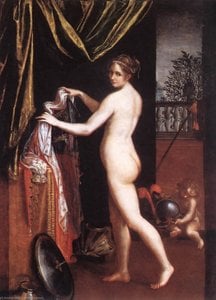
Fontana’s artistic style initially mirrored that of her father, deeply rooted in the traditions of the School of Bologna—a region renowned for its rich artistic heritage. However, she quickly absorbed influences from other prominent artists who frequented Bologna, notably Denis Calvaert, whose school served as a vibrant hub of artistic innovation and experimentation. This exposure proved transformative, leading to an evolution in her work that incorporated elements of the Carracciesque style—characterized by its dramatic compositions, dynamic movement, and intensely vibrant coloring. Simultaneously, she embraced a quasi-Venetian richness, imbuing her paintings with a luminous quality reminiscent of Venetian masters, adding depth and visual allure. She rapidly gained recognition for her portraits, particularly those depicting the upper-class women of Bologna—a demographic that became a significant focus of her artistic practice. These weren’t merely straightforward likenesses; rather, they were carefully constructed celebrations of wealth, status, and feminine grace, imbued with an undeniable sense of elegance and sophistication. Fontana possessed an exceptional ability to capture not only the physical appearance of her subjects but also their inner character—a remarkable feat that fostered unusually warm and enduring relationships between artist and patron. Her portraits are distinguished by meticulous attention to detail—the intricate embroidery on gowns, the shimmering brilliance of jewels, the subtle play of light across skin—all rendered with a breathtaking level of realism and sensitivity. Notable examples include “Double Marriage Portrait” (also known as "Self-Portrait of Lavinia Fontana"), currently housed in the Zaragoza Museum, which offers a captivating glimpse into the fashions and social customs of 16th-century Bologna. Other significant works such as “Venus and Cupid” (1592) and “Newborn Baby in a Crib” (1583) further demonstrate her versatility and artistic range.Breaking Barriers: A Career Forged Against the Grain
Lavinia Fontana’s achievements extended far beyond her technical skill; she was, without question, a true trailblazer—widely regarded as the first woman artist to operate independently within the established art world—free from the constraints of serving solely as a court painter or a convent artist. This remarkable accomplishment occurred during an era when professional opportunities for women were severely limited and often relegated to domestic roles. Her success wasn’t simply a matter of innate talent; it was also the result of astute business acumen, strategic networking, and the unwavering support of her husband, Paolo Zappi—a fellow painter who served as her agent, managed their household, and actively championed her artistic endeavors. The marriage agreement itself was remarkably progressive for its time, acknowledging Lavinia’s potential earnings from her art and effectively negating the traditional dowry requirement. Her rising reputation quickly attracted the attention of influential patrons, including Pope Gregory XIII and his family, leading to commissions for portraits of prominent individuals—a testament to her growing prestige and artistic skill. This patronage propelled her career to new heights, culminating in her relocation to Rome in 1604, where she became a sought-after portraitist at the papal court. In 1611, she received further recognition with a bronze portrait medallion cast by Felice Antonio Casoni, and was elected into the Accademia di San Luca—an unprecedented honor for a woman artist of her time, signifying her acceptance as a full member of Rome’s prestigious artistic guild.Influences and Artistic Development
Fontana's early work demonstrates a clear influence from her father, Prospero Fontana, who had trained her in the traditions of the Bolognese Mannerist school. However, she quickly absorbed influences from other prominent artists working in Bologna, including Denis Calvaert, whose school was known for its innovative approach to painting and its emphasis on classical principles. This exposure led to a gradual shift in her style, incorporating elements of the Carracciesque style—characterized by its dramatic compositions, vibrant colors, and dynamic movement—and a quasi-Venetian richness that added depth and luminosity to her paintings. She was particularly adept at capturing the details of clothing and jewelry, reflecting the opulent fashions of the time. Her portraits were not merely likenesses; they were carefully constructed celebrations of wealth, status, and feminine grace, imbued with an undeniable sense of elegance and sophistication.A Lasting Legacy
Lavinia Fontana’s legacy continues to resonate today, inspiring both artists and art lovers alike. Her work is now housed in museums and collections around the world, serving as a powerful reminder of her enduring talent and historical significance. She not only demonstrated that women could achieve artistic excellence on par with their male counterparts but also paved the way for future generations of female artists to pursue their passions without facing the same societal constraints. While debate continues among art historians regarding whether she was truly among the first women to paint nudes—as evidenced in works like “Judith with the Head of Holofernes” (1600)—her willingness to explore a wider range of subjects, including mythological and religious themes, further solidified her position as a versatile and innovative artist. Fontana’s ability to balance a thriving artistic career with the demands of motherhood—raising eleven children while maintaining a rigorous painting schedule—is a testament to her resilience, dedication, and unwavering commitment to her craft. Her story serves as a powerful reminder that talent knows no gender and that perseverance can overcome even the most formidable obstacles. Lavinia Fontana’s impact extends beyond her paintings; she remains an icon of female empowerment in the art world.Perguntas e Respostas
Existe uma linha do tempo das obras de Lavinia Fontana?
As obras de Lavinia Fontana podem ser visualizadas em ordem cronológica na página de Linha do tempo das obras do artista.
Em qual período histórico Lavinia Fontana trabalhou?
Lavinia Fontana trabalhou no período Renascimento. O período situa a atividade do artista na história.
Existe uma lista completa das obras de Lavinia Fontana?
Todas as obras de Lavinia Fontana no este site podem ser visualizadas na página de Todas as Obras de Arte do artista.