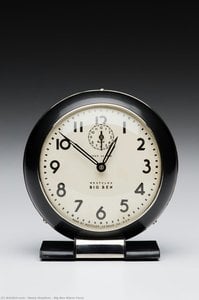
A Testament to Resilience: Exploring Margarete Heymann’s Wall Clock
The square wall clock crafted by Margarete Heymann-Loebenstein (later Marks) stands as more than just a functional timepiece; it embodies the spirit of modernist design intertwined with profound personal experience. Produced in the Haël Werkstätten for Artistic Ceramics during her exile from Nazi Germany, this piece exemplifies the Bauhaus aesthetic—characterized by geometric simplicity and honest material expression—while simultaneously reflecting Heymann’s unwavering dedication to artistic creation amidst turbulent times. Its unassuming appearance belies a complex narrative of innovation, displacement, and enduring beauty.
- Style & Form: The clock's design adheres strictly to Bauhaus principles, prioritizing orthogonal lines and balanced proportions. Rounded corners subtly soften the rigid geometry, introducing an element of humanist consideration into the otherwise austere aesthetic.
- Material & Technique: Constructed from ceramic material and encased in a metal frame, the clock utilizes slip casting—a technique perfected by Heymann—to achieve exceptional dimensional accuracy and surface smoothness. The uranium-based orange glaze imparts a luminous hue that captures ambient light, creating an ethereal glow.
- Numerals & Hands: The black numerals on the clock face are meticulously positioned in a circular arrangement, mirroring the Bauhaus fascination with mathematical precision. Similarly, the black hour and minute hands—crafted from metal—are deliberately designed to convey clarity and functionality.
The Haël Werkstätten for Artistic Ceramics served as a crucial refuge for Heymann during her exile, allowing her to continue her artistic pursuits despite the pervasive restrictions imposed by Nazi ideology. This workshop was founded in 1930 and quickly became renowned for its commitment to producing high-quality ceramic pieces that blended modernist design with traditional craftsmanship. The clock’s creation represents a triumph of creativity within challenging circumstances—a symbol of perseverance and an affirmation of artistic vision as a force for beauty and intellectual engagement.
- Symbolism: The orange glaze, chosen by Heymann herself, carries connotations of warmth, optimism, and vitality—counterbalancing the anxieties associated with exile. Its subtle luminosity speaks to the enduring power of art to illuminate even the darkest periods.
- Historical Context: Produced in the wake of the Bauhaus’s closure in 1932, the clock embodies the Bauhaus movement's legacy of experimentation and its unwavering belief in the transformative potential of design. It stands as a testament to the Bauhaus ethos—a commitment to functional beauty rooted in rational principles.
The image accompanying this description captures the clock’s captivating aesthetic with meticulous detail. The stark white background enhances the vibrancy of the orange glaze and emphasizes the clock's sculptural form, inviting viewers to contemplate its elegance and understated sophistication. Furthermore, the watermark “© 2014 Margarete Heymann-Löbenstein” underscores the artist’s enduring presence—a reminder that this remarkable piece continues to inspire admiration for its harmonious blend of form and technique. Its timeless appeal resonates with collectors and interior designers alike who appreciate objects imbued with both intellectual rigor and emotional resonance.
Further Exploration
For a deeper understanding of Margarete Heymann’s artistic journey, consider visiting the Jewish Museum Berlin's archive (
Jewish Object: Applied Arts Collection) where you can access documents detailing her life and work. Alternatively, explore her contributions to the Bauhaus movement (
Wall clock - Margarete Heymann-Loebenstein (later Marks)), showcasing her pioneering spirit and unwavering dedication to modernist design principles. Finally, delve into the broader context of Jewish art during the Weimar Republic (
Purchase a copy of Wall clock - Margarete Heymann) to appreciate the significance of this extraordinary artwork within its historical milieu.
Perguntas e Respostas
Que emoção transmite "Wall clock" de Margarete Heymann?
O tom emocional registrado para "Wall clock" de Margarete Heymann é Reflective. Ele resume o sentimento que a obra expressa.
Qual é a luminosidade percebida de "Wall clock" de Margarete Heymann?
Em termos de luminosidade percebida, "Wall clock" de Margarete Heymann é brilliant.
Como posso visualizar uma reprodução de "Wall clock" de Margarete Heymann?
Uma prévia de "Wall clock" de Margarete Heymann está disponível na página de Visualização da obra.
Que atmosfera "Wall clock" de Margarete Heymann traz a um ambiente?
"Wall clock" de Margarete Heymann possui uma atmosfera Serene e é recomendado para um(a) Living Room. O clima é o que a obra traz para o espaço ao seu redor.
Como faço para baixar a imagem de "Wall clock" de Margarete Heymann?
"Wall clock" de Margarete Heymann pode ser descarregado na página de Baixar da obra, como download de imagem digital em alta resolução.
Qual é a saturação de cor de "Wall clock" de Margarete Heymann?
A paleta de "Wall clock" possui uma saturação Subtle Color.
Por que o status de direitos autorais de "Wall clock" é como é?
"Wall clock" de Margarete Heymann está em ainda protegido por direitos autorais. Os termos de direitos autorais são calculados a partir do falecimento do artista, e Margarete Heymann faleceu em 1990.
Para que tipo de uso é recomendada uma reprodução de "Wall clock" de Margarete Heymann?
O uso sugerido para "Wall clock" de Margarete Heymann é Accent. Também pode servir para outros fins.



 Visualizar em escala
 Encomendar reprodução pintada à mão
 Enviar
 Compartilhar
 Ver detalhes
 Guia de Obras do Aluno

 Baixar imagem
 Semelhantes
 Raio X
 Apresentação de slides
 Estatísticas

 Ver mais






































 A opção de vidro está disponível apenas para tamanhos inferiores a 110 cm