Visualizar em escala Visualizar em RA Alternar para Impressão Ver Imagem Digital Enviar
Ver detalhes Guia de Obras do Aluno Adicionar aos favoritos Baixar imagem Semelhantes Raio X Apresentação de slides Estatísticas

Untitled

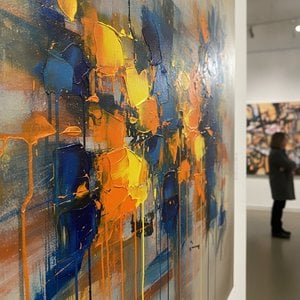
Experience the vibrant energy of Karel Appel's COBRA masterpiece; this abstract burst of color captures raw instinct from 1960—discover your own artistic freedom.

Descubra Karel Appel, fundador do CoBrA holandês! Explore suas pinturas abstratas vibrantes e esculturas – cores ousadas, formas expressivas e uma alma poética definem seu estilo artístico único pós-guerra.

A obra de arte exibida nesta página é protegida por leis de direitos autorais, o que significa que não podemos criar ou vender legalmente uma reprodução idêntica. Esta proteção é aplicada por meio de acordos internacionais, tais como a Convenção de Berna e pelas leis nacionais, incluindo as estabelecidas por Lei de Direitos Autorais dos EUA - Título 17.

Como uma alternativa respeitosa e legal, oferecemos obras de arte personalizadas e pintadas à mão, inspiradas na obra original. Nossos artistas profissionais e experientes estudam cuidadosamente o estilo, a atmosfera e a essência artística da obra original para criar uma peça nova e única que evoque a mesma sensação — permanecendo como uma criação original por direito próprio.

Este método cumpre plenamente as regulamentações de direitos autorais, pois não envolve a cópia ou duplicação da obra protegida. Em vez disso, trata-se de uma reinterpretação criativa — uma nova pintura que é influenciada pela original, mas não idêntica a ela.

Reprodução em Óleo Feita à Mão

Óleo sobre tela pintado à mão no tamanho e moldura de sua escolha, feito sob encomenda pelos nossos artistas. ( Alternar para Impressão Ver Imagem Digital)

Corner sample of the P118B picture frame: poliestireno moldado, 5 cm wide and 3 cm thick
P118B 10
Corner sample of the P118H picture frame: poliestireno moldado, 5 cm wide and 3 cm thick
P118H 10
Corner sample of the P118W picture frame: poliestireno moldado, 5 cm wide and 3 cm thick
P118W 10
Corner sample of the P438Z picture frame: poliestireno moldado, 5.5 cm wide and 3.5 cm thick
P438Z 10
Corner sample of the P508JH picture frame: poliestireno moldado, 7 cm wide and 3.5 cm thick
P508JH 12
Corner sample of the P508YH picture frame: poliestireno moldado, 7 cm wide and 3.5 cm thick
P508YH 12
Corner sample of the P805H picture frame: poliestireno moldado, 5 cm wide and 3.5 cm thick
P805H 10
Corner sample of the P805Z picture frame: poliestireno moldado, 5 cm wide and 3.5 cm thick
P805Z 10
Corner sample of the P919BZ picture frame: poliestireno moldado, 7 cm wide and 3.5 cm thick
P919BZ 10
Corner sample of the P919G picture frame: poliestireno moldado, 7 cm wide and 3.5 cm thick
P919G 10
Corner sample of the P919XJ picture frame: poliestireno moldado, 7 cm wide and 3.5 cm thick
P919XJ 10
Corner sample of the P959ZH picture frame: poliestireno moldado, 5 cm wide and 3 cm thick
P959ZH 10
Corner sample of the P968JZ picture frame: poliestireno moldado, 6 cm wide and 4 cm thick
P968JZ 12
Corner sample of the W106C picture frame: madeira maciça, 5 cm wide and 3 cm thick
W106C 8
Corner sample of the W218G picture frame: madeira maciça, 5 cm wide and 3 cm thick
W218G 10
Corner sample of the W218JH picture frame: madeira maciça, 5 cm wide and 3 cm thick
W218JH 8
Corner sample of the W218Y picture frame: madeira maciça, 5 cm wide and 3 cm thick
W218Y 10
Corner sample of the W307PJ picture frame: madeira maciça, 6 cm wide and 3 cm thick
W307PJ 10
Corner sample of the W316G picture frame: madeira maciça, 6 cm wide and 3 cm thick
W316G 10
Corner sample of the W316PJ picture frame: madeira maciça, 6 cm wide and 3 cm thick
W316PJ 8
Corner sample of the W316Y picture frame: madeira maciça, 6 cm wide and 3 cm thick
W316Y 10
Corner sample of the W398PJ picture frame: madeira maciça, 5 cm wide and 3 cm thick
W398PJ 8
Corner sample of the W4111J picture frame: madeira maciça, 6.5 cm wide and 3.5 cm thick
W4111J 10
Corner sample of the W500HY picture frame: madeira maciça, 7 cm wide and 5 cm thick
W500HY 15
Corner sample of the W500JH picture frame: madeira maciça, 7 cm wide and 5 cm thick
W500JH 15
Corner sample of the W692G picture frame: madeira maciça, 8 cm wide and 4 cm thick
W692G 12
Corner sample of the W849H picture frame: madeira maciça, 5 cm wide and 3 cm thick
W849H 8
Corner sample of the W940BG picture frame: madeira maciça, 7.5 cm wide and 4.5 cm thick
W940BG 15
Corner sample of the W953PJ picture frame: madeira maciça, 6 cm wide and 3.5 cm thick
W953PJ 8

Padrão
sob medida
CM
INCH

Escolha entre os nossos tamanhos pré-definidos que respeitam as proporções originais da obra de arte.

largura
altura

Pode inserir as suas próprias dimensões para se adequar a uma moldura ou espaço específico. Se o tamanho selecionado não corresponder às proporções da imagem original, iremos cortar a obra de arte ou estender a pintura com elementos adicionais pintados à mão. Um esboço digital será enviado para sua aprovação antes do início da produção.
Tenha em atenção que a pré-visualização no ecrã não reflete o corte ou extensão real. Apenas o esboço mostrará com precisão a composição final.
Embora tamanhos personalizados estejam disponíveis, recomendamos selecionar uma dimensão da lista predefinida para preservar as proporções originais.

Exemplos do que pode ser personalizado: Substituir o rosto pela foto do cliente; Adicionar um animal de estimação (ex: substituir gato por cão); Incluir uma mensagem oculta no fundo; Alterar a paisagem ou elementos do fundo.
Após o pedido, a equipa WahooArt.com enviará um e-mail ao cliente para solicitar instruções e fornecer uma prévia do esboço.

Entrega mundial () em 3 a 4 semanas, em vez das 5 semanas padrão. (12 Outubro). Sem comprometer a qualidade.

Envio expresso gratuito para todo o mundo
Tela de Linho Premium
Seguro de transporte total
Garantia de Reembolso de Impostos Alfandegários
Garantia de Fidelidade de Cor
Política de Devolução em 100 Dias (Apenas para Defeitos)
Garantia de reembolso de 100%
Desconto para múltiplas unidades

Preço Total

€ 234

Untitled

Técnica de Reprodução

Dimensões da Reprodução

-

Preço Total

€ 234

Detalhes Rápidos

  • Notable elements or techniques: Gestural forms, Layered texture
  • Subject or theme: Organic shapes
  • Location: Private Collection
  • Title: Untitled
  • Artistic style: Abstract Expressionism

Teste de Conhecimentos Artísticos

Cada pergunta possui apenas uma resposta correta.

Questão 1:
What avant-garde movement is Karel Appel strongly associated with for this artwork?
Questão 2:
Which element of the artwork's composition is described as eschewing traditional perspective?
Questão 3:
According to the description, what emotion is often symbolized by the color yellow in Appel's work?
Questão 4:
What type of forms populate the artwork, described as rounded and organic, reminiscent of natural elements?
Questão 5:
What medium is the artwork most likely to be, given the visible layering and texture?

A Symphony of Spontaneity: The Primal Energy of Karel Appel

In the landscape of post-war European modernism, few voices resonate with as much raw, unbridled vitality as that of Karel Appel. His 1960 work, Untitled, serves as a breathtaking manifesto of the COBRA movement, an avant-garde collective that sought to strip away the suffocating layers of academic tradition in favor of something far more primal. To encounter this piece is to witness a deliberate rebellion; it is not merely a composition of pigment on paper, but an explosion of instinctual expression. The artwork captures a moment where the artist’s hand moves with the freedom of a child, yet carries the profound weight of a man navigating a world recovering from the shadows of conflict. Through its vibrant palette and gestural urgency, the work invites the viewer into a realm where emotion dictates form, and where the boundaries between the creator and the canvas dissolve into pure, rhythmic motion.

The visual language of this masterpiece is defined by its biomorphic forms—organic, rounded shapes that seem to pulse with an internal life force. There is no rigid geometry here, nor any attempt at traditional perspective; instead, Appel utilizes an asymmetrical arrangement where colors and shapes overlap in a dance of beautiful chaos. The palette is nothing short of celebratory, dominated by sun-drenched yellows, deep oceanic blues, and fiery reds, all anchored by bold strokes of black and punctuated by flashes of orange and white. These colors are not merely decorative choices but are deeply symbolic; the yellow radiates an infectious optimism, while the blue offers a moment of contemplative stillness amidst the surrounding energy. This interplay of hues creates a complex textural landscape, where the visible layering of the printmaking process suggests a tactile depth that draws the eye into a continuous, wandering exploration.

Historical Resonance and Interior Inspiration

To understand the soul of this work, one must look to the historical heartbeat of the COBRA movement. Born from a desire to break free from the constraints of Surrealism and Cubism, Appel and his contemporaries looked toward the "primitive"—finding profound inspiration in African masks, tribal art, and the uninhibably honest drawings of children. This 1960 print embodies that search for authenticity, rejecting meticulous representation in favor of intuition and gesture. The technique, likely a screenprint or lithograph, allows for a fascinating tension between the flatness of the medium and the perceived movement of the brushstrokes. Each layer of ink contributes to a sense of immediacy, as if the artist’s energetic movements were captured in mid-motion, frozen forever in a state of becoming.

For the discerning collector or interior designer, this artwork offers more than just visual interest; it provides a transformative emotional atmosphere. Its lack of a singular focal point allows it to integrate seamlessly into sophisticated modern environments, acting as a dynamic anchor in a room. In a minimalist setting, its bold colors can provide a much-needed burst of life and character, while in a more eclectic space, it serves as a testament to the enduring power of the avant-garde. Owning a high-quality reproduction of this piece is an invitation to live alongside a fragment of art history—a piece that celebrates the joy of existence, the beauty of imperfection, and the eternal, restless spirit of human creativity.

Perguntas e Respostas

Como posso visualizar uma reprodução de "Untitled" de Karel Appel?

A página de Visualização de "Untitled" permite que você visualize a obra de arte antes de fazer o pedido.

"Untitled" permaneceu no país de origem do seu artista?

Não – a obra de arte encontra-se no exterior. O país de nascimento do artista é Países Baixos, e o museu que detém a obra original está em Reino Unido.

Posso ver "Untitled" como um slideshow em tela cheia?

"Untitled" de Karel Appel pode ser visualizada como um slideshow na página de Apresentação de slides da obra.

"Untitled" de Karel Appel utiliza contrastes fortes ou harmonias suaves?

A composição cromática de "Untitled" de Karel Appel combina um contraste Statement com uma harmonia Balanced Harmony.

Para que tipo de uso é recomendada uma reprodução de "Untitled" de Karel Appel?

O uso recomendado de uma impressão de "Untitled" é Accent.

Como as cores de "Untitled" de Karel Appel se relacionam com a sua emoção?

Em "Untitled", cores de Neutrals acompanham um sentimento Joyful.

Onde posso ver o original "Untitled" de Karel Appel?

A obra original "Untitled" de Karel Appel encontra-se no Tate Britain, Londres, Reino Unido. Uma reprodução permite que a obra seja exibida em sua casa.

O que "Untitled" compartilha com o restante da obra de Karel Appel?

"Untitled" pertence à obra COBRA Expressionism de Karel Appel, cujos temas recorrentes incluem expressionist roots, organic forms exploration, bold color dialogue, rejection formal norms, central cobra vision.


Biografia do Artista

A Life Painted in Bold Strokes: The World of Karel Appel

Christiaan Karel Appel, known affectionately as ‘Kik’ from childhood, burst onto the post-war art scene like a vibrant explosion of color and energy. Born in Amsterdam in 1921, his early life was steeped in the everyday rhythms of working-class Holland – his father a barber, his lineage tracing back to French Huguenots through his mother. This grounding, however, would soon be superseded by an irrepressible artistic drive that defied convention and ultimately reshaped the landscape of European art. A pivotal moment arrived at age fourteen with his first painting, a still life of fruit, followed shortly after by a paint set and easel gifted by his uncle Karel Chevalier, who also provided early instruction. These gifts weren’t merely tools; they were keys unlocking a world where imagination reigned supreme. The shadow of the Second World War loomed large over Appel’s formative years. Studying at the Rijksakademie van Beeldende Kunsten in Amsterdam during the German occupation proved challenging, yet it was there he forged lifelong bonds with fellow artists Corneille and Constant, friendships that would prove crucial to his artistic evolution. Facing opposition from his parents regarding his chosen path and fearing forced labor under Nazi rule, Appel bravely left home, choosing a life dedicated to art over conformity.

Early Life and Artistic Beginnings

Christiaan Karel Appel was born on April 25, 1921, in Amsterdam’s Dapperstraat 7, the son of Jan Appel and Johanna Chevallier. His father operated a barbershop, while his mother descended from French Huguenots—a heritage that instilled in him a certain independence and intellectual curiosity. From a young age, Appel demonstrated an innate fascination with art, producing his first painting at fourteen – a depiction of fruit – which foreshadowed his lifelong commitment to visual expression. A significant catalyst for his artistic journey was the generous gift of a paint set and easel from his uncle Karel Chevalier, who nurtured his talent through early instruction. This familial support wasn’t simply material; it represented encouragement and validation of Appel's burgeoning passion.

The CoBrA Revolution: Spontaneity and the Childlike Vision

Appel’s artistic trajectory truly gained momentum with the formation of the CoBrA group in 1948 – an acronym derived from Copenhagen, Brussels, and Amsterdam—representing the movement’s core cities. Alongside Corneille Guillaume Beverloo and Constant Nieuwenhuys, Appel spearheaded a radical departure from established artistic norms. CoBrA wasn’t merely a style; it was a philosophy rooted in spontaneity, experimentation, and a profound embrace of the untamed creativity found in children's art and primitive cultures. Influenced by masters like Pablo Picasso and Henri Matisse, as well as the raw energy of Jean Dubuffet, Appel rejected rigid formalism in favor of intuitive expression. He began sculpting in 1947, utilizing assemblage techniques – constructing works from found materials painted in a bold palette of white, red, yellow, blue, and black—a technique that would become synonymous with his artistic vision. The CoBrA group’s manifesto declared “La cause était entendue,” rejecting the conventions of Surrealism and De Stijl. They sought to liberate art from dogma, mirroring the spirit of rebellion prevalent in Europe after World War II.

International Horizons: From Paris to New York and Beyond

Recognizing the limitations of CoBrA’s reception within the Netherlands, Appel relocated to Paris in 1950—a city that offered greater artistic freedom and recognition—marking the beginning of an expansive period of international travel and exposure. He immersed himself in Parisian intellectual life, engaging with artists like Jean Dubuffet and Willem de Kooning, whose work profoundly impacted his stylistic development. Appel’s debut exhibition at Martha Jackson Gallery in 1954 garnered critical acclaim and cemented his position within the burgeoning American art scene. Notably, “Child and Beast II” was included in MoMA’s influential “The New Decade” exhibition of 1955—a testament to CoBrA's ability to resonate across continents. Appel continued to sculpt throughout his life, exploring diverse materials and techniques, solidifying his legacy as a multifaceted artist.

Legacy and Influence

Karel Appel’s contribution to post-war European art is undeniable. He established the Karel Appel Foundation in 2002 to safeguard his artworks and promote public awareness of his oeuvre—a testament to his enduring belief in the transformative power of artistic expression. Despite a brief setback when some of his pieces disappeared in 2002, they were thankfully recovered in 2012—underscoring the importance of preserving cultural heritage. Appel’s work continues to inspire contemporary artists who champion experimentation and reject traditional boundaries—ensuring that his bold vision persists for generations to come. His distinctive style—characterized by vibrant colors, simplified forms, and a preoccupation with childlike imagery—remains a significant influence on artists exploring new avenues of creative exploration.
Karel Appel

Karel Appel

1921 - 2006 , Países Baixos

Informações Rápidas

  • Artistic Movement Or Style: CoBrA, Expressionismo
  • Artists Who Influenced This Artist:
    • Picasso
    • Matisse
    • Dubuffet
  • Date Of Birth: 25 Abril de 1921
  • Date Of Death: 3 Maio de 2006
  • Full Name: Christiaan Karel Appel
  • Nationality: Holandês
  • Notable Artworks:
    • Quadrado Humano
    • Mulher Papagaio
    • Hip, Hip, Hoorah
  • Place Of Birth: Amsterdam, Países Bajos