Chiura Obata: A Life Bridging Worlds
Chiura Obata’s journey was one of remarkable resilience and artistic synthesis, a testament to the power of cultural exchange and the enduring spirit of creativity even in the face of adversity. Born Zoroku Sato in 1885 in Okayama Prefecture, Japan, his early life was steeped in tradition. At the age of seven, he was adopted by his older brother, Rokuichi, an artist himself, initiating a formal artistic education in the delicate art of sumi-e – Japanese ink painting. This foundational training instilled within him not just technical skill but also a deep reverence for nature and a philosophical approach to art that would permeate his entire career. Though initially steered towards a military path by his brother, Obata’s spirit yearned for artistic freedom, leading him at fourteen to leave home and pursue studies in Tokyo under masters like Tanryo Murata, Kogyo Terasaki, and Gaho Hashimoto. These years were crucial, exposing him not only to the nuances of Japanese aesthetics but also to burgeoning Western influences that would later shape his unique style. In 1903, a young Obata embarked on a new chapter, immigrating to the United States with aspirations of studying American art before continuing his journey in Europe – a path that ultimately led him to settle and flourish in San Francisco.Early Life and Artistic Foundations
Obata’s formative years were marked by a profound engagement with Japanese artistic traditions. From the age of five, he received instruction in sumi-e from Rokuichi Sato, his adoptive brother—a master painter who instilled within him not merely technical proficiency but also an unwavering appreciation for the beauty of natural landscapes and the meditative qualities of ink painting. This dedication to sumi-e would become a cornerstone of Obata’s artistic practice throughout his life, informing his distinctive style and shaping his worldview. Recognizing Obata's talent, Rokuichi encouraged him to pursue formal studies in Tokyo under prominent instructors like Tanryo Murata, Kogyo Terasaki, and Gaho Hashimoto—artists who championed both Japanese aesthetics and Western influences. These mentors exposed Obata to a diverse range of artistic techniques and perspectives, fostering his intellectual curiosity and preparing him for a lifetime of creative exploration.From Illustration to Landscape: Finding a Californian Voice
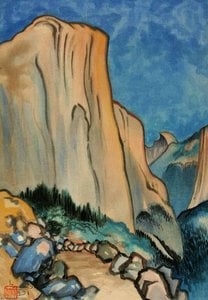
Following his return from Europe in 1928, Obata experienced a transformative encounter with the American West—specifically Yosemite National Park—which ignited an enduring passion for landscape painting. Inspired by the grandeur of granite peaks and cascading waterfalls, he embarked on a sketching expedition that yielded approximately one hundred pencil, watercolor, and sumi ink drawings—a remarkable testament to his ability to capture the sublime beauty of nature through meticulous observation and expressive brushstrokes. This experience profoundly impacted Obata’s artistic sensibilities, prompting him to synthesize Japanese techniques with Western subject matter—a hallmark of his oeuvre. Simultaneously, he established the East West Art Society in San Francisco, an organization dedicated to fostering dialogue between artists from different cultures—reflecting Obata's own conviction that art could transcend borders and promote understanding across civilizations.Teaching and Artistic Legacy
Chiura Obata’s commitment to artistic education extended beyond his studio practice; he served as a professor at UC Berkeley for nearly two decades, imparting not only technical skills but also a philosophical approach to art rooted in contemplation and respect for the natural world. During this period, Obata championed the importance of observation—encouraging students to engage deeply with their surroundings and to translate their perceptions onto canvas. Furthermore, he instilled within them a belief that art could serve as a vehicle for conveying profound truths about human experience—a conviction that resonated throughout his teaching career. Notably, Obata’s unwavering dedication to artistic expression was particularly evident during World War II when he founded an art school within the Topaz Relocation Center—demonstrating resilience and reaffirming the transformative power of creativity amidst adversity.A Master of Sumi-e and Californian Landscapes
Chiura Obata achieved lasting renown for his masterful execution of sumi-e painting, particularly his celebrated “World Landscape Series,” consisting of thirty-five exquisitely detailed colored woodblock prints depicting Yosemite National Park—a project that cemented his reputation as an artist capable of seamlessly blending Japanese traditions with Western subject matter. Each print embodies Obata’s profound reverence for nature and his ability to distill its essence onto canvas—resulting in images of breathtaking beauty and spiritual depth. His legacy continues to inspire artists and audiences alike, reminding us of the enduring importance of cultural exchange and the transformative potential of artistic practice.Perguntas e Respostas
De onde é Chiura Obata?
Chiura Obata nasceu em Japão.
Onde posso ver as obras de Chiura Obata em ordem cronológica?
Existe uma linha do tempo das obras de Chiura Obata: a página Linha do tempo das obras do artista organiza as obras por data de criação.
Qual é a cidade e o país de nascimento de Chiura Obata?
Chiura Obata nasceu em Okayama, em Japão.