Alternar para Impressão Encomendar reprodução pintada à mão Enviar
Ver detalhes Guia de Obras do Aluno Adicionar aos favoritos Baixar imagem Semelhantes Apresentação de slides Estatísticas

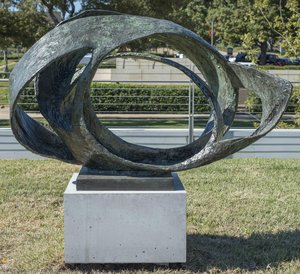
Prototype for Maquette, Three Forms in Echelon

Barbara Hepworth's 'Prototype for Maquette, Three Forms in Echelon' is an iconic abstract sculpture embodying modernism’s elegance and exploration of form & space. Discover its layered composition & artistic significance.

Explore as esculturas inovadoras de Barbara Hepworth (1903-1975). Pioneira na arte abstrata, Hepworth combinou surrealismo e abstração em obras marcantes como 'Oval Form' & 'Two Forms'. Descubra seu legado no Museu Hepworth Wakefield.

Adquira uma imagem digital de alta resolução e aprimorada, muito superior à prévia online.

Cada arquivo é meticulosamente preparado por nossos especialistas internos, utilizando ferramentas avançadas e retoques manuais de alta precisão. Garantimos que cada imagem apresente clareza excepcional, fidelidade de cores e detalhes minuciosos.

O arquivo final é entregue por e-mail em até 72 horas, otimizado para uso imediato em ambientes profissionais, editoriais e de impressão. Esta é a mesma qualidade utilizada por estúdios de design de alto nível, editoras e galerias.

Imagem Digital

Baixe um arquivo de alta resolução para exibição pessoal, impressão e projetos criativos. ( Alternar para Impressão Encomendar reprodução pintada à mão)

Preço Total

$ 24,90

Incluído em cada pedido de imagem digital

Entrega Digital Especializada e Garantida

Ao escolher o WahooArt.com, você não está apenas adquirindo uma imagem — você está recebendo uma obra de arte digital profissionalmente aprimorada, elaborada com precisão e com garantia de satisfação. Aqui está tudo o que acompanha seu pedido, automaticamente:

shipping_icon
Entrega rápida por e-mail

O seu arquivo de imagem digital em alta resolução será enviado por e-mail em até 72 horas após o pedido — pronto para uso imediato.

canvas_icon
Arquivo Digital com IA Otimizado

Sua obra de arte é otimizada profissionalmente por meio de ferramentas avançadas de IA e edição manual, garantindo o máximo de detalhes, clareza e precisão de cores.

insurance_icon
Reenvio gratuito vitalício

Apagou ou perdeu o seu ficheiro acidentalmente? Não se preocupe – nós reenviamos para si a qualquer momento, gratuitamente.

tax_icon
Sem Taxas de Importação - Sempre

Desfrute da sua obra de arte instantaneamente, sem taxas alfandegárias, impostos ou custos de entrega — downloads digitais são sempre isentos de taxas.

color_icon
Garantia de Precisão de Cores

Garantimos que sua imagem digital reflita as cores originais com a maior fidelidade possível, utilizando ferramentas profissionais e gerenciamento de cores.

return_icon
Garantia de satisfação de 100 dias

Se não estiver satisfeito com a sua imagem digital, nós a revisaremos ou reembolsaremos 100% dentro de 100 dias — sem perguntas.

guarantee_icon
Garantia de Reembolso 100%

Não está satisfeito? Receba o reembolso total em até 100 dias após o recebimento do seu arquivo digital — sem perguntas.

discount_icon
Descontos para pedidos em lote

Compre 3 imagens, economize 10% - Compre 5, economize 15% - Compre 10+, economize 20%. Ideal para projetos criativos, galerias e agências.

Detalhes Rápidos

  • Subject or theme: Organic shapes, balance
  • Location: Tate St Ives
  • Notable elements: Echelon arrangement, curved forms
  • Movement: Modernism
  • Artist: Barbara Hepworth
  • Influences: Abstraction-Création
  • Medium: Wood/Stone Sculpture

Teste de Conhecimentos Artísticos

Cada pergunta possui apenas uma resposta correta.

Questão 1:
What is the primary material used in Barbara Hepworth’s sculpture, ‘Prototype for Maquette, Three Forms in Echelon’?
Questão 2:
The sculpture's arrangement follows which compositional principle?
Questão 3:
What artistic movement is Barbara Hepworth most closely associated with?
Questão 4:
The photograph’s lighting appears to be...
Questão 5:
Based on the description, what is a possible symbolic interpretation of the sculpture’s forms?

A Sculptural Meditation on Form and Space

Barbara Hepworth’s “Prototype for Maquette, Three Forms in Echelon,” a deceptively simple yet profoundly resonant sculpture, stands as a testament to the artist's pioneering approach to modern abstraction. Created in 1961 during a period of intense experimentation and exploration within her studio at St Ives, Cornwall, this piece isn’t merely a collection of shapes; it’s an invitation to contemplate the relationship between form, space, and the inherent qualities of materials – specifically, the cool, tactile embrace of stone or wood.

The sculpture presents three distinct, organically curved forms arranged vertically on a stark white background. These aren't representational figures; instead, they embody an elemental language, suggesting echoes of natural forms—waves, rocks, or perhaps even the contours of the human body—without ever explicitly depicting them. The arrangement follows an echelon pattern, each form subtly offset from the one below, creating a dynamic sense of upward movement and spatial depth. This deliberate asymmetry is key to Hepworth’s aesthetic; she sought to disrupt traditional notions of balance and harmony, favoring instead a more intuitive and expressive approach.

Materiality and Technique: A Dance Between Hand and Stone

Hepworth's process was deeply rooted in the materiality of her chosen medium. She rarely used preparatory sketches, preferring to work directly from intuition and feeling, allowing the stone or wood to guide the form. The “Prototype” itself is a crucial stage in this process – a preliminary model intended to refine the composition and explore the interplay of light and shadow before committing to a larger-scale version. The matte texture of the sculpture, achieved through careful carving and polishing, invites tactile engagement; one can almost feel the cool smoothness of the stone beneath their fingertips.

Her technique involved a subtractive approach – carefully removing material to reveal the underlying form—combined with an understanding of how light interacts with different surfaces. The subtle tonal shifts within the sculpture’s surface, achieved through meticulous polishing and manipulation of the grain, create a sense of depth and volume, drawing the eye upwards and inviting contemplation. The stark white background serves not as a distraction but as a crucial element in highlighting the forms' inherent qualities, emphasizing their purity and simplicity.

Symbolism and Emotional Resonance

Hepworth’s work consistently explores themes of human connection to nature and the inner self. These three abstract forms can be interpreted as representing interconnectedness—a visual metaphor for the flow of life forces or perhaps a meditation on the fundamental building blocks of existence. The vertical arrangement evokes a sense of aspiration, reaching towards something beyond the immediate, while the subtle curves suggest fluidity and movement.

Considering Hepworth’s broader body of work, this “Prototype” shares affinities with her earlier explorations of ‘Form and Function,’ where she sought to create sculptures that were both aesthetically pleasing and responsive to their environment. It's a piece that speaks to the enduring power of abstraction—its ability to evoke profound emotions and ideas through purely visual means. The sculpture’s quiet intensity invites viewers to engage in a personal dialogue with its forms, prompting reflection on the nature of beauty, space, and our relationship to the world around us.

Further Exploration


Biografia do Artista

Barbara Hepworth: A Pioneer of Modern Sculpture

Barbara Hepworth (Wakefield, Yorkshire, 10 January 1903 — Saint Ives, Cornwall, 20 May 1975), was an English artist and sculptor whose groundbreaking approach to abstraction revolutionized the art world in the mid-20th century. Born into a family of engineers—her father, Herbert Hepworth, worked for West Riding County Council—Jocelyn Barbara Hepworth’s early life instilled in her a fascination with precision and form, influences that would permeate her artistic vision throughout her career.
  • Early Influences & Education: Hepworth's formative years were marked by exposure to the landscapes of Yorkshire and the encouragement of Miss McCroben, headteacher at Wakefield Girls’ High School, who recognized Hepworth’s talent for drawing and encouraged her ambition to pursue higher education. She excelled academically, securing a scholarship to Leeds School of Art in 1920 where she encountered Henry Moore—a friendship that would endure for decades and profoundly shape their artistic trajectories.
  • Royal College of Art & The Birth of Modern Sculpture: Hepworth’s studies at the Royal College of Art from 1921 to 1924 proved pivotal. Alongside Moore, she embraced a radical new aesthetic—direct carving—rejecting traditional modeling techniques in favor of working directly with stone and wood. This method allowed for an unprecedented level of spontaneity and responsiveness to material qualities, establishing Hepworth as one of the foremost figures in the burgeoning movement of abstraction-création.

The Surrealist Years & Collaboration with Ben Nicholson

Hepworth’s artistic journey gained momentum during her involvement with the Hampstead Circle group—a collective of avant-garde artists united by a shared commitment to exploring subconscious imagery and geometric abstraction. Her relationship with Ben Nicholson blossomed in 1931, culminating in marriage shortly thereafter. Together they established a studio in St Ann's Terrace, Hampstead, where Hepworth honed her craft and experimented with new materials—particularly stringed sculptures that captured the essence of natural forms through rhythmic repetition and textural interplay.

Monumental Sculpture & Recognition

The Second World War brought Hepworth and Nicholson to St Ives, Cornwall, where they found inspiration in the rugged Cornish coastline. During this period, Hepworth undertook ambitious commissions—most notably Winged Figure (1961–3), a monumental sculpture commissioned by John Lewis for their Oxford Street flagship store—demonstrating her mastery of scale and materiality. Her work gained international acclaim, securing prestigious awards and cementing her place as one of the most influential sculptors of her time.

Legacy & Artistic Significance

Barbara Hepworth’s enduring legacy resides in her unwavering dedication to exploring the fundamental principles of form and space—a pursuit that transcended stylistic conventions and established her as a visionary pioneer of modern sculpture. Her sculptures continue to inspire artists worldwide, serving as testament to her artistic genius and her profound contribution to the history of art.
Barbara Hepworth

Barbara Hepworth

1903 - 1975 , Reino Unido

Informações Rápidas

  • Artistic Movement Or Style: Modernismo
  • Artists Or Movements Influenced By This Artist: ['Unit One']
  • Artists Who Influenced This Artist: ['Henry Moore']
  • Date Of Birth: 10 janeiro 1903
  • Full Name: Jocelyn Barbara Hepworth
  • Nationality: Inglesa
  • Notable Artworks:
    • Oval Form
    • Two Forms
    • Totem
  • Place Of Birth: Wakefield, Inglaterra