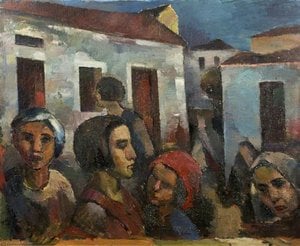
Theodor Kern, 1900 – 1969

Obrazy: 87 najsłynniejszych dzieł artysty Theodor Kern, zestawienie

Najsłynniejszym obrazem Theodor Kern jest Street Scene, Sicily (1930). Wraz z Beach Scene, Italy (1930) i Portrait of a Young Man (1937) tworzy to zestaw trzech dzieł, które zna każdy. Nasz katalog zawiera 88 dzieł autorstwa Theodor Kern; poniższych 87 to te, na które świat patrzy najczęściej – każde z podaniem roku powstania, muzeum, w którym się znajduje, oraz uzasadnieniem jego znaczenia.

Ranking oparty na naszym wskaźniku popularności, który łączy liczbę wyszukiwań, wizyt oraz zamówień dla każdego dzieła. Aktualizacja: Październik 2026.

Portret Theodor Kern
Theodor Kern · 1900 – 1969
Urodzony · zmarł
1900 – 1969, Salzburg
Nurt
Post-impressionism
Dzieła w naszym katalogu
88
Najsłynniejsze
Street Scene, Sicily (1930)
Najwięcej dzieł w
Bolton Museum And Art Gallery

10 najsłynniejszych obrazów artysty Theodor Kern

Theodor Kern, obrazy od 11 do 87

Landscape (1960) autorstwa Theodor Kern
#32

Landscape

1960 · Bolton Museum And Art Gallery
Wood, Hungary (1936) autorstwa Theodor Kern
#86

Wood, Hungary

1936

The painting Wood, Hungary by Theodor Kern is a beautiful representation of a forest scene in Hungary. Created in 1936 using oil on canvas, this artwork measures 61…

Draped Nude (1932) autorstwa Theodor Kern
#87

Draped Nude

1932 · Bolton Museum And Art Gallery

The painting Draped Nude by Theodor Kern is a stunning example of 20th-century art, showcasing the artist's unique style and technique. Created in 1932, this oil on canvas…

Tematy, które najczęściej malował Theodor Kern

Cztery tematy najczęściej powracające w tych arcydziełach, wraz z najdoskonalszym przykładem każdego z nich.

Gdzie można zobaczyć obrazy Theodor Kern

2 muzeów, w których znajduje się najwięcej obrazów z tej strony.

Muzea Miasto Dzieła artysty Theodor Kern Obrazy z tej listy
Bolton Museum And Art Gallery, BoltonBolton Museum And Art Gallery Bolton 5 Self Portrait, Continental Landscape, Self Portrait
Stockwood Discovery Centre, LutonStockwood Discovery Centre Luton 2 Building with a Wooded Hill Beyond and a Tree Lined Path in front, Portrait of a Youth with a Yellow Coat

Najsłynniejsze obrazy Theodor Kern z każdej dekady

  1. 1920s
  2. 1930s
  3. 1940s
  4. 1950s
    Self Portrait (1950) autorstwa Theodor Kern
    Miejsce 31 / 87

    Self Portrait

    Wiek 50 – 59 · Bolton Museum And Art Gallery
  5. 1960s
    Landscape (1960) autorstwa Theodor Kern
    Miejsce 32 / 87

    Landscape

    Wiek 60 – 69 · Bolton Museum And Art Gallery

Pytania o obrazy Theodor Kern

Jakie jest najsłynniejsze dzieło Theodor Kern?Pokaż odpowiedź

Street Scene, Sicily (1930). Następnie Beach Scene, Italy (1930) i Portrait of a Young Man (1937).

Ile lat miał Theodor Kern, gdy namalowano Street Scene, Sicily?Pokaż odpowiedź

30 lat: Street Scene, Sicily pochodzi z 1930, a Theodor Kern urodził(a) się w 1900.

Jakie są 10 najlepszych obrazów autorstwa Theodor Kern?Pokaż odpowiedź

Street Scene, Sicily, Beach Scene, Italy, Portrait of a Young Man, Miss Maureen Bently, Landscape with a Tree by a River and Hills in the Distance, Christ in the House of Martha and Mary, Floral Study, Untitled, Female Portrait i Street Scene (possibly Italy). Powyższy ranking zawiera rok oraz muzeum dla każdego z nich.

Ile obrazów stworzył/a Theodor Kern?Pokaż odpowiedź

Nasz katalog obejmuje 88 dzieł autorstwa Theodor Kern, datowanych od 1928 do 1960.

Gdzie znajdują się najsłynniejsze obrazy Theodor Kern?Pokaż odpowiedź

Większość z nich znajduje się w Bolton Museum And Art Gallery (Bolton) i Stockwood Discovery Centre (Luton). Powyższa tabela zawiera listę muzeów po kolei.

Kiedy Theodor Kern namalował swoje najsłynniejsze dzieła?Pokaż odpowiedź

W okresie 1930s: 18 z 87 dzieł na tej stronie pochodzi z tego czasu, w tym Street Scene, Sicily.

Jakie są najwcześniejsze i najpóźniejsze słynne obrazy Theodor Kern?Pokaż odpowiedź

Najwcześniejszy na tej stronie to Italian Girl (1928), najpóźniejszy Landscape (1960).

Co najczęściej malował Theodor Kern?Pokaż odpowiedź

Portrait (5), Reflection (3) i Architectural art (2), spośród 87 dzieł na tej stronie.

Do jakiego nurtu artystycznego należy Theodor Kern?Pokaż odpowiedź

Post-impressionism, co pokazują obrazy na tej stronie.

Które obrazy Theodor Kern można zobaczyć w Bolton Museum And Art Gallery?Pokaż odpowiedź

Self Portrait, Continental Landscape i Self Portrait to jedne z 5 dzieł na tej stronie znajdujących się w zbiorach Bolton Museum And Art Gallery, Bolton.

O Theodor Kern

The Formative Spirit and the Jugendstil Legacy

The dawn of the twentieth century brought with it a profound shift in the artistic consciousness of Europe, and Theodor Kern stood at the very heart of this transformation. Born in 1900, Kern’s early life was steeped in the rich, academic traditions that would eventually serve as the foundation for his more radical explorations. His journey through the prestigious Kunstakiente Düsseldorf allowed him to immerse himself in the flowing, organic rhythms of Jugendstil, where he studied under masters such as Wilhelm Trübschenne and Hugo Steiner-Samuels. This period was not merely about technical acquisition; it was an era of learning how to breathe life into decorative forms and how to use line and color to evoke deep, underlying emotions. As his training progressed through the Fine Art Academy in Vienna, Kern began to develop a command over draftsmanship that would later allow him to transition seamlessly between the delicate precision of religious frescoes and the expansive, sweeping vistas of the natural world.

Ascending the Heavens: The Aerial Revolution

While many of his contemporaries remained tethered to the earth, Kern possessed an unquenchable thirst for a new perspective—literally. He became a pioneer in the burgeoning field of aerial photography, a pursuit that required as much courage as it did artistic vision. Collaborating with the legendary Nicola Perscheid, Kern utilized the nascent technology of aircraft to document landscapes that had never before been seen by the human eye from such heights. This was more than mere documentation; it was an act of visual discovery. Together, they captured the breathtaking geometry of the Egyptian pyramids and the rugged, mist-shrouded peaks of the Alps. These photographic endeavors were deeply influenced by the graphic sensibilities of Henri de Toulouse-Lautrec and the intricate beauty of Japanese woodcuts, imbuing his aerial captures with a sense of stylized grandeur. Through the lens, Kern did not just photograph scenery; he translated the vastness of the world into a structured, expressive language of light and shadow.

A Multifaceted Mastery of the Canvas

Despite his groundbreaking work in the skies, Kern’s heart remained profoundly connected to the tactile reality of the canvas. His repertoire as a painter was remarkably diverse, ranging from the intimate to the monumental. In his portraiture, one finds a striking ability to capture quiet introspection, seen in works like his Head and Should::Portrait of a Woman in a Blue and Purple Dress, where visible brushstrokes and subtle shading create a sense of living presence. His landscapes, too, were legendary, capturing the very essence of Swiss heritage through an Impressionistic lens that celebrated the vibrant light of the Alpine regions. Kern was never one to be confined by a single movement; he moved with ease from the soft, atmospheric qualities of Post-Impressionism to the fragmented, geometric explorations of Cubism.
  • Portraiture: An exploration of human emotion through evocative color and light.
  • Landscape: A tribute to the enduring majesty of the European terrain.
  • Innovation: The seamless integration of photographic perspective with classical painting techniques.
Through this unique blend of scientific curiosity and artistic passion, Theodor Kern left an indelible mark on the history of Swiss and European art, reminding us that true visionaries can find beauty both in the smallest human detail and the widest horizon.